ALLPCB


Power conversion for medical wearable devices
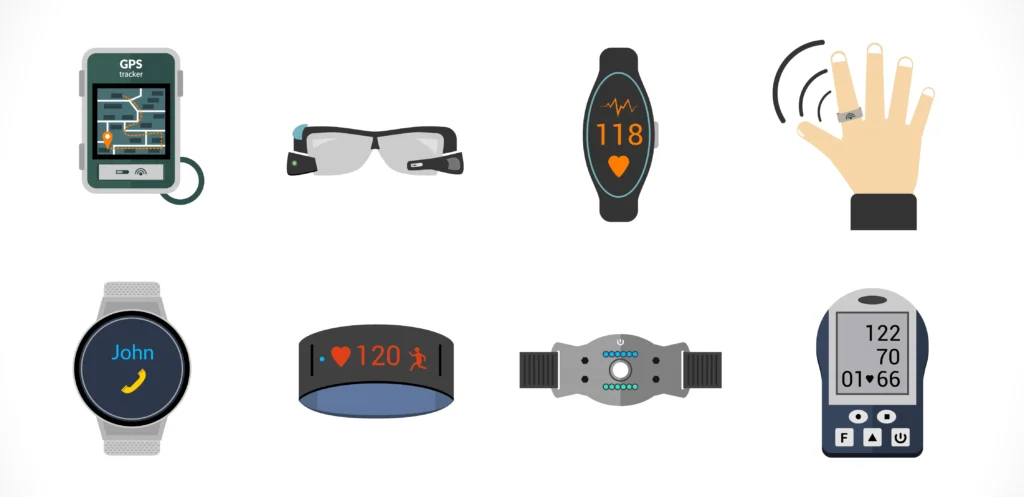
The market for smart wearables has grown rapidly in recent years, producing products for healthcare and fitness, medical, infotainment, military, and industrial applications. A new wave of devices includes medical wearables that use sensors to capture biometric data, enabling more proactive health monitoring. This article reviews design requirements for smart wearables and power conversion solutions from ADI suitable for low-power wireless devices.
Wearables require ultra-low power to extend battery life
The number and variety of wireless sensors supporting the Internet of Things (IoT) are increasing quickly, driving demand for small, compact, and highly efficient power converters tailored to low-power wireless devices. One clear application of the emerging wearable segment is health monitoring. Medical wearables record biometric data such as body temperature, pulse/heart rate, respiratory rate, and blood pressure to track vital signs.
These vital-sign measurements are important because adverse changes may indicate deteriorating health, and timely detection enables adjustments to behavior or treatment. Historically these measurements were taken in hospitals or clinics. Portable, timely, and efficient measurement enables continuous monitoring and can improve health outcomes.
The core architecture of a smart wearable depends on the product. A typical wearable is a miniature embedded system. Generally, the architecture includes a microprocessor or microcontroller or similar IC, MEMS sensors, small mechanical actuators, GPS ICs, Bluetooth/cellular/Wi-Fi connectivity for data collection, processing, and synchronization, imaging electronics, LEDs, computation resources, rechargeable or primary batteries or battery packs, and supporting electronics. Design priorities are compact size, low weight for comfort, and ultra-low power consumption to extend battery run time and lifetime.
Energy harvesting systems extend wearable operating time
To extend operating time beyond the primary battery, an energy harvesting system can significantly increase a wearable device's useful life. Common energy harvesting technologies include vibration energy harvesters and indoor or wearable photovoltaic cells, which typically generate power on the order of milliwatts under common conditions. Although this power may be limited, the cost per unit energy of harvested energy can be comparable to that of long-life primary batteries.
Claims of 10-year battery life from some primary batteries depend heavily on the power draw and duty cycle. Systems with energy harvesting can recharge after depletion, unlike systems powered only by a primary battery. Many implementations use an environmental energy source as the primary power with the battery providing backup when the source is unavailable, effectively acting as a "battery life extender" and lengthening system lifetime toward the battery shelf life, which for some lithium thionyl chloride chemistries is around 12 years.
Energy available from a harvester depends on how long it can operate, so the main comparison metric is power density rather than energy density. Harvested power is usually low, variable, and unpredictable. Hybrid architectures connecting the harvester and an auxiliary power store are common. The auxiliary store may be a rechargeable battery or a storage capacitor. The harvester provides the energy source, while the auxiliary store delivers higher output power when needed and periodically receives charge from the harvester.
Harvesting systems for wearables must use power conversion ICs that can handle very low power and very small currents, potentially tens of microwatts and tens of nanoamps. ADI has introduced several power conversion ICs that include features and performance suitable for energy harvesting in wearable devices.
Highly integrated DC/DC converters to extend battery life
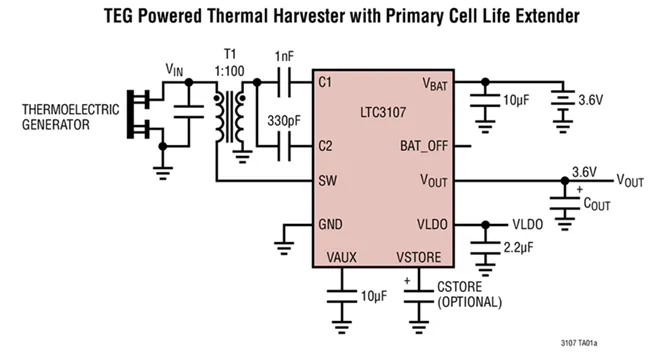
The LTC3107 is a highly integrated DC/DC converter designed to collect and manage excess energy from very low input voltage sources, such as thermoelectric generators, to extend the life of the primary battery in low-power wireless systems. The boost topology can operate from inputs as low as 20 mV.
The LTC3107 uses a small boost transformer and provides a complete power management solution for typical wireless sensor applications that rely on a primary battery. A 2.2 V LDO can power an external microprocessor, and the main output voltage automatically tracks the primary battery voltage. When harvested energy is available, the LTC3107 can switch seamlessly from the battery to the harvested source, extending battery life. A BAT_OFF indicator tracks battery usage. An optional storage capacitor accumulates excess harvested energy to further extend battery life.
A load-point harvester implementation using the LTC3107 requires minimal space, limited to the 3 mm x 3 mm DFN package and a few external components. By producing an output that tracks the existing battery voltage, the LTC3107 can integrate harvested thermal energy into new and existing battery-powered designs. Depending on load and available harvested energy, the LTC3107 can supplement the battery or supply the load entirely.
DC/DC converters for high-voltage energy harvesting sources
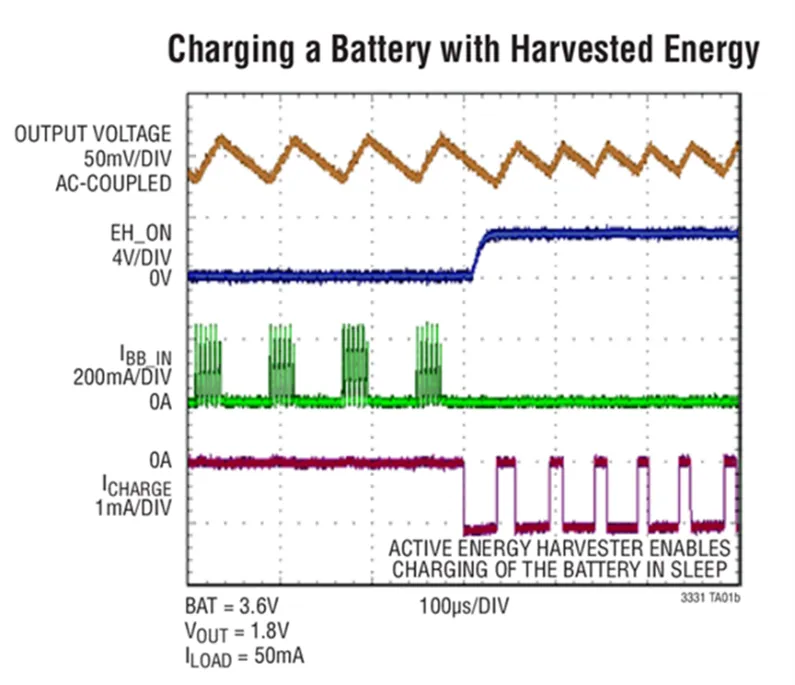
The LTC3331 integrates a high-voltage energy harvesting front end with a rechargeable-battery-powered synchronous buck-boost DC/DC converter to create a single-output supply for alternative energy applications. A 10 mA shunt allows simple battery charging from harvested energy, and a low-battery disconnect function prevents deep discharge.
The LTC3331 includes an integrated full-wave bridge rectifier and a high-voltage buck DC/DC stage to harvest energy from piezoelectric, solar, or magnetic sources. Either DC/DC converter can power the single output. The buck converter can operate when harvested energy is available, reducing shunt charger quiescent current from the battery to 200 nA and thus extending battery life. When harvested energy is unavailable, the buck-boost supplies VOUT from the battery.
The LTC3331 is a complete energy harvesting regulator that can provide up to 50 mA of continuous output current when harvested energy is available, enabling battery life extension. When harvested energy powers the load, the battery is not required to supply current; when the battery powers the system without load, device quiescent current is 950 nA.
The LTC3331 integrates a high-voltage harvesting front end and a synchronous buck-boost converter powered by a rechargeable battery to provide an uninterrupted output for sensor nodes, IoT devices, and wearables using harvested energy. It also includes a supercapacitor balancer to increase output storage. Input and output voltage and current set points are configured via pin-strapping logic inputs. The LTC3331 comes in a 5 mm x 5 mm QFN-32 package.
High-efficiency, low-quiescent-current buck-boost converters
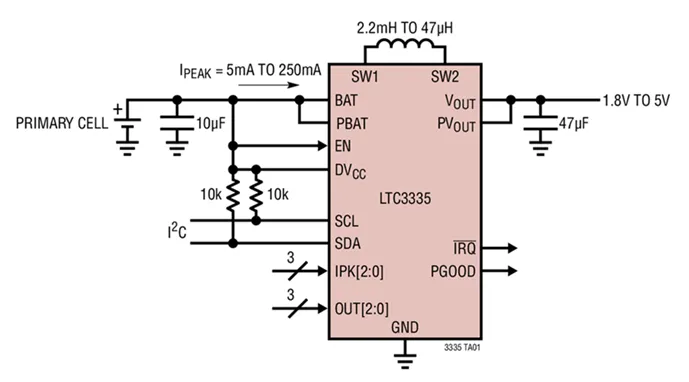
The LTC3335 is a high-efficiency, low-quiescent-current (680 nA) micropower buck-boost DC/DC converter that includes an integrated high-precision coulomb counter for monitoring accumulated battery discharge in long-life battery-powered applications. It targets wireless sensor networks and general energy-harvesting applications. The buck-boost can operate with input voltages down to 1.8 V and offers eight pin-selectable output voltages and up to 50 mA of output current.
The integrated coulomb counter in the LTC3335 monitors accumulated battery discharge and stores the value in an internal register accessible via an I2C interface. A programmable discharge alarm threshold triggers an interrupt on the IRQ pin when reached. To support various battery types and sizes, the LTC3335 peak input current is selectable from 5 mA to 250 mA, and the full-scale coulomb counter has a programmable range of 32,768:1. The LTC3335 is available in a 3 mm x 4 mm QFN-20 package.
Summary
Most smart wearables are battery powered, and extending battery run time and lifetime is a primary design goal. Integrating energy harvesting can significantly extend device operating time. Low-power conversion solutions are therefore a key enabling technology for wearables, but supplying small-current wearable devices remains challenging. ADI provides a range of power conversion ICs designed to achieve high performance at low power levels for energy harvesting and battery-extended wearable applications.