ALLPCB


Background
China's Ministry of Industry and Information Technology (MIIT) recently issued a draft notice on promoting the evolution and application innovation of 5G Reduced Capability (RedCap) technology. The draft sets targets for 2025, including significant improvements in the overall RedCap industry capabilities, continuous introduction of new products and service models, scaled deployment of converged applications, and strengthened security capabilities. One objective is to achieve scaled 5G RedCap coverage in China’s county-level and higher cities and to increase RedCap connections by tens of millions.
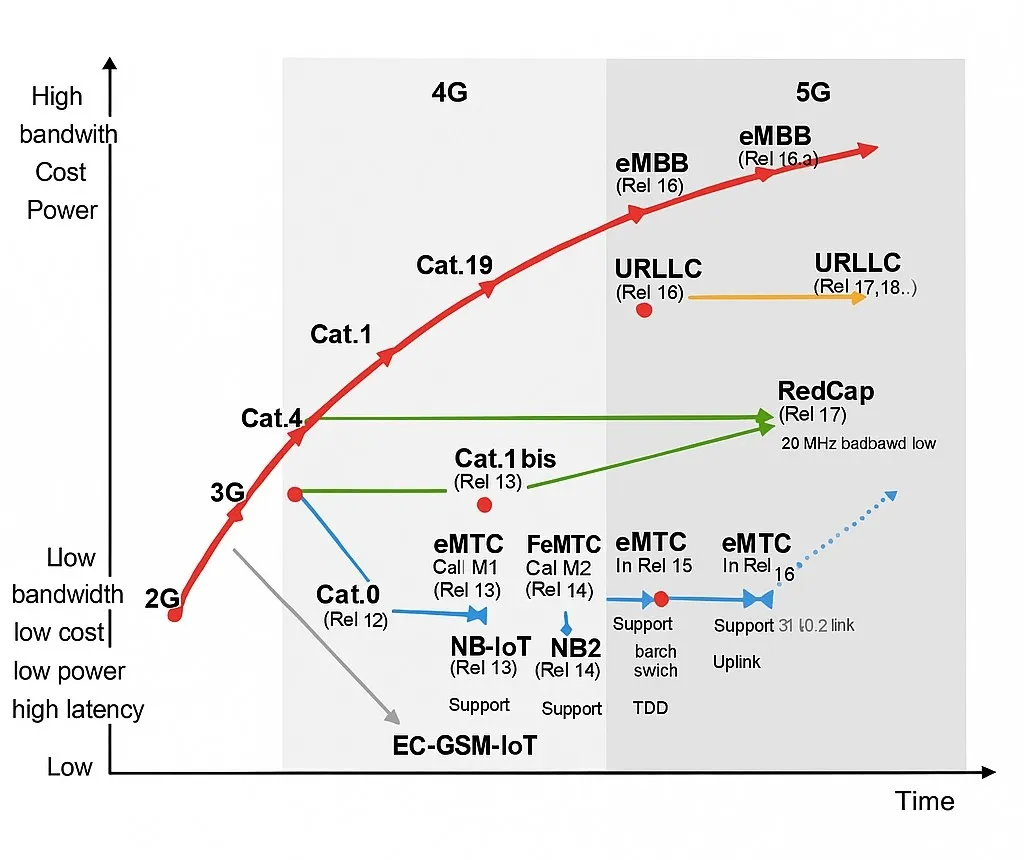
Evolution of Cellular IoT Technologies
Since Release 8, as mobile broadband (MBB/eMBB) peak rates have grown, 3GPP has introduced multiple cellular IoT technologies tailored to different needs, including LTE Cat 1, Cat 1 bis, Cat 0/eMTC (LTE-M), NB-IoT, EC-GSM-IoT, and RedCap. These technologies apply different levels of capability pruning to reduce module and device complexity, cost, size, and power consumption so they fit diverse IoT use cases.
Brief summaries:
LTE Cat 1 / LTE Cat 1 bis
LTE Cat 1 was defined in 3GPP Release 8 for M2M IoT applications with a 20 MHz channel bandwidth, downlink peak rate up to 10 Mbps and uplink up to 5 Mbps. LTE Cat 1 bis (Release 13) evolved Cat 1 by reducing the dual-receive antenna requirement to a single receive antenna.
LTE Cat 0 / eMTC (LTE-M)
LTE Cat 0 (Release 12) targets IoT use with a 20 MHz channel and peak rates up to 1 Mbps. It supports a single receive antenna and half-duplex modes, reducing device complexity significantly compared with Cat 1. In Release 13, Cat 0 evolved to eMTC (Cat M1), which reduces the maximum channel bandwidth to 1.4 MHz, further lowering complexity and improving coverage. eMTC continued evolving through 5G Releases 15 and 16.
NB-IoT
NB-IoT (Release 13) is a narrowband IoT technology with a 180 kHz channel and peak rates on the order of dozens to a few hundred kbps. Like eMTC, NB-IoT continued evolving from 4G-era Releases 13 and 14 into the 5G era to support massive IoT scenarios.
EC-GSM-IoT
EC-GSM-IoT, part of Release 13, is an evolution of 2G GSM through software upgrades. It uses a 200 kHz channel and peak rates roughly between 70 and 240 kbps.
RedCap
RedCap, introduced in 5G Release 17, stands for Reduced Capability NR. It is a simplified, lightweight version of 5G NR designed to meet IoT needs that sit between high-capacity eMBB and low-rate mMTC.
Why Introduce RedCap?
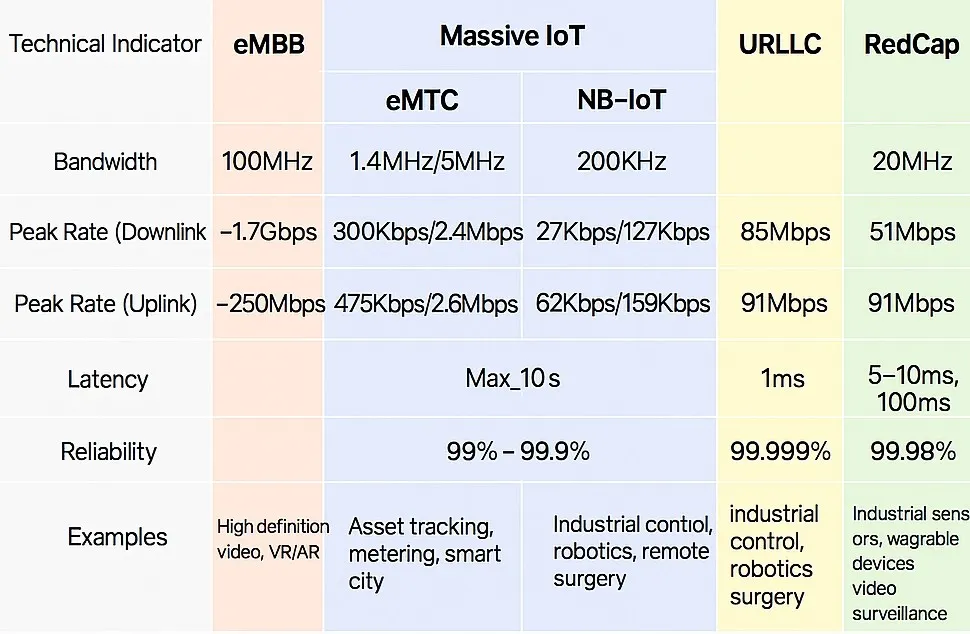
5G initially defined three usage scenarios: eMBB, uRLLC, and mMTC, corresponding to broadband IoT, mission-critical IoT, and massive IoT respectively. However, many IoT applications fall into a middle range of requirements that neither eMBB nor mMTC address well.
Examples of mid-range requirements:
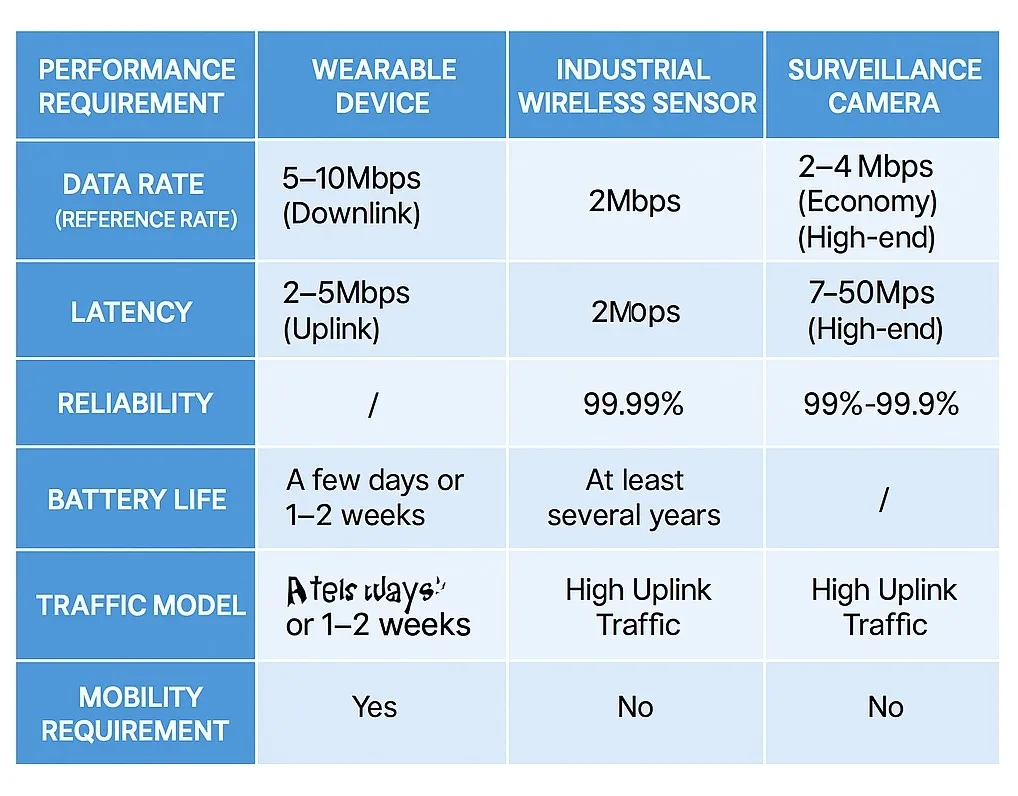
- Industrial wireless sensors collecting temperature, humidity, pressure, etc.: ~2 Mbps, latency <100 ms, reliability ~99.99%.
- Smartwatches, medical monitoring, AR/VR headsets: ~2–10 Mbps.
- Surveillance cameras: ~2–25 Mbps, latency <500 ms, reliability 99%–99.9%.
Using eMBB or uRLLC for these use cases would waste resources, while mMTC lacks sufficient rate and latency performance. RedCap fills that middle ground, providing a 5G-based mid-tier IoT technology.
What Capabilities Does RedCap Trim?
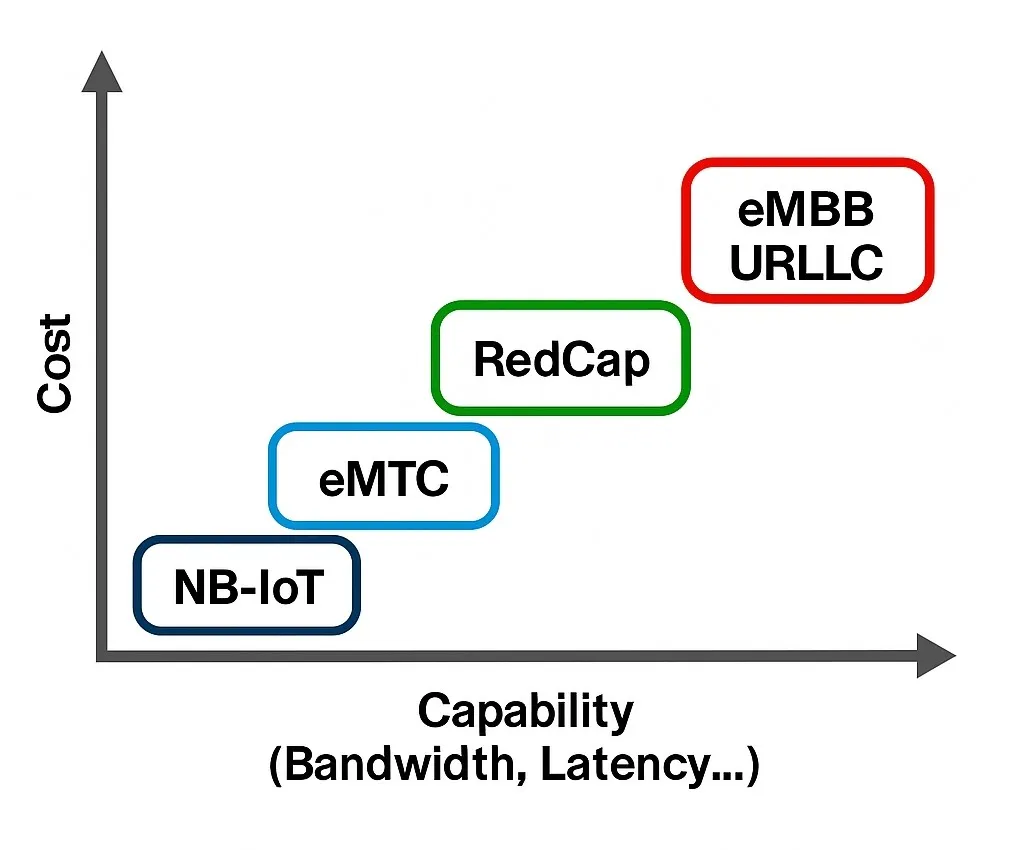
Release 17 RedCap trims several NR features to reduce device complexity and cost by an estimated 50% to 65%. Typical reductions include:
- Maximum bandwidth reduced from NR’s 100 MHz to 20 MHz.
- Antenna configuration reduced from NR 2T4R to 1T1R or 1T2R.
- Minimum downlink MIMO layers reduced to 1.
- Maximum modulation order supported down to 64QAM.
- Support for half-duplex operation.
RedCap devices can optionally select higher-end features to achieve greater peak rates, such as supporting two receive antennas, two downlink MIMO layers, 256QAM, or full-duplex FDD.
For battery-constrained devices like wearables and industrial sensors, RedCap also incorporates power-saving measures such as lower transmit power classes, eDRX, and relaxed RRM measurements to extend battery life to days or years depending on the application.
Which Technologies Will RedCap Replace?
Comparing technical profiles, RedCap is positioned to replace LTE Cat 4 and LTE Cat 1 / Cat 1 bis IoT applications:
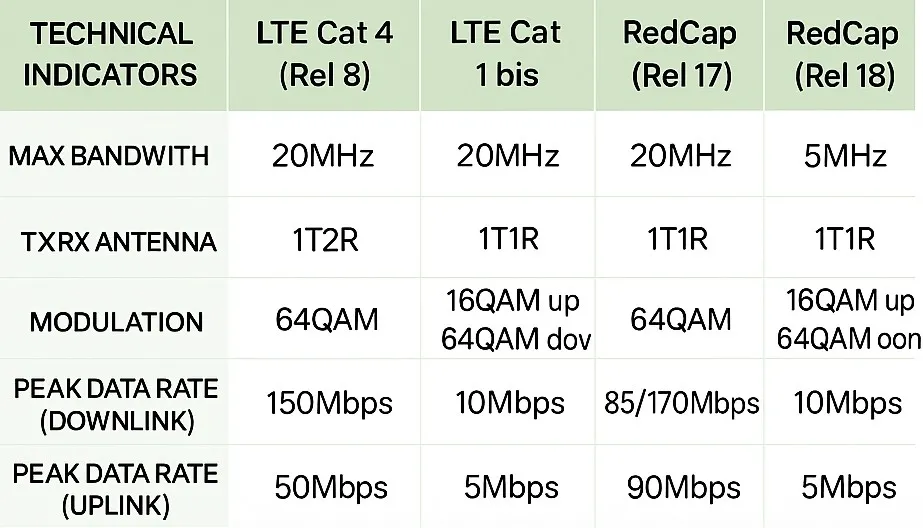
More specifically, Release 17 RedCap is expected to replace IoT applications based on LTE Cat 4. The enhanced RedCap planned for Release 18 is expected to replace applications based on LTE Cat 1 and Cat 1 bis. Enhanced RedCap in R18 may add support for 5 MHz, 10 MHz, and 40 MHz bandwidths, further reduce device complexity and cost, and add features such as improved positioning and sidelink, enabling support for a broader range of IoT applications.
Why replace LTE Cat 4 and Cat 1 / Cat 1 bis?
- RedCap provides a migration path from 4G LTE IoT to 5G, which helps operators repurpose LTE spectrum and advance toward 5G-based IoT services. Currently, LTE Cat 1 bis and Cat 4 account for a substantial portion of the cellular IoT market.
- RedCap has inherent 5G advantages: broader frequency support including mmWave, higher network efficiency, enhanced 5G security capabilities, and compatibility with 5G features such as network slicing, private networks, and positioning. Operators can generally deploy RedCap through software upgrades to existing 5G networks.
- By filling the mid-tier IoT segment, RedCap helps unify IoT connectivity across low-, mid-, and high-tier application classes, simplifying management and improving efficiency.