ALLPCB


Overview
In September 2022, Huawei published a white paper advocating measures to accelerate the arrival of an advanced 5G era and discussed the concept of "5.5G." This article explains what 5.5G is and how it differs from 5G and 6G.
1. 5G: High speed, low latency, massive connectivity
5G refers to fifth-generation mobile communication technology. It is characterized by high data rates, low latency, and large-scale device connectivity. 5G network infrastructure forms the foundation for connecting people, machines, and things. The theoretical peak throughput of 5G can reach up to 20 Gbps, about 2.5 GB per second, more than 10 times faster than typical 4G network speeds. For example, a 1 GB movie can be downloaded in about 4 seconds under ideal conditions.
As of the end of July 2022, China had cumulatively built and activated 1.968 million 5G base stations and had 475 million 5G mobile subscribers, a net increase of 120 million since the end of 2021. These deployments represent the largest 5G network footprint globally by several metrics.
Over the three years since commercial 5G licenses were issued in China, network construction continued rapidly: China accounted for more than 60% of the world's 5G base stations and more than 70% of global 5G subscribers. Commercial 5G applications have been widely deployed. 5G fusion applications now cover about 40 industry categories, and have been applied in more than 200 smart mines, over 1,000 smart factories, more than 180 smart power grid projects, 89 ports, and over 600 tertiary hospital projects, with more than 20,000 application cases reported.
2. 5.5G: A transitional evolution toward immersive experiences
5.5G is best understood as a transitional stage between 5G and 6G. Mobile communication generations normally shift roughly every decade, but rapid technological progress creates significant differences within a generation. Intermediate naming conventions are used to distinguish technology stages between whole-number generations. Historical examples include labels such as 2.5G and 3.75G. In this context, 5.5G essentially means "5G Advanced."
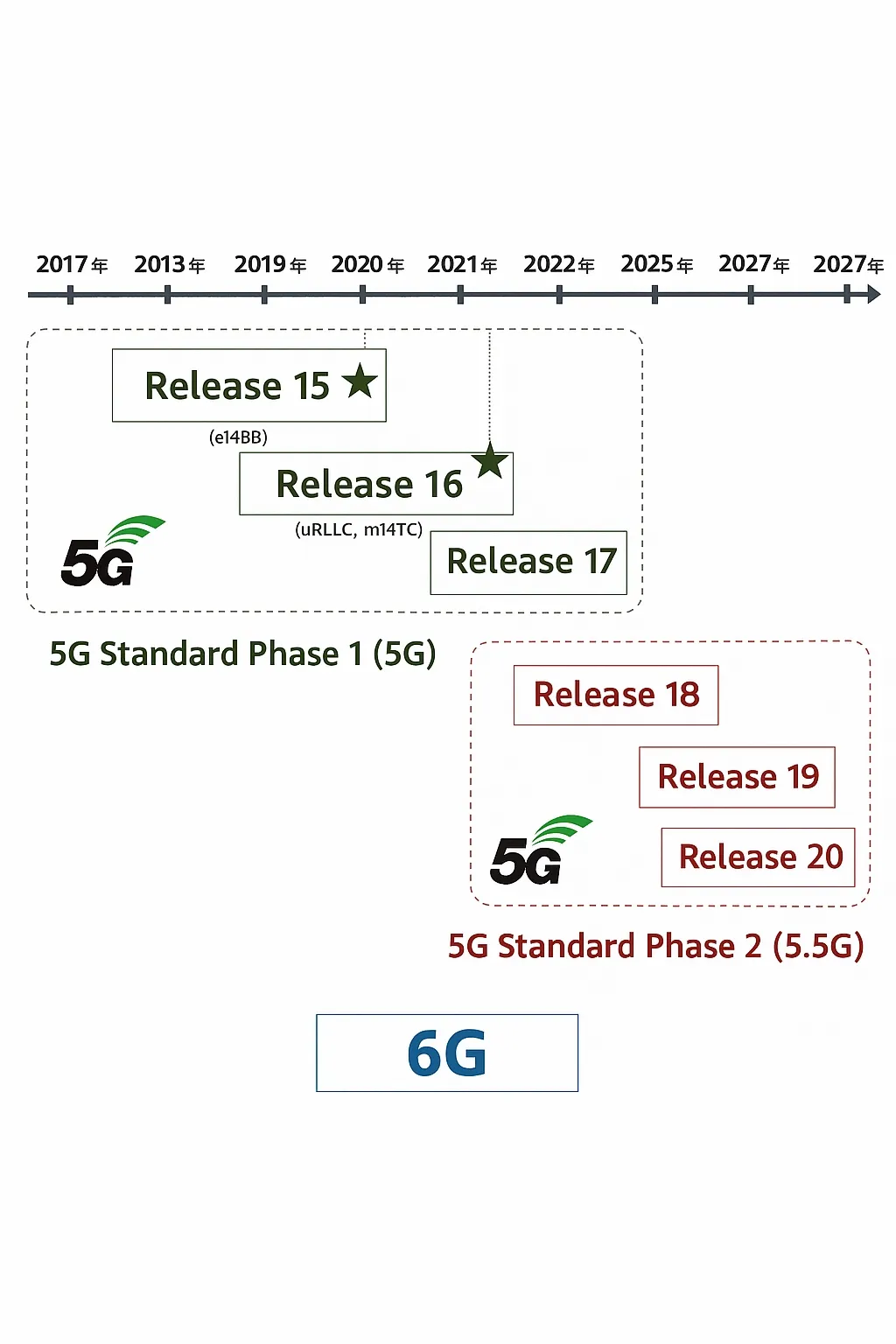
International standards organization 3GPP advances technology through periodic Releases. A Release appears approximately every two years, and each generation typically spans multiple Releases over about a decade. 5.5G represents the second phase of 5G standardization: Releases R15–R17 defined the initial 5G stage, while R18–R20 are positioned as the advanced stage commonly referred to as 5.5G. After R20, 6G development is expected to take center stage (roughly 2028–2030). As a transitional phase, 5.5G will likely span more than five years.
Deployment of 5.5G is expected to begin as early as 2025 given current technical progress. As an evolutionary stage, 5.5G is not expected to introduce disruptive paradigm shifts. Instead, its two main missions are to address and strengthen areas where 5G is insufficient and to explore directions for future 6G development.
Building on pervasive gigabit experiences and massive connectivity, 5.5G will raise targets toward ubiquitous 10-gigabit experiences and hundreds of billions of connections. Specifically, 5.5G aims for downlink peak rates of 10 Gbps and uplink peak rates of 1 Gbps, millisecond-level latency, and low-cost support for hundreds of billions of IoT devices. Millisecond latency will support real-time interaction and enable immersive "presence" experiences. Applications such as cloud VR live streaming, dual 8K VR broadcasts, and competitive digital sports could become practical, allowing viewers to experience events as if they were on-site in parallel locations. Faster uplink rates will also enhance IoT capabilities, meeting upload demands in industrial and manufacturing scenarios such as machine vision and large-scale broadband IoT.
3. 6G: Multisensory networks and extreme performance
Research on networks beyond 5G, including 6G, is already underway. China Mobile's chief expert Liu Guangyi told media that future networks will offer far more extreme performance and multidimensional capabilities than today’s Internet, providing higher-speed and more precise connectivity. For 6G, projected improvements include orders-of-magnitude increases in throughput and significant reductions in latency, with global coverage that 5G cannot provide. Transmission rates could increase by 10 to 100 times compared with 5G, and communication latency could drop to 0.1 ms or lower.
Using an analogy, current Internet infrastructure is like ordinary roads, while future networks will be more like high-speed rail, addressing congestion and delay issues in traditional data transport. Liu Guangyi suggested that a "tactile Internet" could transmit not only auditory and visual information but also touch, smell, and taste, enabling multisensory interconnection. Interactive holography could allow holographic objects to interact with each other in ways akin to physical objects.
Such capabilities may make scenarios that once seemed fictional—meeting distant relatives via hologram and sensing their body temperature—more plausible. Future networks are expected to accelerate digital twin technologies and deep intelligence across society, transforming industrial, agricultural, energy, and transportation sectors. From centimeter-level positioning and contactless healthcare to smarter factories and advanced autonomous driving, 6G could drive major changes in the real economy.
Market projections indicate massive growth in IoT terminals toward the 2040 timeframe. Based on a white paper from the China Academy of Information and Communications Technology titled "6G Typical Scenarios and Key Capabilities," IoT terminals could reach explosive counts in the hundreds of billions, with connection ratios exceeding 90%. Immersive services based on XR and holographic devices could account for over half of average monthly traffic, ultimately creating a market with hundreds of billions of connected terminals and monthly data volumes measured in trillions of gigabytes.