ALLPCB


Overview
Wearable devices face a major constraint from the need for uninterrupted, efficient power for data-intensive sensing and wireless transmission. Conventional thermoelectric solutions struggle to perform under very low voltage conditions. A research team from multiple universities and institutes in China, together with the University of Illinois at Urbana-Champaign, has proposed a wearable solution that integrates a flexible thermoelectric generator (FTEG) with an energy management system (EMS) to harvest body heat and power sensors and Bluetooth. The work, titled "Flexible thermoelectric generator and energy management electronics powered by body heat," was published in Microsystems & Nanoengineering.
Key Contributions
- Operation at small temperature differences: The system enables the thermoelectric generator to operate continuously with very small temperature differences between skin and ambient environment (as low as 4 K), supporting reliable data transmission within 1.6 s.
- Ultra-low-voltage harvesting: The design charges from body heat at ultra-low voltages (starting at 30 mV), enabling continuous, battery-free operation for wearable health monitors.
- Innovative energy management: An energy management circuit combined with a supercapacitor controls and exploits the irregular output of the thermoelectric generator, enabling operation at lower temperature gradients and improving availability.
- System integration and compatibility: Thermoelectric elements and energy management electronics are integrated on the same polyimide (PI) substrate, reducing interface effects and increasing normalized power density. The system is designed to start at 30 mV, broadening compatibility with various thermoelectric devices and simplifying deployment of self-powered wearable systems.
System Design and Materials
The proposed wearable is a body-heat-powered health-monitoring wristband that integrates a flexible thermoelectric generator, wearable energy management electronics, a Bluetooth Low Energy (BLE) radio, sensors, and peripheral electronics. The device is intended to be worn on the wrist.
Bismuth telluride-based alloys are chosen for their favorable thermoelectric properties at room temperature. Bi2Te3 thermoelectric particles are used as the basic building blocks of the flexible generator. P-type and N-type Bi2Te3 particles are arranged in an interleaved pattern on a polyimide film used as the flexible substrate. Copper electrodes connect the bottom and top polyimide layers in a pi-type configuration to form the electrical connections of the flexible thermoelectric generator.
Integration and Application
Skin temperature is acquired in real time by on-board sensors and transmitted wirelessly via BLE to a mobile health-monitoring application, enabling continuous body temperature monitoring. The flexible circuit uses a polyimide substrate to enable full flexible integration of the thermoelectric generator, energy management system, sensors, BLE, and peripheral electronics. The integrated EMS matches the generator performance so the FTEG can operate stably at low temperature differences, addressing the maintenance limitations associated with battery-powered wearables.
Electrode Layout and Stress Flow Analysis
Existing flexible thermoelectric generators often overlook stress flow in electrode layout. In practical wearable use, devices are subject to bending, producing significant stress changes in P-type and N-type thermoelectric particles and electrodes. The researchers analyzed stress flow in conventional electrode layouts and proposed a low-stress electrode arrangement.
The team compared stress distributions for two electrode layouts across different flexures, set a stress threshold for the copper electrodes, and calculated the ratio of electrodes below the threshold under various curvatures. The threshold ratio for the conventional layout is significantly higher than for the proposed layout. Stress maps show that the conventional layout experiences greater stress under bending, which is unfavorable for high-flexibility wearable scenarios. Device designs for wearables should thus include stress analysis to ensure operation under low-stress conditions and improve durability.
Performance Under Small Temperature Differences
With full integration of the FTEG, EMS, data acquisition, and wireless transmission electronics, the researchers developed a flexible wristband for human health monitoring. The FTEG output voltage and current increase with the temperature gradient between skin and environment. At a temperature difference of 2 K under normal conditions, the FTEG provides a stable output voltage of 89 mV and a current of 3 mA, demonstrating reliable power at very small temperature gradients. The FTEG output polarity is connected to the EMS so that, regardless of output polarity, the EMS functions correctly. This addresses polarity inversion that can occur when hot and cold ends reverse, for example if ambient temperature exceeds skin temperature; as long as the temperature difference reaches 2 K, the integrated system operates correctly.
Testing Platform and Results
To evaluate practical performance, the team built a flexible thermoelectric test platform. A heated water bath and beaker served as the hot source, while a condenser tube helped cool the cold side. Aluminum foil was fixed to the cold and hot sides to ensure uniform temperature distribution across the FTEG. The temperature difference was adjusted by changing the temperatures of the water bath and condensate.
Thermoelectric performance was measured for both flat and bent states. The bending radius was set to 30 mm, approximately the average adult male wrist radius. Comparing internal resistance for flat and bent states, the researchers observed that when the temperature difference exceeded 5 K, the internal resistance in the flat state was about 15 Ω; when worn and bent, internal resistance increased to about 60 Ω. Consequently, the output power in the bent state dropped to roughly one fifth of the unbent state.
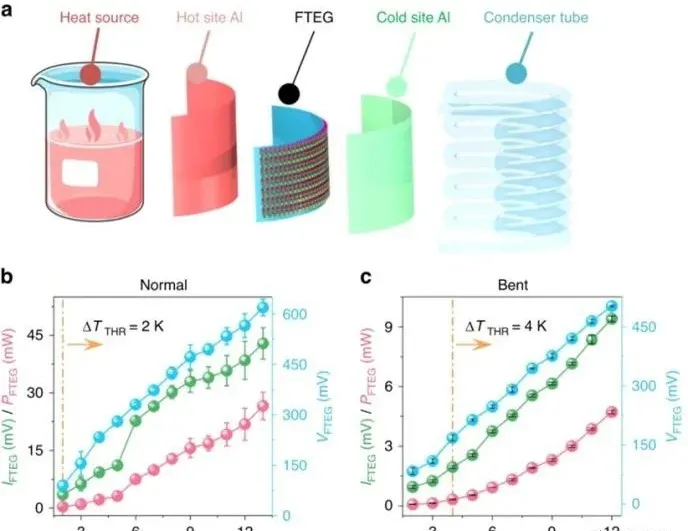
Performance tests of the FTEG in flat and bent configurations
Conclusion and Outlook
The researchers presented a fully flexible, body-heat-driven, self-powered wearable for health monitoring that integrates an FTEG and energy management electronics. The FTEG captures body heat and converts it to electrical energy, while a tailored EMS efficiently manages harvested energy to power sensors and a wireless transmission module for stable real-time body temperature monitoring. The team also analyzed electrode layout from a stress-flow perspective and introduced a low-stress electrode arrangement that significantly reduces electrode stress in the worn state compared with conventional pi-type structures, improving device reliability.
Experiments show that the FTEG and EMS can power sensors and BLE at temperature differences of 2 K in normal conditions and 4 K in worn conditions. Simulations indicate that body-heat-driven FTEG and EMS can provide reliable, continuous health monitoring for IoT scenarios. The researchers note that demand for safer thermoelectric materials in wearables will drive future work toward enhanced biocompatibility and improved device structures. They also highlight the value of adaptive energy management methods to enhance practical deployment of advanced flexible thermoelectric devices, such as thermoelectric fibers and particles, for real-time health monitoring.