ALLPCB


Market shift toward medical functions
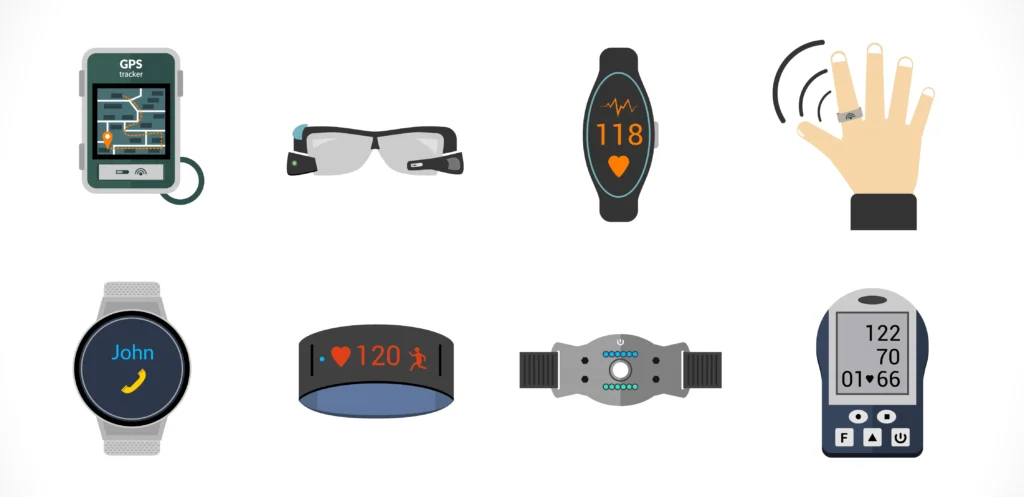
From fitness bands and smartwatches to TWS earbuds, the wearable device market frequently produces breakout products and remains active. Annual wearable shipments now exceed those of personal computers, making wearables an important application area for component manufacturers. Medical and health functions have become key features for many wearable products. According to Yole, global shipments of wearable medical and health products reached 347 million units in 2019 and are projected to exceed 750 million units by 2025.
Miniaturization and multifunction integration of sensors and chips will further increase portability and improve continuous operating time. Interaction between smart wearables and other devices beyond smartphones, such as smart home appliances, will strengthen. Control methods will diversify, with gesture control being adopted by some devices. Native communication functions will increasingly become standard on smartwatches. Overall, wearables are evolving toward richer functionality, more varied form factors, higher measurement accuracy, and longer battery life, playing larger roles across social networking, medical health, navigation, business, and media.
Clinical acceptance of wearable data
Basic fitness functions such as activity tracking and exercise guidance are widely accepted; common bands and watches measure heart rate and step cadence. However, these consumer-grade readings are generally not suitable for clinical use. With technological progress, more medical-grade monitoring functions are being integrated into wearables, such as blood pressure, blood oxygen, and electrocardiogram measurements. These medical-grade functions mark the transition of wearables toward providing clinicians with referenceable data.
Since the COVID-19 outbreak in 2019, strained medical resources and more complex hospital procedures have increased interest in home medical monitoring. Wearable medical devices allow patients to monitor body temperature, blood oxygen, heart rate, and respiration, and regularly transmit data to designated clinics for screening, early detection, and at-home monitoring. The value of a wearable largely depends on the range of measurable parameters, so even if daily life returns to normal, medical-capable wearables are likely to become increasingly important.
The portability of wearables enables long-term monitoring of ambulatory patients, which benefits management of chronic conditions with significant risks, such as chronic obstructive pulmonary disease, atrial fibrillation, and obstructive sleep apnea.
Atrial fibrillation (AFib) screening is a typical medical application for wearable ECG devices. AFib is a common persistent arrhythmia in which the atria contract irregularly at rates far above normal, leading to ineffective atrial contraction and increased risk of heart failure, stroke, and sudden death. AFib raises stroke risk by about fivefold compared with people without it. Early detection and treatment can control or even resolve AFib, but the challenge is that roughly half of patients are asymptomatic when not in AFib episodes. For asymptomatic populations, widespread screening is the only reliable approach. Consumer ECG patches and similar devices can perform early AFib screening, and their detection results have gained clinical acceptance.
Wearable pulse oximetry is increasingly adopted in pulmonary and respiratory clinical practice. Low blood oxygen saturation (SpO2) can indicate heart failure, chronic lung disease, or sleep apnea. Since COVID-19, monitoring SpO2 has been used as one measure to assess disease severity.
In diabetes management, continuous glucose monitors provide patients and clinicians with continuous data that enable more precise treatment decisions.
Medical-grade accuracy in small form factors
Meeting medical applications imposes new requirements on key components in wearables: they must satisfy the traditional wearable constraints of light weight and small size while meeting medical-grade demands for high accuracy, high reliability, low power consumption, and long operating time.
Medical-grade applications require clinical-level accuracy. For example, clinical body-temperature measurement requires accuracy of ±0.1°C within the measurement range. ADI's MAX30208 digital temperature sensor achieves ±0.1°C accuracy between +30°C and +50°C and ±0.15°C accuracy between 0°C and +70°C. Because components generate heat during operation, minimizing self-heating interference is a critical consideration for clinical thermometry. The MAX30208 operates at very low current—about 67 μA during operation and 0.5 μA in standby—reducing self-heating. The device dissipates heat via package pins at the package bottom, while the temperature sensor die is placed at the package top, away from the pins, which greatly reduces thermal interference.
The MAX30208 is part of ADI's third-generation Health Sensor Platform (HSP 3.0). HSP 3.0 also includes the MAX86176 analog front-end for PPG and ECG. The MAX86176 supports ECG and SpO2 measurements with clinical-grade performance.
In clinical ECG, wet electrodes are typically used and require conductive gel, which can dry out and affect measurements, making them unsuitable for long-term monitoring by nonprofessionals. Dry electrodes enable wearable ECG measurement, but they have lower contact conductivity and are more sensitive to motion artifacts. The MAX86176's ECG channel meets the IEC 60601-2-47 standard for mobile ECG devices. It contains a high-precision ADC with a fully differential input architecture and over 110 dB common-mode rejection at mains frequency, supporting dry-electrode ECG applications. This chip is used in single-lead monitors, single-lead wireless patches, and chest-strap heart-rate monitors.
The MAX86176 uses photoplethysmography (PPG) to measure blood oxygen and provides a 110 dB signal-to-noise ratio to achieve medical-grade SpO2 detection. Optical and bioimpedance measurements require LED drivers to emit light and source excitation currents. Many optical systems use multiple wavelengths, so multi-LED-drive capability is important. The MAX86176 supports up to six LEDs and four photodiode inputs, accommodating different measurement scenarios. Its PPG channel can detect heart rate, SpO2, muscle and tissue oxygen saturation (SmO2 and StO2), and body hydration, with clinical-grade accuracy.
Because wearables demand compact components, highly integrated multi-function chips such as the MAX86176 are attractive. Its successor, the MAX86178, integrates optical, ECG, and bioimpedance measurement systems and supports four vital-sign measurements: ECG, SpO2, heart rate, and respiration rate, providing a foundation for multifunction wearables.
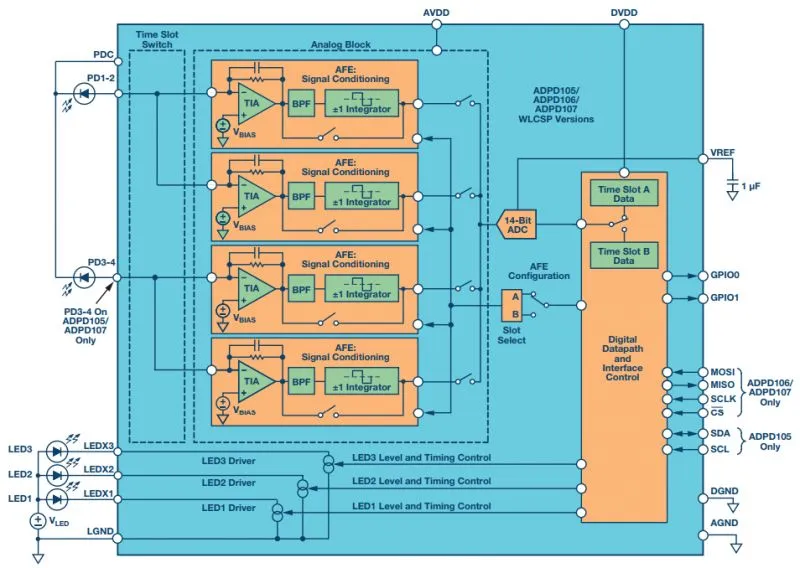
ADI's ADPD4000 is another wearable analog front-end product with eight input channels and multiple operating modes to support PPG, ECG, electrodermal activity (EDA), impedance, and temperature measurements.
Manufacturers such as ADI continue to increase integration, add functions, and improve measurement accuracy to deliver medical-grade capabilities for wearable users.
Battery life and low-power design
Portability is a key advantage of wearables but also imposes limits. To remain comfortable to wear, weight and volume must be minimized, which constrains battery size. To meet the operating requirements of medical and health applications with limited battery capacity, designers must reduce power consumption and optimize battery management.
ADI's HSP 3.0 platform demonstrates low-power design principles: sensors such as the MAX30208 and the MAX86176 are engineered to minimize operating and standby currents. For example, the MAX86176 has a standby current of only 0.5 μA.
The platform recommends ultra-low-power microcontrollers designed for sensor management and system-level low-power operation. The MAX32670 is intended for sensor management and supports algorithms for pulse rate, SpO2, heart rate, respiration rate, sleep quality, and stress monitoring. The MAX32670 can be configured as a sensor concentrator (hardware and algorithms) or an algorithm concentrator, and it supports managing MAX86176 PPG and ECG AFE sensors and providing raw or processed data. In backup mode, the device maintains memory with a power consumption of 2.6 μA (supply 1.8 V) and consumes only 350 nA when only the RTC is active.
The MAX32666 is used for communication and main application processing. It supports low-energy Bluetooth (BLE) and includes dual Arm Cortex-M4F cores with an additional SmartDMA that allows the BLE stack to run independently, enabling the cores to handle main tasks. The microcontroller integrates a full security suite and error-correcting code (ECC) memory for higher system reliability. The MAX32666 provides dynamic voltage scaling to reduce core power, and can execute from cache with a power efficiency down to 27.3 μA/MHz at 3.3 V. It also offers multiple shutdown modes to extend battery life, with a lowest-mode consumption of 1.2 μA at 3.3 V.
HSP 3.0 includes a dedicated power-management device, the MAX20360, optimized for medical wearables. This highly integrated battery and power-management IC includes a high-accuracy ModelGauge m5 EZ fuel gauge, a tactile driver, and a low-noise boost/buck converter to improve SNR and reduce power for optical and bio-detection.
The MAX77659 is another single-input, multi-output power-management IC optimized for multifunction wearables. It requires only one external inductor to provide one charging voltage and three independently programmable output voltages, significantly reducing solution size. A multi-function wearable power module can reduce BOM by up to 60% and device size by up to 50%.
Conclusion
Advances in medical-grade wearable technology have improved the accuracy and reliability of measurements while enabling integration of multiple functions in compact, power-efficient designs that meet clinical application requirements. Because wearables are in direct contact with the human body, developers must address safety and ergonomics in addition to electrical performance, drawing on electronics, materials, and industrial design to meet requirements for safety, water and dust resistance, comfort, and durability.
As medical functions in wearables become more widespread, their value will increase and will further drive development of related component technologies.