ALLPCB


Introduction
Printed circuit board (PCB) assembly stands at a pivotal juncture as demands for higher density, faster production, and greater reliability intensify in electronics manufacturing. Automation in PCB assembly has transitioned from basic pick-and-place machines to fully integrated systems that incorporate robotics and artificial intelligence (AI). These advancements address longstanding challenges like component miniaturization and mixed-technology boards, enabling electric engineers to achieve consistent quality across production runs. Robotics in electronics manufacturing now handles intricate tasks such as selective soldering, while smart PCB assembly leverages data connectivity for real-time optimization. As Industry 4.0 principles take hold, AI in PCB assembly promises predictive maintenance and defect prevention, reshaping workflows for engineers focused on troubleshooting and process refinement.
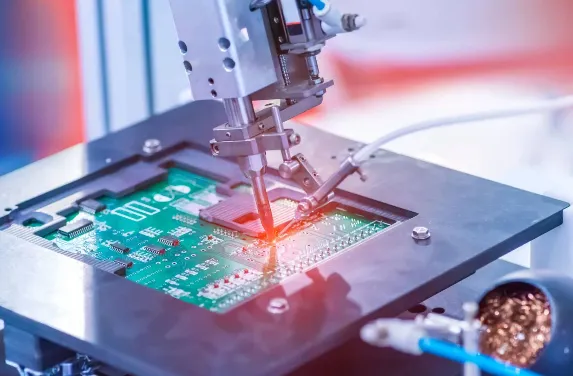
Future directions point toward fully lights-out factories where automation handles mixed technologies like fine-pitch SMT alongside through-hole components. Engineers must consider thermal profiling advancements, such as 4D systems that generate spatial heat maps to optimize reflow for boards with varying thermal masses. These tools cut optimization time and minimize defects like overheating or insufficient wetting. Integration with enterprise resource planning (ERP) enables predictive replenishment of feeders, ensuring continuous flow without manual intervention.
The Evolution of Automation in PCB Assembly
Automation in PCB assembly began with surface-mount technology (SMT) lines but now encompasses closed-loop process control across solder paste inspection (SPI), placement, reflow, and automated optical inspection (AOI). Electric engineers benefit from systems that measure solder paste volume, height, and area in real time, detecting issues like stencil wear before they impact yield. Data from these automated stages feeds into manufacturing execution systems (MES) for trend analysis and corrective actions, reducing process drift. Peripheral automation, including SMEMA-compliant handling and buffering, minimizes bottlenecks and handling damage during board transfer. This evolution supports higher throughput while maintaining traceability from materials to final assembly, crucial for troubleshooting variability in high-mix, low-volume production.
Robotics in Electronics Manufacturing
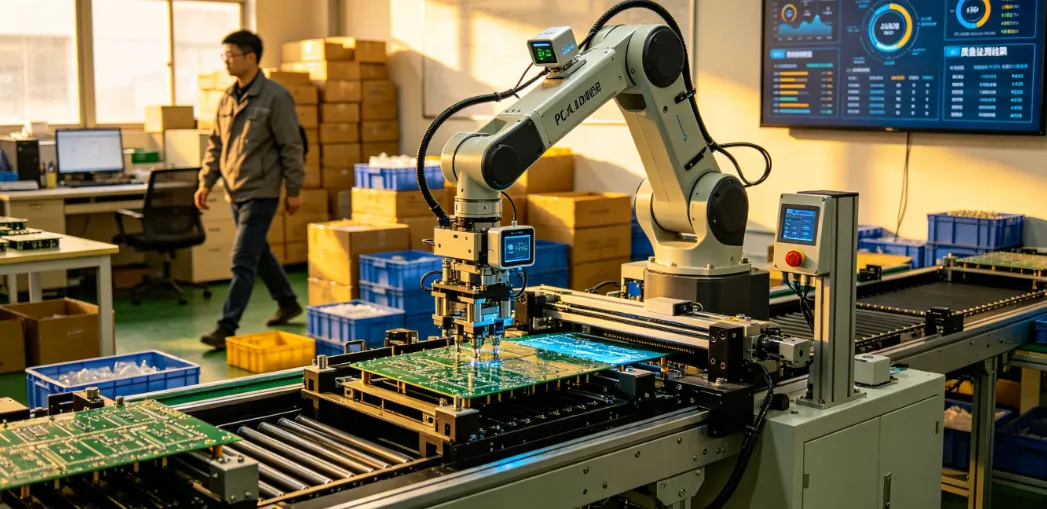
Robotics in electronics manufacturing excels in pick-and-place operations, where arms equipped with vacuum nozzles or grippers retrieve components from feeders and align them with sub-millimeter precision using vision systems. High-resolution cameras and software interpret Gerber files to guide placement on dense boards featuring 0201 resistors or fine-pitch ICs. Selective soldering robots employ laser or induction heating for through-hole joints, delivering repeatable quality with minimal thermal stress to nearby components. Inspection follows immediately via integrated 3D AOI, flagging misplacements or bridging in real time. For electric engineers, this means fewer rework cycles and reliable performance in applications demanding high-density interconnects.
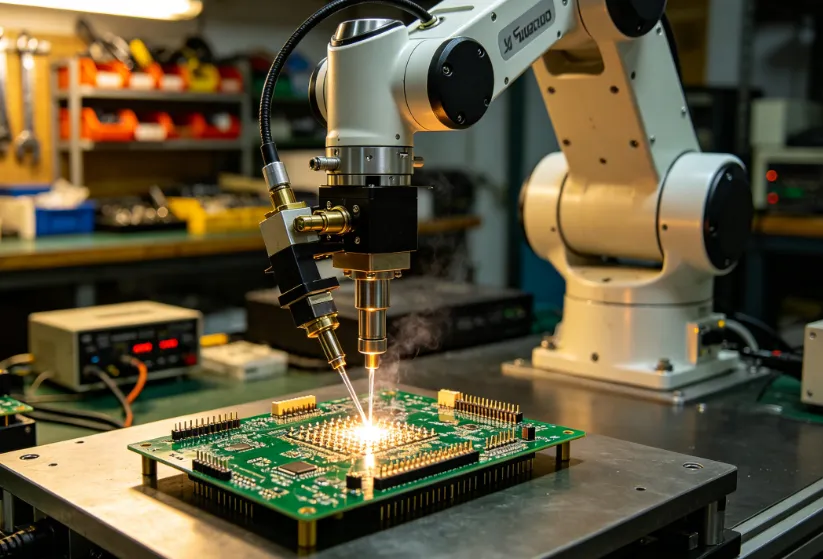
Challenges arise in programming for custom designs, requiring engineers to validate vision algorithms against board variations like warpage or fiducial misalignment. Collaborative robots, or cobots, offer flexibility by working alongside humans for prototyping or changeovers. Maintenance routines, including nozzle calibration and gripper inspection, prevent downtime—engineers should schedule these based on usage logs from the robot's software.
Related Reading: Pick and Place Machine Programming: A Beginner's Guide to SMT Automation
AI's Transformative Role in PCB Assembly
AI in PCB assembly enhances inspection by replacing rule-based AOI with machine learning models trained on vast datasets of good and defective joints. These systems distinguish true defects from process variations, slashing false positives and enabling closed-loop feedback to upstream processes like SPI printers. For instance, 3D SPI data adjusts paste deposition automatically, compensating for stencil wear or material inconsistencies. Predictive analytics from AI monitor equipment health, forecasting failures in feeders or reflow ovens to schedule maintenance proactively. Electric engineers troubleshooting yield issues can analyze AI-generated heat maps from thermal profilers to pinpoint reflow anomalies.
In smart PCB assembly, AI-driven image recognition powers vision systems on robotic arms, adapting to component shifts or lighting changes without reprogramming. This integration supports Industry 4.0 by creating digital twins of assembly lines for simulation and optimization. Engineers gain actionable insights from statistical process control dashboards, correlating defects to variables like humidity or paste viscosity.
Industry 4.0 and Smart PCB Assembly
Industry 4.0 PCB assembly interconnects machines via IoT for seamless data flow, enabling real-time monitoring and adaptive production. Smart factories use MES to enforce FIFO material handling and traceability at the serial level, linking inspection results to specific boards for root-cause analysis. Robotic systems integrate with this ecosystem, sharing placement data for downstream AOI targeting of high-risk areas. Electric engineers benefit from standardized interfaces like SMEMA, ensuring compatibility across diverse equipment vendors. Compliance with standards such as IPC-A-610 for electronic assembly acceptability becomes more achievable through automated verification of joint criteria.
J-STD-001 provides requirements for soldered assemblies, guiding automated soldering processes to meet criteria for voids, wetting, and hardware installation like standoffs. Troubleshooting in these environments involves validating data integrity across the line—engineers should cross-check AI outputs against manual samples periodically.
Related Reading: Automation Unleashed: Transforming PCB Assembly for High-Volume Output
Challenges and Practical Troubleshooting
Despite advances, high initial costs for robotic and AI systems challenge smaller operations, often offset by long-term savings in labor and defects. Programming complexity for varied boards leads to placement errors; engineers troubleshoot by refining fiducial recognition and running dry cycles. Miniaturization to 01005 components strains nozzle precision and paste control, requiring stencil redesigns and validation runs. Maintenance lapses cause feeder jams or vision drift—implement logging and alerts via MES. Material traceability gaps in high-mix lines demand barcode integration from incoming parts.
Thermal management issues in mixed assemblies prompt use of advanced profilers to adjust profiles per zone. Engineers facing inconsistent yields should audit data trails for correlations, such as ambient conditions affecting paste release.
Best Practices for Electric Engineers
Select automation scalable for production volumes, prioritizing systems with upgrade paths for smaller components. Validate robotic programming with design for manufacturability (DFM) checks, simulating placements offline. Integrate AI inspection early, training models on your specific defect library for accuracy. Ensure line interoperability via open protocols, facilitating future expansions. Regularly calibrate vision and thermal systems against known standards to maintain process capability.
For soldering, adhere to J-STD-001 guidelines in robotic setups, verifying joint fillet and hole fill via X-ray samples. Document traceability protocols to support audits, using serial-level logging for full lineage.
Conclusion
Automation, robotics, and smart manufacturing propel PCB assembly toward unprecedented efficiency and precision, empowering electric engineers to tackle complexity head-on. AI enhances defect detection and process optimization, while Industry 4.0 fosters interconnected, data-rich environments. Robotics delivers consistency in high-density tasks, aligning with standards like IPC-A-610 and J-STD-001 for reliable outcomes. Engineers adopting these technologies will troubleshoot proactively, ensuring robust electronics in demanding applications. The future promises even greater integration, with cobots and agentic AI driving adaptive factories.
FAQs
Q1: What is automation in PCB assembly and why does it matter for electric engineers?
A1: Automation in PCB assembly involves interconnected systems for solder paste application, component placement, reflow, and inspection, replacing manual steps with precise machinery. It matters because it handles miniaturization and mixed technologies reliably, reducing defects and enabling data-driven troubleshooting. Engineers gain closed-loop feedback to refine processes, ensuring compliance with standards like IPC-A-610 while scaling production efficiently. This shift minimizes variability from human factors, critical for high-reliability designs.
Q2: How does robotics in electronics manufacturing improve PCB assembly?
A2: Robotics improves PCB assembly through high-speed pick-and-place, selective soldering, and real-time inspection via vision systems. It achieves sub-millimeter accuracy for fine-pitch components, boosting throughput and consistency. Challenges like programming are offset by software interpreting design files directly. Electric engineers benefit from reduced rework and scalable operations, ideal for prototyping to volume runs.
Q3: What role does AI play in PCB assembly processes?
A3: AI in PCB assembly powers machine learning-based AOI and SPI, distinguishing defects with fewer false calls and providing feedback loops for process adjustments. It enables predictive maintenance and thermal optimization via data analytics. For engineers, this means faster root-cause identification and higher yields on complex boards. Integration with robotics enhances adaptability in smart lines.
Q4: How is Industry 4.0 transforming smart PCB assembly?
A4: Industry 4.0 transforms smart PCB assembly with IoT connectivity, MES integration, and full traceability for real-time monitoring. It supports automated material handling and adaptive lines handling high-mix production. Engineers troubleshoot via digital twins and dashboards, aligning with J-STD-001 for soldering quality. This framework drives efficiency in regulated sectors like aerospace.
References
IPC-A-610 — Acceptability of Electronic Assemblies. IPC
IPC-J-STD-001J — Requirements for Soldered Electrical and Electronic Assemblies. IPC