ALLPCB


Introduction
In high-volume PCB manufacturing, contamination from flux residues, particulates, and handling introduces risks that compromise reliability and performance. Automated PCB cleaning systems address these challenges by eliminating manual intervention, ensuring consistent results across thousands of boards daily. These systems integrate seamlessly into production lines, supporting the demands of modern electronics assembly where even microscopic residues can lead to failures under electrical stress or environmental exposure. As production scales, the shift to no-touch processes becomes essential for maintaining quality control and meeting tight deadlines. This article explores the principles, types, and benefits of automated PCB cleaning systems, with a focus on their role in optimizing high-volume operations.
What Are Automated PCB Cleaning Systems and Why Do They Matter?
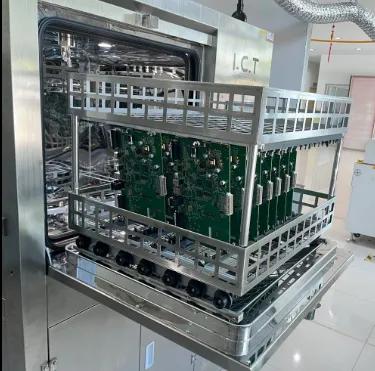
Automated PCB cleaning systems are engineered equipment designed to remove contaminants from printed circuit boards without human contact, using controlled chemical, mechanical, and thermal processes. They differ from manual methods by incorporating robotics, sensors, and programmable logic for repeatable cleaning cycles tailored to specific flux types and board geometries. In high-volume manufacturing, these systems prevent ionic residues that cause electrochemical migration or dendrite growth, which degrade signal integrity and insulation resistance over time.
The relevance stems from industry-wide pushes for defect-free assemblies, particularly as component densities increase and lead-free soldering amplifies residue challenges. J-STD-001 outlines cleanliness requirements for soldered assemblies, emphasizing the need for residue limits to ensure long-term reliability in harsh environments. Without effective cleaning, high-volume runs amplify failure rates, leading to rework costs and yield losses. Automated systems mitigate these by standardizing processes, aligning with factory quality metrics.
Technical Principles Behind Automated PCB Cleaning
Automated PCB cleaning relies on fluid dynamics, cavitation, and evaporation to dislodge and extract contaminants like solder paste residues, oils, and dust. Aqueous-based systems circulate deionized water mixed with surfactants through high-pressure nozzles or immersion tanks, leveraging spray impingement for thorough surface coverage. Ultrasonic variants generate high-frequency sound waves that create microscopic bubbles, imploding to scrub under components and in vias without mechanical abrasion.
Inline PCB cleaning systems process boards continuously via conveyor belts, with multi-stage zones for cleaning, rinsing, and drying to achieve residue levels below detection thresholds. Batch PCB cleaning systems, conversely, handle grouped boards in enclosed chambers, often combining immersion with agitation for flexibility across varying board sizes. Drying stages employ hot air knives or vacuum extraction to prevent watermarks, critical for subsequent coating or assembly steps. Sensors monitor parameters like conductivity and pH, enabling real-time adjustments for process stability.
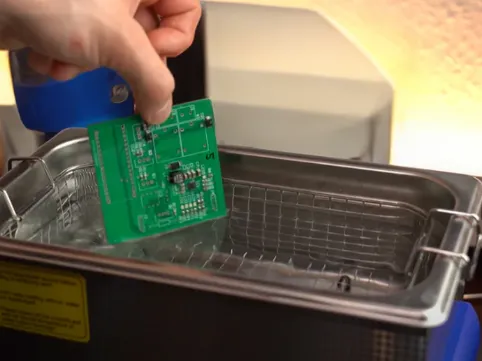
Comparison of Automated PCB Cleaning Systems: Inline vs. Batch
When evaluating automated PCB cleaning systems, inline and batch configurations serve distinct high-volume needs based on throughput, footprint, and flexibility. Inline PCB cleaning systems excel in continuous production, transporting boards through sequential modules without stopping the line, ideal for rates exceeding 1,000 boards per hour. They minimize handling risks and integrate with SMT lines, but require larger floor space and higher upfront investment due to robust conveyor and plumbing infrastructure.
Batch PCB cleaning systems process loads of 20 to 100 boards in cycles, offering lower initial costs and easier scalability for mid-volume runs or prototyping. They provide superior access for complex boards with tall components, using vertical immersion for uniform cleaning. However, cycle times limit throughput, and manual loading introduces potential contamination points despite automation within the chamber.
Inline PCB Cleaning Systems:
- Throughput: High (continuous flow)
- Floor Space: Large
- Initial Cost: Higher
- Flexibility for Board Sizes: Moderate (fixed conveyor width)
- Integration: Seamless with production lines
Batch PCB Cleaning Systems:
- Throughput: Medium (cyclic loads)
- Floor Space: Compact
- Initial Cost: Lower
- Flexibility for Board Sizes: High (adjustable racks)
- Integration: Standalone or semi-integrated
A comparison of automated PCB cleaning systems reveals inline options prioritize speed for mass production, while batch suits variable demands.
Best Practices for Implementing Automated PCB Cleaning Systems
Successful deployment begins with chemistry selection matched to flux activators, ensuring compatibility with board materials and avoiding corrosion. Pre-clean profiling via ion chromatography verifies baseline contamination, guiding system parameterization. Integrate inline PCB cleaning systems post-reflow to capture fresh residues, with redundant rinsing stages using conductivity-monitored DI water below 0.5 microsiemens per centimeter.
Maintenance protocols include daily filter changes and weekly nozzle inspections to sustain performance, per guidelines in IPC-CH-65 for printed board cleaning. For batch systems, optimize load density to balance cycle efficiency without shadowing effects. Operator training on PLC interfaces ensures quick fault diagnosis, minimizing downtime.
The ROI of automated PCB cleaning equipment materializes through reduced manual labor, lower defect rates, and extended equipment life. Factories report faster payback in high-volume settings via yield improvements and compliance with cleanliness specs, offsetting capital with operational savings over 12 to 24 months.
Challenges and Solutions in High-Volume Automated Cleaning
High-volume operations face issues like shadow cleaning under low-standoff components, addressed by multi-angle nozzles or ultrasonic boosts in inline setups. Water conservation demands closed-loop rinsing with ion exchange resins, recycling up to 90 percent of fluids. Variability in board warpage requires adjustable fixtures to maintain spray uniformity.
Residue re-deposition during drying is countered by staged hot air and IR heating, ensuring surfaces reach ambient moisture equilibrium. IPC-5704 specifies cleanliness thresholds for unpopulated boards, guiding validation tests like ROSE to confirm system efficacy. Proactive sensor calibration prevents drift, sustaining factory throughput.
Conclusion
Automated PCB cleaning systems represent a pivotal advancement for high-volume manufacturing, delivering consistent, no-touch contaminant removal essential for reliable electronics. Inline configurations drive efficiency in continuous lines, while batch options offer versatility, with choices guided by production scale and ROI projections. Adhering to standards ensures compliance and performance, positioning factories for scalable quality. As demands for denser, faster assemblies grow, these systems fortify the production backbone against contamination pitfalls.
FAQs
Q1: What are inline PCB cleaning systems, and when should they be used?
A1: Inline PCB cleaning systems convey boards through continuous cleaning, rinsing, and drying zones, ideal for high-volume manufacturing exceeding 500 boards per shift. They integrate directly with reflow ovens and SMT lines, minimizing handling and enabling real-time monitoring via conductivity sensors. Use them when throughput and line speed are priorities, ensuring residues meet J-STD-001 limits without production halts.
Q2: How do batch PCB cleaning systems compare to inline systems?
A2: Batch PCB cleaning systems load multiple boards into chambers for immersion or spray cycles, suiting variable production or complex geometries better than inline setups. A comparison of automated PCB cleaning systems shows batch lower in cost and space but slower for mass runs, with ultrasonic options excelling in under-component cleaning. Choose based on volume: batch for flexibility, inline for speed.
Q3: What is the ROI of automated PCB cleaning equipment in high-volume settings?
A3: The ROI of automated PCB cleaning equipment arises from yield gains, labor reductions, and defect prevention, often recouping costs within 18 months in high-volume lines. Automated processes standardize cleaning, cutting rework by ensuring consistent residue removal aligned with IPC standards. Long-term savings include lower warranty claims and faster cycles, making investment viable for factories scaling to thousands of boards daily.
Q4: Why are automated PCB cleaning systems critical for quality control?
A4: Automated PCB cleaning systems eliminate variability from manual methods, achieving uniform cleanliness vital for high-reliability assemblies. They handle flux residues that cause migration under bias, per industry benchmarks, supporting conformal coating and testing. In high-volume manufacturing, they boost first-pass yields and compliance, directly impacting factory metrics.
References
IPC-5704 — Cleanliness Requirements for Unpopulated Printed Boards. IPC.
J-STD-001 — Requirements for Soldered Electrical and Electronic Assemblies. IPC/JEDEC.
IPC-CH-65 — Guidelines for Cleaning of Printed Boards and Assemblies Using Solvents. IPC.