ALLPCB


Measuring power is becoming an increasingly important element in the smart home. The deployment cost of smart meters and smart grids should be offset by energy savings, but simple measurement solutions are still needed. Smart networks also seek to identify major power-consuming devices to minimize current consumption, reduce bills, and distribute load on the public power grid.
Overview
A key factor in power measurement is the sensor. Hall-effect magnetic sensors are well suited to provide the information required by consumers and utilities. These sensors have evolved toward standard CMOS processes with integrated ferromagnetic concentrators and data converters. Modern smart-network implementations pair these sensors with wireless transceivers and optional microcontrollers to send data back to a central hub. The data can be examined locally to identify power usage or aggregated anonymously for regional statistics.
Hall-effect Sensors
The Melexis MLX91205 current sensor is a single-axis magnetic sensor based on the Hall effect. It combines CMOS Hall circuitry with a thin ferromagnetic concentrator. The CMOS circuit contains two pairs of Hall elements with sensitivity directions parallel to the chip surface. The ferromagnetic concentrator amplifies external magnetic fields and focuses them on the Hall elements to provide a larger signal for power measurement. This makes the device suitable for AC and DC currents, producing an analog, linear, ratio output voltage proportional to the magnetic field parallel to the chip surface.
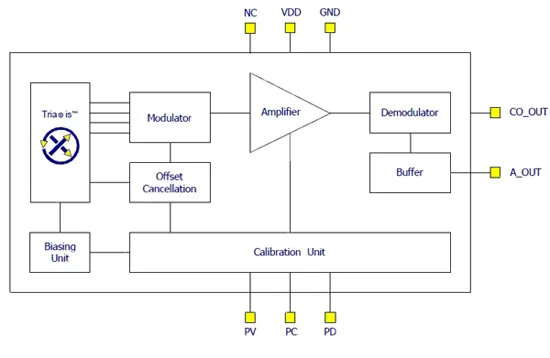
Melexis MLX91205 current sensor showing Hall circuit and ferromagnetic concentrator.
The circuit is manufactured in a standard CMOS process with a ferromagnetic layer added in a simple back-end step. The single-chip device integrates Hall elements, offset cancellation circuitry, a current source, chopper-stabilized amplification, and parameter programming features.
Using dynamic offset cancellation reduces offset voltages arising from temperature variation, package stress, and similar effects. The device therefore provides an extremely stable signal output, resistant to mechanical stress and largely unaffected by temperature cycling. This yields wide applicability and high accuracy. Unlike some other linear Hall sensors, the MLX91205 measures magnetic fields parallel to the chip surface, making it suitable for open-loop current sensing on printed circuit boards and for meters or equipment. The device is compact and supports a range of current levels.
Fast response time and high bandwidth make the sensor suitable for noncontact, high-current, high-voltage settings and fast current measurements. Two product versions are available: the 91205HB with a linear magnetic field range of +/-25 mT and the 91205LB with +/-10 mT. HB denotes the high-field range and LB the low-field range.
Low Current Measurement (up to +/-2 A)
The MLX91205 can measure low currents by increasing the magnetic field with a coil around the sensor. The measured sensitivity (output voltage per coil current) depends on coil size and number of turns; adding shielding around the coil can increase sensitivity and improve immunity to external fields. A coil provides high dielectric isolation, making it suitable for high-voltage power supplies with relatively low current. The output should be scaled so that the maximum measured current produces the maximum voltage for optimal accuracy and resolution.
Medium Current (up to +/-30 A)
If a single conductor runs on the PCB, currents up to 30 A can be measured. PCB trace dimensions must account for current handling and total power dissipation; traces need to be thick and wide enough to continuously handle the RMS current. In this configuration the differential output voltage can be approximated as VOUT = typ. 35-40 mV/A * I. That implies an output of approximately 1050 mV for a 30 A current level.
High Current (up to +/-600 A)
Another method to measure high currents on a PCB is to use a large, thick copper trace capable of carrying current on the opposite side of the board. The MLX91205 should be placed near the center of the trace; however, for very wide traces the output is less sensitive to exact placement. Because of conductor distance and width, this configuration yields lower sensitivity.
In many applications the 91205 output voltage is measured by a microcontroller. System calibration after assembly can significantly improve accuracy: apply a known current, for example 100 A, and calibrate the microcontroller reading so that the output corresponds to an exact value, e.g., 100 A -> 2.000 V. This simple calibration adjusts offset and sensitivity at a given temperature.
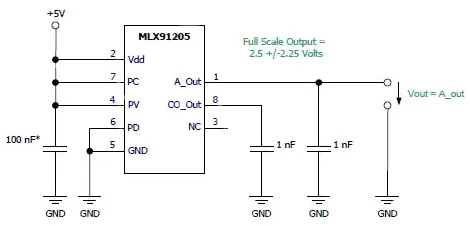
Single-ended output of the MLX91205 current sensor.
The sensor can be used in single-ended mode, where the voltage across A_out determines the current. This output can be connected to an ADC integrated in a low-cost microcontroller and RF transceiver. A 12-bit ADC captures the voltage and transfers the digital value to microcontroller registers, which the transceiver can access. Typical transceivers operating in 240-960 MHz ISM bands provide extended home range and low power consumption. The value can be polled remotely or sent as part of a smart-home network.
Using the differential output, the current is represented by the voltage difference between A_out and CO_out. Both lines can be routed to ADC inputs in the microcontroller. Differential output cancels noise that can affect single-ended signals. If the supply is exposed to EMI, adding a 100 pF ceramic capacitor in parallel with a 100 nF capacitor on the second bypass node can be useful.
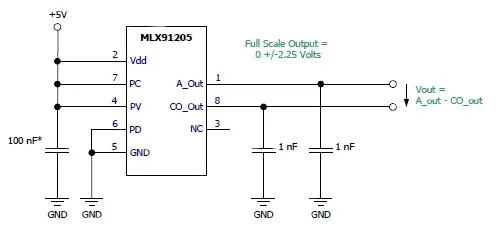
Differential output of the MLX91205 current sensor.
Integrated Transceivers and Network Protocols
Other integrated transceivers operate in the 2.4 GHz band using protocols such as ZigBee to provide in-home networking. Devices such as TI's CC2531 integrate an 8-channel 12-bit sigma-delta ADC, an 8-bit microcontroller, and a 2.4 GHz front end. These are optimized for ZigBee and low-power smart-home lighting and network applications.
Current ZigBee implementations using IPv4 allow mesh networking of home devices and link them back to a central hub. The hub can be accessed via the Internet to display device energy usage and highlight patterns and opportunities for savings offered by integrated current sensors. Next-generation ZigBee devices will support IPv6, enabling direct Internet access to devices while hubs remain useful due to limited radio range. This can simplify hub design and reduce deployment cost.
Consumer Devices
For consumer devices, the Allegro ACS711 provides a cost-effective, accurate solution for AC or DC current sensing in audio, communication systems, and white goods up to 100 V. The package facilitates circuit protection and current monitoring.
The device uses a linear Hall sensor circuit with a copper conductive path near the chip surface. Current through this copper path generates a magnetic field sensed by the integrated Hall IC and converted to a proportional voltage. The close proximity of the magnetic signal to the Hall sensor optimizes accuracy.
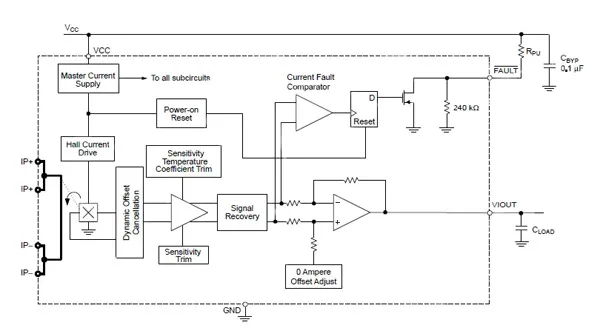
ACS711 Hall-effect current sensor showing temperature compensation and signal recovery.
The device output has a positive slope proportional to the current between IP+ and IP- pins. Internal resistance is 0.6 mΩ for the EX package and 1.2 mΩ for the LC package, providing a noninvasive sensing interface that conserves power in efficiency-sensitive smart-home applications. The LC package supports +/-12.5 A and +/-25 A full-scale ranges, while the EX package supports +/-15.5 A and +/-31 A. The conductive element thickness allows survival of up to 5x overcurrent conditions for surge protection. The ACS711 is available in small SOIC8 and QFN12 packages for easy PCB integration without external sense resistors.
Proportional Current Measurement and On-Chip Conversion
Some devices use architectures better suited to integrating ADCs on-chip, allowing digital outputs to be used directly by on-board transceivers or microcontrollers. On-chip ADCs can collect data from multiple sensors and enhance the role of smart networks in the home.
Infineon’s TLE4997 Hall-effect IC is designed for current measurement applications and provides a proportional analog output voltage that is well suited for ADCs referenced to the supply. It uses on-chip digital signal processing with 16-bit DSP architecture and digital temperature compensation to ensure long-term stability. Overall resolution is at least 12 bits, with some internal stages providing up to 20-bit resolution.
The IC is manufactured in BiCMOS with high-voltage capability and reverse-polarity protection. Magnetic flux is measured by Hall units and the output is converted from analog to digital by the DSP. Shorted Hall units and continuous-time A/D conversion provide a low, stable magnetic offset, and a programmable low-pass filter reduces noise. Temperature can be measured and converted to digital format for software-based second-order compensation.
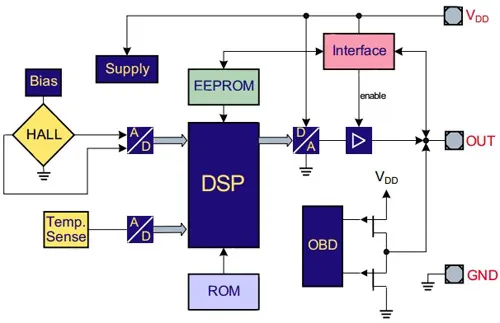
TLE4997 Hall-effect sensor with onboard DSP and digital conversion.
This approach allows the output-voltage range to be clamped by digital limiters and made proportional to the supply voltage (ratio DAC). On-board diagnostics can force the output to VDD or GND in fault conditions. The transceiver can then use the digital or GPIO outputs directly as part of a smart-home network.
Conclusion
Placing current sensors near potential power-consuming sources in the home provides higher granularity in power measurement. Connecting these sensors to a network via a hub using IPv4 or directly using IPv6 enables broader access to real usage data. Analyzing this data supplies utilities and customers with key information on how much power is used, when, and where. This improves awareness and enables consumers to reduce consumption and cost. It also helps utilities schedule generation and delivery more efficiently to lower overall costs.