ALLPCB


Introduction
“smart grid” is the next major phase in upgrading AC power networks. The existing grid supplies power from centralized generation and provides little or no insight into individual users (industrial, commercial, or residential) regarding load and usage; users rarely have visibility into their own consumption or load-based costs. The current grid architecture is also poorly suited to highly local, independent power sources (for example, home solar panels) that feed unpredictable amounts of power into the grid or draw power from it.
The smart grid aims to deliver power more efficiently and balance loads. It also gives end users better insight into costs and timing of usage for load balancing. Equally important, it will accommodate growing amounts of intermittent local generation that can feed power back to the grid or store energy for later use when conditions allow.
Sensors at Every Layer
Realizing the smart grid depends on introducing sensors at multiple levels of the grid hierarchy (Figure 1). According to market research firm IHS, the smart-grid-related sensor market will expand nearly 20-fold from 2014 to 2021, reaching $350 million. The smart grid uses these sensors, together with smart meters installed at each customer site, to inform both users and utilities about power availability, loads, and operating costs. These meters will link with in-premises devices and lighting, local generation/storage, and the utility grid for intelligent control.
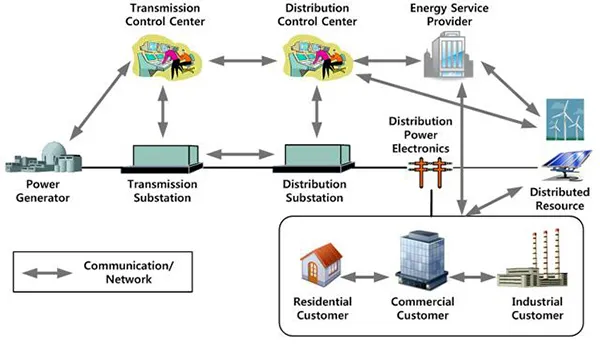
Figure 1: The smart grid is a significant upgrade to traditional power systems; it improves generation, transmission, and consumption efficiency and enables smaller-scale procurement and localized storage.
Smart Grid Overview
Historically, AC power grids connected multiple generating plants (fueled by coal, oil, gas, hydro, or nuclear) into a network so any source could support users anywhere in the system. Utilities operating power plants and the grid can measure power and energy through parts of the grid, adjust supply and throttling where needed, and meter each end-user's energy consumption (kW-h) via various telemetry techniques.
However, that level of insight is limited. Their feedback loops have relatively large time constants because they mainly respond to large-scale changes, such as lower demand at night and slower rise/fall in the morning and evening, with somewhat stable daytime peaks. In an increasingly 24/7 world, even these traditional patterns are changing.
The smart grid aims for flexible combinations of energy sources, delivery paths, and storage that must be balanced in near real time and dynamically adjusted as needed. The goal of a successful smart grid deployment is to minimize dependence on large centralized generation or long-distance transmission. Strong financial incentives are being used to encourage load shifting, off-peak usage, local generation, and even local storage (for example, see Tesla's recently announced Powerwall systems for homes and offices).
Low-Level Building Blocks Enable High-Level Architecture
The potential flexibility and benefits of the smart grid are compelling, but turning that into reality requires many low-level building blocks at the end-user level. Residential installations are especially variable, with no single building-management professional per home. The smart-grid capability pyramid starts with monitoring, and possibly utility-driven control, of energy delivered to or provided by a home. Implementing this requires several stages.
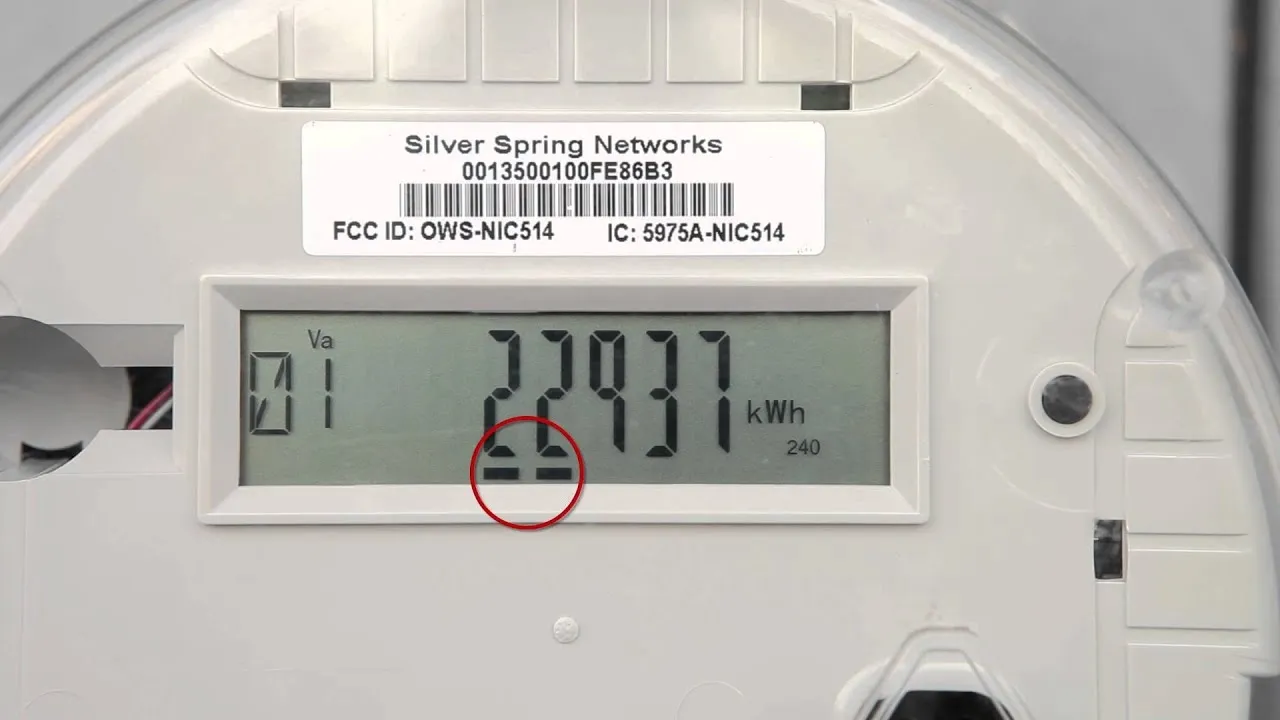
First, each household needs a smart meter called advanced metering infrastructure (AMI) to measure power use and provide data to utilities for billing and tracking. AMI also gives consumers insight into usage and pricing, and enables more practical control over energy consumption. AMI works with residential energy management (REM) systems that use a home area network (HAN) installed by the utility to communicate with meters, thermostats, lights, and other monitored or controlled devices. HAN connections use wireless links or power-line communication (PLC).
Consumers are often skeptical about utility control over energy use timing, and research on consumer acceptance is incomplete. An alternative is utility-provided REM, replaced by a consumer-owned independent REM (iREM) that connects via the AMI metering subsystem and actively monitors energy use while allowing the user to retain personal control.
Integrated Circuits, Sensors, and Software
Converting these high-level goals into deployable devices, such as smart meters and smart appliances/fixtures, represents large-volume opportunities but faces strong cost pressure.
IHS estimated global smart meter shipments would double from 2011 to 2016 to about 62 million units, which would in turn double the semiconductor market in that period. In a report summary, IHS industrial electronics analyst Jacobo Carrasco Heres noted that replacing traditional meters with smart meters was initially motivated by energy savings, but the more compelling incentive is grid instrumentation. Smart meters give utilities a well-mapped grid that allows more effective planning and resource management. The following examples illustrate steps suppliers have taken to make these smart-grid building blocks practical.
One leading smart-meter IC is Maxim Integrated's Teridian 78M6631, a highly integrated three-phase power-measurement and monitoring system-on-chip (SoC) (Figure 2). It integrates a 22-bit delta-sigma A/D converter, an 8051-compatible MPU core, and a 32-bit computation engine for processing AC-line data. The 78M6631 is designed for power and quality measurement in both delta and wye three-phase configurations.
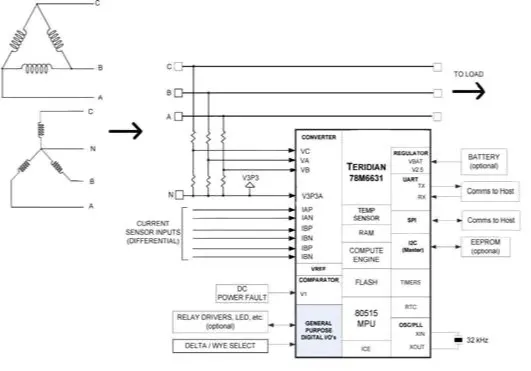
Figure 2: The Maxim Teridian 78M6631 power-measurement and monitoring SoC implements much of a smart meter's functionality and supports a range of line sensor types and three-phase connection configurations.
The device provides six analog inputs to the A/D converter (three differential current and three voltage) for connecting current and voltage sensors used for AC-line sensing. It offers better than 0.5% accuracy across a 2000:1 dynamic range. For interface to a host processor, the 56-pin TQFN package includes SPI, I2C, and UART I/O. It also includes basic digital I/O ports for controlling LEDs to indicate meter status, driving external relays, and even selecting among input sensors.
Smart-meter ICs alone, regardless of functionality or integration, are only part of the solution. Maxim supplies application software as firmware that can be loaded into 128 KB of flash to provide analysis and system tuning, including:
- True RMS current and voltage calculations
- Active, reactive, apparent, fundamental, and harmonic power calculations
- Fundamental and harmonic current and voltage calculations
- Line frequency and power-factor calculations
- Phase compensation (upward)
- Built-in calibration routines
- Programmable alarm thresholds
The combination of appropriate line current/voltage sensors, the Teridian IC, embedded firmware, and analytics can meet the accuracy, timeliness, and reporting requirements of many global performance and regulatory standards.
Lighting Control and LED Drivers
Residential and commercial lighting is a domain the smart grid can integrate to save significant energy. Unlike HVAC, which must run to maintain temperature, lighting has greater flexibility. Users can adjust lighting levels based on available daylight, occupancy, and other factors. Lighting also contributes waste heat, which may be beneficial or detrimental depending on external temperature.
As many fixtures migrate to LED-based lamps for improved efficiency, longer life, and dimming capability (with appropriate control circuits and algorithms), vendors offer ICs optimized for LED lighting. One example is Cypress Semiconductor's CY8CLED0xD/G0y series PowerPSoC smart LED drivers, a family of related ICs that vary in memory, I/O count, and internal features (Figure 3). Each device comprises five main modules: the PSoC core, digital system, analog system, system resources, and power peripherals (including power FETs, hysteresis controllers, current amplifiers, and PrISM/PWM modulators). The PowerPSoC series is intended to replace traditional MCUs, system ICs, and many surrounding discrete components.
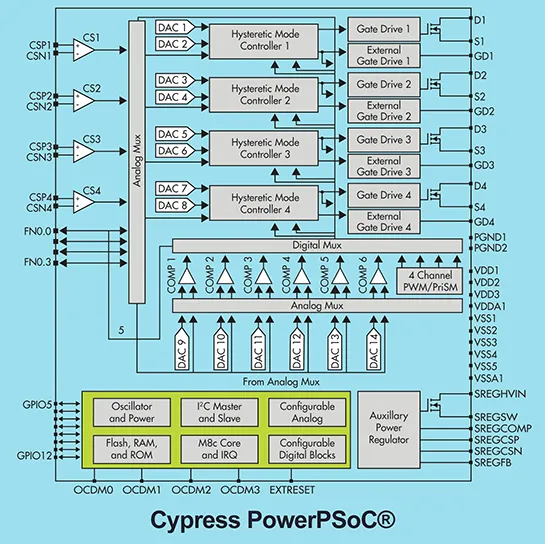
Figure 3: Multiple CY8CLED0xD/G0y PowerPSoC ICs from Cypress Semiconductor are designed for intelligent LED driving, replacing incandescent and CFL lamps with carefully monitored drive characteristics.
Each PowerPSoC integrates a range of power peripherals and digital control features. Power peripherals include:
- Up to four independently operated MOSFETs (32 V/1 A) to drive high-power LEDs
- Up to four programmable hysteresis controllers to provide controlled current output for LEDs
- Up to four programmable low-side gate drivers supporting voltages above 32 V for external MOSFETs
- Support for floating-load buck, floating-load buck-boost, and boost converter topologies to accommodate different voltage requirements
- Switching frequencies up to 2 MHz, allowing smaller, less expensive inductors
- Auxiliary power regulators to power single-device supplies
- 16-bit dimming for applications requiring high-resolution dimming
On the digital-control side, users have access to:
- Eight programmable digital blocks for timers, counters, PWM, UART, and similar functions
- Six programmable analog blocks for amplifiers, ADCs, DACs, filters, and comparators
- At least 16 KB of flash memory
- An 8-bit microcontroller
Configurable power, analog, digital, and interconnect circuits in the PSoC devices enable a high level of integration to support industrial, commercial, and consumer LED lighting requirements.
Simple Sensors Matter
Simple sensors can also make a large difference. At the minimum level of smart-grid and intelligent energy interaction, using room occupancy detectors can eliminate wasted lighting energy, especially in areas with highly intermittent use (think restrooms). Basic components like the Zilog Zmotion ZRE200BP PIR passive infrared detector provide significant benefit for modest investment.
Conclusion
The smart grid offers substantial potential for energy savings and efficiency from generation through consumption and storage. Turning the concept into reality requires major upgrades across all stages of grid systems, with extensive local and residential work where cost must remain low, installation and use must be simple, and tangible benefits must be practical. Suppliers of components such as power metering ICs, lighting and energy-control ICs, and even basic sensors play a critical role in upgrading the grid toward greater awareness, flexibility, and resilience.