ALLPCB


Introduction
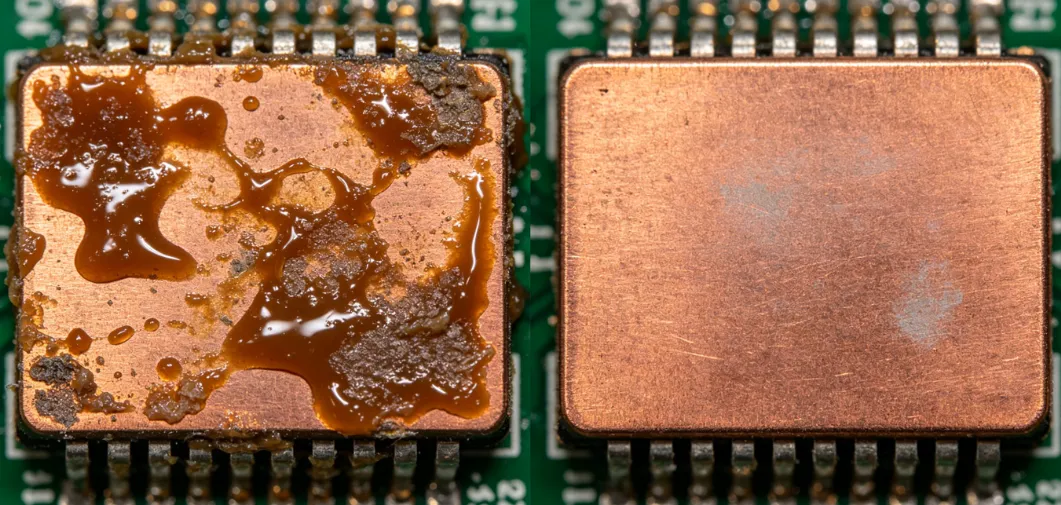
In PCB assembly, effective cleaning removes flux residues, solder balls, and contaminants that can lead to failures like electrochemical migration or dendritic growth. Engineers face the choice between aqueous PCB cleaning and solvent PCB cleaning, each with distinct processes, equipment needs, and outcomes. Aqueous methods use water-based solutions, while solvents rely on organic chemicals for residue dissolution. This decision impacts reliability, cost, and compliance in high-volume production. Understanding the differences helps select the optimal approach for specific assembly challenges. The environmental impact of PCB cleaning also plays a key role in modern manufacturing decisions.
Understanding Aqueous PCB Cleaning
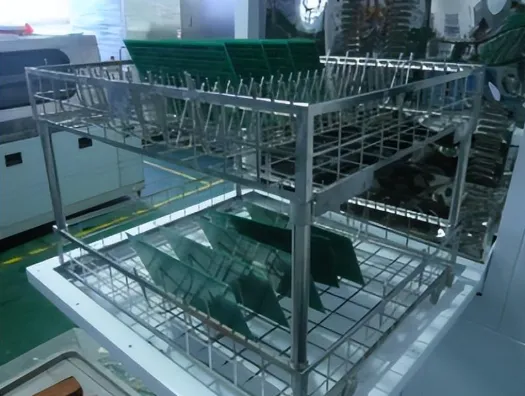
Aqueous PCB cleaning employs deionized water combined with detergents or saponifiers to lift and emulsify flux residues from assembled boards. The process typically involves spray washing in heated solutions, followed by rinsing with high-purity water to prevent ionic contamination. Drying stages use hot air convection or infrared heaters to evaporate moisture without residue. This method excels with water-soluble fluxes, common in lead-free soldering, where residues activate under humidity. Equipment for aqueous PCB cleaning includes inline or batch systems with multiple zones for wash, rinse, and dry, ensuring thorough coverage on complex board geometries. Maintenance focuses on water filtration and drag-out minimization to sustain cleaning efficacy.
Exploring Solvent PCB Cleaning
Solvent PCB cleaning uses organic compounds like alcohols or hydrocarbons that dissolve non-water-soluble residues directly. Vapor degreasing or immersion baths allow solvents to condense on surfaces, cleaning via phase change without mechanical agitation in some setups. No rinsing is required, as residues dissolve completely, leading to rapid air drying at ambient conditions. This suits no-clean or low-residue fluxes, where aqueous methods might leave water traps under components. Solvent systems demand explosion-proof enclosures due to flammability risks, with distillation for fluid recycling. Engineers appreciate the simplicity for spot cleaning or low-volume runs.
Key Technical Differences in Aqueous vs. Solvent PCB Cleaning Equipment
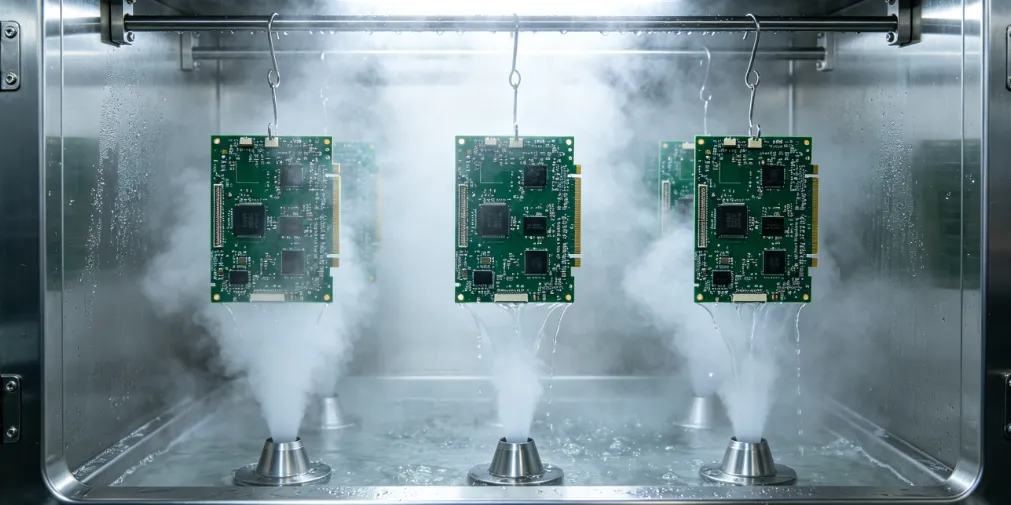
Aqueous vs. solvent PCB cleaning equipment differs fundamentally in design and operation. Aqueous machines feature heated tanks up to 70 degrees Celsius, pump-driven sprays for impingement, and conductivity-monitored rinses to achieve low ionic levels. Solvent equipment prioritizes sealed vapor zones or ultrasonic agitation in non-flammable baths, with condensation coils for solvent recovery. Aqueous systems handle higher throughput but require effluent treatment, while solvents offer footprint efficiency for space-constrained facilities. Power consumption is higher for aqueous drying, contrasting solvent's minimal energy needs post-clean. Selection hinges on residue compatibility and process speed requirements.
- Process Zones — Aqueous: Wash, rinse, dry; Solvent: Immersion/vapor, distillation
- Temperature — Aqueous: Heated (50-80°C); Solvent: Ambient to boil point
- Drying Time — Aqueous: 10-30 minutes; Solvent: Instantaneous
- Footprint — Aqueous: Larger (multi-zone); Solvent: Compact
- Utilities — Aqueous: DI water, drains; Solvent: Ventilation, fire suppression
Related Reading: From Flux to Function: A Comprehensive Guide to PCB Cleaning Solvents
Cleaning Mechanisms and Residue Removal Effectiveness
Flux residues vary by chemistry, influencing cleaning choice. Water-soluble fluxes ionize in aqueous solutions, saponifiers breaking rosin or halide bonds for emulsification. Solvents penetrate organic matrices, solvating colophony acids without hydrolysis risks. IPC J-STD-001 outlines cleanliness requirements, mandating residue removal to prevent SIR failures under bias testing. Aqueous processes risk redeposition if rinse water quality drops below 1 microsiemens per centimeter. Solvents avoid this but may swell plastics if incompatible. Testing via ion chromatography verifies both methods meet thresholds for Class 3 assemblies.
Pros and Cons: Performance Comparison
Aqueous cleaning provides superior removal of polar contaminants, with spray dynamics reaching under low standoff components. However, moisture sensitivity demands robust drying to avoid popcorn effects during reflow rework. Solvent cleaning penetrates tight gaps effectively, ideal for high-density interconnects, but generates vapors requiring scrubbers. Aqueous setups scale for mass production, while solvents suit precision cleaning of optics or hybrids. Cost-wise, aqueous incurs water and energy expenses, offset by lower chemical hazards. Reliability data shows both achieve bare board cleanliness when optimized.
Related Reading: Beyond IPA: Advanced Cleaning Solvents for SMT Assembly
Environmental Impact of PCB Cleaning Methods
The environmental impact PCB cleaning receives scrutiny under regulations for waste and emissions. Aqueous processes produce rinse water with dissolved solids, necessitating closed-loop filtration or neutralization before discharge. Solvents emit volatile organic compounds, contributing to smog formation unless captured in vapor recovery systems. Aqueous methods reduce hazardous air pollutants, aligning with sustainability goals through biodegradable chemistries. Solvent recycling reaches 95 percent efficiency, minimizing disposal volumes compared to water treatment sludge. Lifecycle assessments favor aqueous for low global warming potential, though energy use tempers gains. Engineers must balance local regs with global footprints.
Practical Factors for Selection in PCB Assembly
Choose based on flux type first: water-soluble demands aqueous, while rosin-mild suits solvents. Board features like fine-pitch or bottom-terminated components favor solvents for no-rinse drying. Production volume tips toward inline aqueous for throughput above 1000 boards per hour. Cost modeling includes chemistry, utilities, and downtime for maintenance. Pilot testing with ROSE or resistivity probes validates choices per IPC-CH-65 guidelines. Hybrid approaches combine both for mixed residues.
Best Practices for Implementation
Optimize aqueous cleaning by maintaining spray pressure at 2-5 bar for flux dislodgement, followed by cascade rinsing. Monitor drag-out with conductivity meters to prevent cross-contamination. For solvents, preheat boards to enhance evaporation rates and use ultrasonics below 40 kHz to avoid cavitation damage. Implement process control with periodic ion chromatography per J-STD-001. Train operators on compatibility testing to sidestep material degradation. Regular equipment audits ensure consistent performance across shifts.
Troubleshooting Common Cleaning Issues
White residue post-aqueous cleaning often stems from incomplete rinsing; extend cascade stages or boost DI water flow. Solvent cleaning leaves oily films if distillation fails, resolved by sump skimming and filter replacement. Corrosion under fine-pitch leads indicates halide activation; switch to halide-free flux or enhance neutralization. Drying spots arise from shadowed areas, fixed by rotation fixtures or forced convection. Verify cleanliness with surface insulation resistance testing before conformal coating. Document failures to refine process parameters iteratively.
Conclusion
Aqueous and solvent PCB cleaning both ensure reliable assemblies, but neither universally excels. Aqueous suits high-volume, water-soluble flux lines with eco advantages, while solvents shine in precision, no-rinse scenarios. Evaluate flux, equipment, environment, and standards like IPC-CH-65 for decisions. Practical testing confirms fit, minimizing defects in electric engineering applications. Prioritize process control for long-term yield gains. The best choice aligns cleaning with assembly goals for optimal performance.
FAQs
Q1: What are the main advantages of aqueous PCB cleaning over solvent methods?
A1: Aqueous PCB cleaning excels in handling water-soluble fluxes with thorough spray impingement and rinsing, reducing ionic residues effectively. It avoids flammability risks and VOC emissions, supporting environmental compliance. Equipment scales for batch or inline use in high-volume assembly. However, drying demands attention to prevent moisture traps. Overall, it fits modern lead-free processes per industry guidelines.
Q2: When should electric engineers prefer solvent PCB cleaning?
A2: Opt for solvent PCB cleaning with no-clean fluxes or oil-based contaminants, where rapid drying prevents handling damage. It penetrates tight geometries without rinse needs, ideal for complex assemblies. Vapor systems recover fluid efficiently, lowering long-term costs. Test compatibility to avoid component swelling. This method troubleshooting shines in low-volume or rework scenarios.
Q3: How does the environmental impact PCB cleaning differ between aqueous and solvent?
A3: Aqueous generates wastewater treatable via filtration, minimizing air pollutants but requiring energy for heating. Solvent emits vapors needing scrubbers, with recycling curbing disposal. Aqueous aligns better with sustainability for VOC reduction. Both demand compliance monitoring. Choose based on facility infrastructure and local regulations.
Q4: What equipment features matter most in aqueous vs solvent PCB cleaning equipment?
A4: Aqueous equipment needs multi-zone wash-rinse-dry with DI systems and hot air dryers for residue-free boards. Solvent prioritizes sealed vapor chambers and distillation for safety. Throughput favors inline aqueous, compactness suits solvent. Include monitoring for process control. Match to flux and volume for reliability.
References
IPC J-STD-001 — Requirements for Soldered Electrical and Electronic Assemblies. IPC.
IPC-CH-65 — Guidelines for Cleaning of Printed Boards and Assemblies Using Solvents, Aqueous, Semi-Aqueous and Vapor Processes. IPC.
IPC-610 — Acceptability of Electronic Assemblies. IPC.