ALLPCB


In modern electronics, increasing functionality, miniaturization, and higher power densities have made thermal management one of the most critical challenges in PCB design. Inadequate heat dissipation not only degrades performance but can also lead to component failure, reliability issues, and reduced product lifespan. Effective thermal design is therefore essential, especially in high-power, high-frequency, or mission-critical applications such as power electronics, automotive systems, telecommunication equipment, LED lighting, and industrial controls.
This article provides a comprehensive overview of advanced thermal management strategies for PCB design, covering material selection, design techniques, manufacturing considerations, and system-level solutions.
Understanding Heat Sources in PCB Assemblies
Before optimizing thermal performance, it is essential to understand where and how heat is generated on the PCB. Common heat sources include:
- High-power components: Power transistors, MOSFETs, CPUs, GPUs, and FPGAs.
- Voltage regulators and power converters: DC-DC converters, linear regulators, and LDOs.
- High-frequency switching circuits: Inductors and transformers in power supplies.
- LED arrays and laser drivers: High-brightness LEDs generate significant localized heating.
The amount of heat generated depends on factors such as electrical efficiency, current density, switching losses, and package thermal resistance.
PCB Material Selection for Improved Thermal Conductivity
The choice of PCB base materials significantly impacts thermal management capability:
1.FR-4 Limitations
Standard FR-4 has low thermal conductivity (~0.3–0.5 W/m·K), which limits its ability to conduct heat away from components.
2.High-Thermal Conductivity Laminates
Advanced materials such as metal core PCBs (MCPCBs), ceramic-based substrates (Al?O?, AlN), or thermally enhanced FR-4 can offer much higher thermal conductivity ranging from 1 to 9 W/m·K or more.
3.Metal Core PCBs
MCPCBs use aluminum or copper cores to rapidly spread heat, making them ideal for LED lighting, power supplies, and automotive applications.
4.Hybrid Materials
Some designs combine multiple materials (e.g., FR-4 with thermal interface layers) to balance cost and performance.
Optimizing Copper Thickness and Area
Copper is a primary conductor of both electrical current and heat. Increasing copper thickness and maximizing copper areas are fundamental methods for improving thermal dissipation:
Standard copper weights: Typically 1 oz/ft² (35 μm); high-current designs may require 2 oz (70 μm), 3 oz, or even 6 oz copper layers.
Large copper pours: Maximizing copper planes under and around heat-generating components helps distribute heat laterally across the board.
Thermal spreading layers: Additional internal copper layers can serve as heat spreaders.
Thermal Vias and Via Arrays
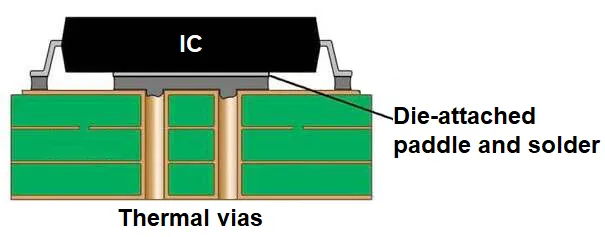
Thermal vias are one of the most effective techniques for transferring heat from surface-mounted components to inner layers or bottom copper planes:
Design Considerations:
- Use large via arrays directly beneath high-power components.
- Use multiple small vias (0.2–0.3 mm diameter) to maximize density.
- Prefer via filling or via-in-pad structures for better heat transfer and planarity.
- Connect vias to large ground or power planes to act as heat sinks.
Via Plating: Ensure sufficient copper plating thickness in vias (20–25 μm or more) to improve vertical thermal conduction.
Component Placement and Layout Optimization
Thermal management begins at the component placement stage:
Separate heat sources: Distribute heat-generating components across the board to avoid localized hotspots.
Sensitive component isolation: Keep temperature-sensitive components away from high-heat areas.
Proximity to board edges: Place major heat sources near PCB edges to allow heat escape via convection or external heat sinks.
Airflow alignment: Align heat sources along airflow paths in forced-air systems.
Heatsinks, Heat Spreaders, and Mechanical Aids
For high-power applications, PCB-level thermal design alone may not be sufficient. Mechanical solutions can be integrated to further dissipate heat:
External heatsinks: Mounted directly on IC packages or the PCB.
Heat spreaders: Copper or aluminum plates mounted to the PCB surface.
Thermal interface materials (TIMs): Improve thermal coupling between components and heatsinks.
Standoffs and conductive enclosures: Use metal chassis or casings as part of the heat dissipation system.
Conformal Coating and Surface Finishes
Some surface finishes may influence thermal performance:
ENIG (Electroless Nickel Immersion Gold) adds a thin nickel layer that can affect heat transfer slightly.
OSP (Organic Solderability Preservatives) offers minimal thermal resistance but is limited in high-reliability environments.
In high-heat designs, minimize coating layers where direct heat transfer is critical.
System-Level Thermal Management
PCB thermal design must be considered as part of the entire system:
Enclosure design: Ensure adequate airflow, ventilation slots, or active cooling systems.
Environmental controls: Limit exposure to high ambient temperatures.
Redundancy and derating: Design circuits to operate below maximum capacity to reduce internal heat generation.
Simulation and Thermal Analysis
Modern PCB design tools offer integrated thermal simulation features that allow designers to predict thermal performance during the design phase:
Use 3D thermal simulation to identify hotspots and validate cooling strategies.
Perform worst-case scenario analysis for high-load conditions.
Iterate designs early to avoid costly rework after prototyping.
Manufacturing and Process Considerations
Fabrication tolerances: Work closely with PCB fabricators to ensure via filling, copper plating, and stacking meet thermal requirements.
Cost trade-offs: Balance material costs with long-term reliability improvements.
Process control: Ensure consistency in copper thickness, via metallization, and lamination quality.