ALLPCB


TDR for Signal Integrity Analysis: Mastering Time Domain Reflectometry
Time domain reflectometry serves as a fundamental technique for evaluating transmission line behavior in high-speed printed circuit boards. Engineers rely on TDR testing to identify impedance variations that can degrade signal quality. This method sends a fast-rising edge pulse along a trace or cable and observes the reflected waveform to locate discontinuities. In modern designs operating above several gigahertz, even small impedance mismatches create reflections that increase bit error rates. Proper application of TDR analysis helps maintain signal integrity throughout the interconnect path.
What Is Time Domain Reflectometry and Why It Matters
Time domain reflectometry measures the impedance profile of a transmission line by analyzing the amplitude and timing of reflected signals. A step or impulse stimulus travels down the line, and any change in characteristic impedance produces a reflection whose magnitude depends on the reflection coefficient. The round-trip delay directly indicates the physical location of the anomaly. For electric engineers working on multilayer boards, this capability proves essential when validating controlled-impedance traces required by high-speed protocols. Without accurate TDR impedance measurement, designs risk intermittent failures that surface only after assembly or in the field.
Signal integrity issues such as ringing, overshoot, and crosstalk often trace back to impedance discontinuities. TDR testing provides both qualitative waveform inspection and quantitative impedance values along the entire path. This dual insight supports root-cause analysis during prototype validation and production sampling. Industry standards such as IPC-6012E emphasize the need for consistent electrical performance in rigid printed boards, making TDR a practical verification tool. As data rates continue to rise, the technique remains relevant for both single-ended and differential pair structures.
Technical Principles of TDR Analysis
The core equation relating reflection coefficient to impedance is straightforward: the reflected voltage divided by the incident voltage equals (Z_load minus Z0) divided by (Z_load plus Z0), where Z0 is the characteristic impedance of the test system. Engineers calibrate the TDR instrument to a known reference impedance, typically 50 ohms for single-ended lines or 100 ohms for differential pairs. The displayed waveform shows a flat trace at the reference level until a discontinuity appears, after which the trace rises or falls according to the local impedance change. Rise time of the stimulus determines spatial resolution; faster edges resolve smaller features but require careful fixturing to avoid introducing artifacts.
Multiple reflections can occur when several discontinuities exist along the line. The first reflection masks subsequent events unless the engineer accounts for the round-trip path and applies de-embedding techniques. Differential TDR extends the method to balanced pairs by driving both lines with opposite-polarity signals and measuring the differential reflection. This approach reveals common-mode to differential-mode conversion caused by asymmetries in trace geometry or dielectric variation. Accurate interpretation therefore requires understanding both the time axis, calibrated in distance using the propagation velocity, and the vertical scale calibrated in ohms.
TDR Testing and Impedance Measurement Procedures
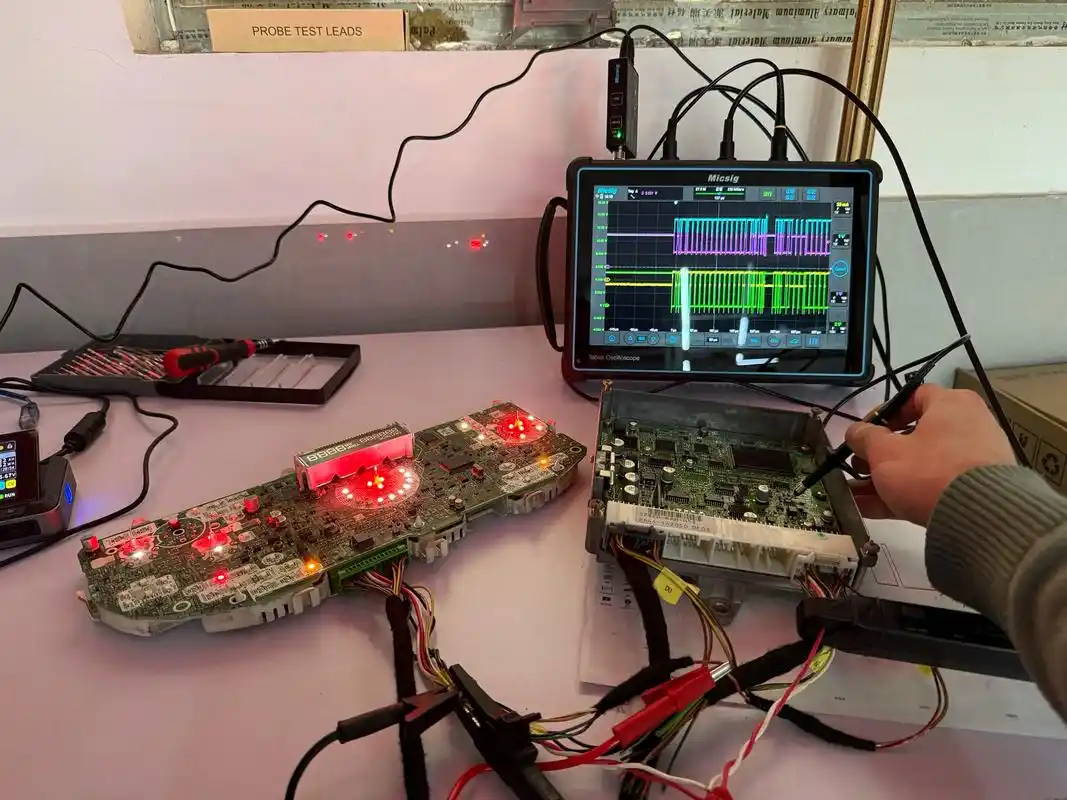
A typical TDR setup connects the instrument to a test coupon or the actual board via high-bandwidth probes or connectors. The engineer first verifies the reference plane and cable delay, then acquires a baseline waveform on a known good trace. Subsequent measurements compare the device under test against this reference. Impedance values are extracted at specific cursor positions, and the full waveform is examined for step changes, ramps, or ringing that indicate opens, shorts, or gradual impedance transitions. Test fixtures must maintain the same characteristic impedance as the line under test to prevent the fixture itself from becoming a dominant discontinuity.
Environmental factors such as temperature and humidity can shift dielectric constants and therefore measured impedance. Consistent laboratory conditions and proper board conditioning help reduce variability. When evaluating production boards, sampling plans often include both inner-layer and outer-layer coupons to capture the full range of manufacturing variation. Documentation of probe placement, calibration method, and pass-fail criteria ensures repeatability across different operators and equipment.
Practical Solutions and Best Practices for Signal Integrity Troubleshooting
Engineers begin troubleshooting by correlating TDR results with layout data and schematic expectations. A sudden impedance increase often points to a neck-down, via stub, or connector transition, while a decrease may indicate copper flooding or dielectric thinning. Once the physical location is identified from the time delay, cross-section or X-ray inspection can confirm the root cause. Corrective actions include trace width adjustments, via back-drilling, or connector redesign, followed by re-measurement to verify improvement.
Best practices include maintaining a library of reference waveforms for each controlled-impedance structure used in the design. This library accelerates comparison during failure analysis. When multiple boards exhibit similar signatures, statistical analysis of impedance distributions helps identify process drifts. Regular calibration of the TDR system according to manufacturer guidelines preserves measurement accuracy. In addition, combining TDR data with frequency-domain measurements such as S-parameters provides a more complete picture of signal integrity performance.
Another useful technique involves time-domain gating to isolate specific segments of the interconnect. By mathematically removing the contribution of upstream discontinuities, the engineer can examine downstream features more clearly. This method proves especially valuable when connector or cable effects would otherwise obscure board-level issues. Consistent application of these procedures supports reliable signal integrity troubleshooting across development and manufacturing phases.
Conclusion
Time domain reflectometry remains an indispensable tool for verifying impedance continuity and locating signal integrity problems in high-speed printed circuit boards. Systematic application of TDR testing, combined with careful interpretation of reflection waveforms, enables engineers to achieve the electrical performance demanded by modern digital systems. Adherence to established qualification practices such as those outlined in IPC-6012E further reinforces the reliability of the measurement process. When integrated into the overall design verification flow, TDR analysis contributes directly to reduced debug time and improved product robustness.
FAQs
Q1: How does time domain reflectometry support signal integrity analysis in PCB designs?
A1: Time domain reflectometry provides a direct impedance profile along transmission lines, allowing engineers to locate and quantify discontinuities that cause reflections and degrade signal quality. By measuring round-trip delay and reflection amplitude, designers identify specific physical features such as vias, connectors, or trace variations that affect high-speed performance. This information guides layout corrections and validates that controlled-impedance requirements are met in production boards.
Q2: What are the key steps in performing TDR impedance measurement?
A2: The process begins with instrument calibration to a known reference impedance, followed by connection to a test structure or board trace using appropriate fixturing. A fast-edge stimulus is launched, and the reflected waveform is captured and scaled in both time and impedance. Cursor measurements extract local impedance values, while the overall shape of the trace reveals opens, shorts, or gradual transitions. Results are compared against design targets and reference waveforms to confirm compliance.
Q3: When should TDR testing be applied during signal integrity troubleshooting?
A3: TDR testing is most effective after initial simulation indicates potential impedance mismatches or when prototype measurements show unexpected ringing or eye closure. It serves as a rapid diagnostic step before more time-consuming frequency-domain or full-system testing. Engineers typically apply it to both test coupons and assembled boards to distinguish between design, material, and manufacturing contributions to signal integrity issues.
Q4: How does TDR analysis complement other signal integrity verification methods?
A4: TDR analysis supplies time-domain impedance data that directly correlates with physical layout features, whereas frequency-domain techniques such as S-parameter measurements characterize overall insertion loss and return loss. The combination allows engineers to pinpoint the exact location of a discontinuity and then quantify its impact across the operating frequency range. This complementary approach improves both fault isolation speed and the accuracy of corrective actions.
References
IPC-6012E — Qualification and Performance Specification for Rigid Printed Boards. IPC, 2017
IPC-A-600K — Acceptability of Printed Boards. IPC, 2020
IPC-2141A — Design Guide for High-Speed Controlled Impedance Circuit Boards. IPC, 2022