ALLPCB


Overview
With global diabetes incidence continuing to rise, there is growing interest in noninvasive blood glucose measurement methods. Despite many efforts, a commercially viable noninvasive continuous glucose monitor has not yet been established.
According to MEMS Consulting, researchers at Penn State University have developed a wearable electrochemical sweat biosensor that proposes a low-cost, high-sensitivity platform for continuous glucose monitoring. The work was published in Advanced Functional Materials. The device integrates laser-induced graphene (LIG) nanocomposite electrodes with a microfluidic mesh for sweat collection.
Device concept and operation
The researchers developed a skin patch based on the wearable sensor that can monitor sweat glucose levels continuously for several weeks.
Electrochemical biosensors for detecting biomarkers in sweat face several challenges toward commercialization. Sweat salinity, pH, and temperature vary between individuals and can affect sensor readout. In addition, biomarker concentrations in sweat are typically lower than in blood or interstitial fluid.
Laser-induced graphene (LIG)
Penn State postdoctoral researcher Farnaz Lorestani and colleagues selected laser-induced graphene (LIG)—a 3D porous carbon-based nanomaterial produced by direct laser writing—as the electrode material for the biosensor. Since its discovery in 2014, LIG has emerged as a promising approach that can substantially reduce manufacturing costs compared with conventional wet-chemical processing techniques.
Lorestani noted that the sensitivity and stability of porous LIG are limited, which poses challenges for accurate detection of trace biomarkers in sweat and other biofluids. To address this, the team developed a flexible sensing platform combining high sensitivity, selectivity, cost-effectiveness, and durability for continuous, precise health monitoring.
Sensor architecture and performance
The sensor retained more than 91% of its initial sensitivity over 21 days under ambient conditions.
The device comprises three main components: a three-electrode electrochemical glucose and pH sensor based on LIG, an LIG-based temperature sensor, and a stretchable microfluidic mesh for sweat collection. The researchers used simple plasma and laser treatments to build a 3D network of conductive nanomaterials on the porous graphene electrodes.
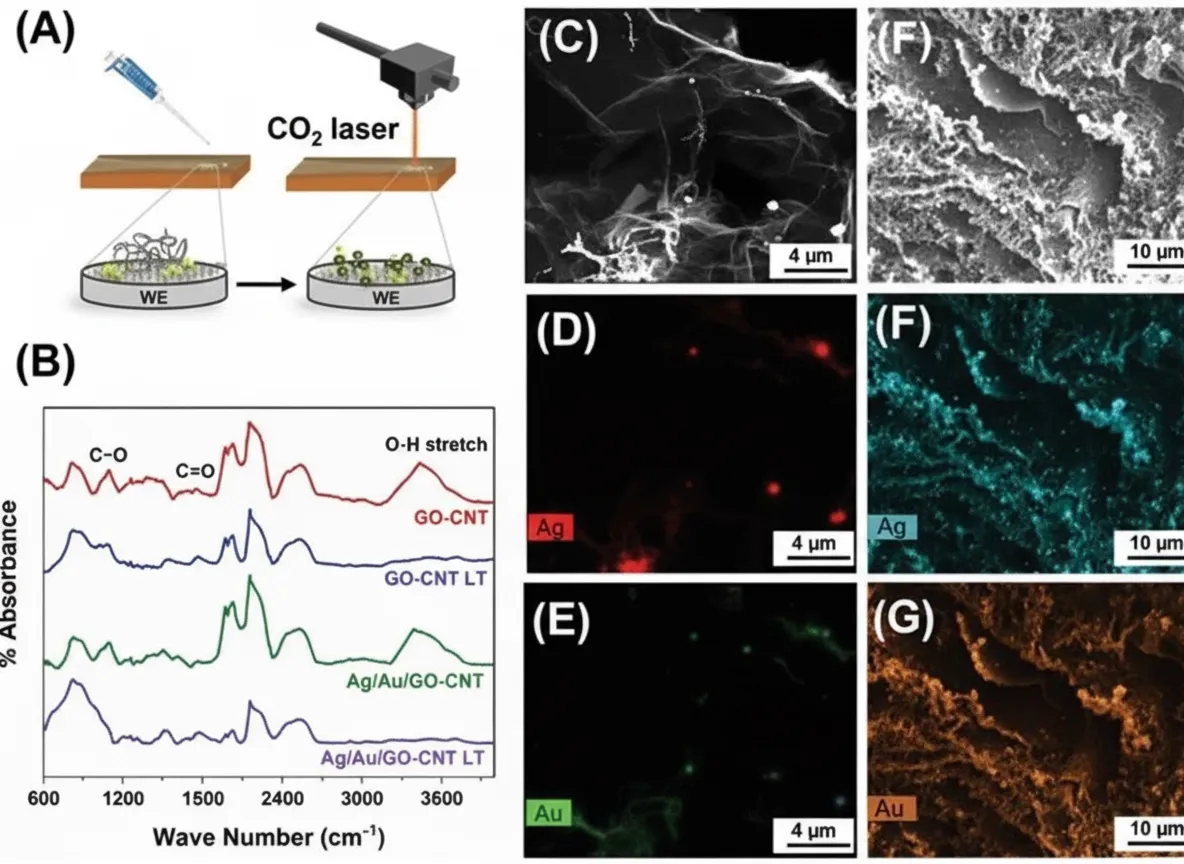
Lorestani explained that this forms a 3D conductive network that facilitates electron transfer for non-enzymatic detection of glucose and other biomarkers, improving sensitivity and stability. When combined with flexible porous graphene pH and temperature sensors, the wearable device can calibrate glucose readings according to temperature and pH, since both factors affect sensor performance.
After initial calibration using artificial sweat, the researchers validated the sensor in human measurements two hours after a meal by comparison with a commercial blood glucose meter. The results showed the sensor maintained over 91% sensitivity for 21 days under standard conditions.
Lorestani added that the flexible sensing platform based on high-sensitivity, stable nanomaterials could enable next-generation sensors for continuous, noninvasive monitoring of multiple biomarkers and physiological signals.