ALLPCB


Introduction
Stable power delivery forms the foundation of reliable electronic systems. Engineers working on complex boards recognize that even minor voltage fluctuations can lead to signal integrity problems, component failures, or complete system resets. Effective PCB power supply schematic design addresses these risks through careful component selection, layout planning, and noise mitigation strategies. When power rails remain clean and regulated, overall circuit performance improves across digital, analog, and mixed-signal sections. This article explores practical approaches that help maintain consistent voltage levels while minimizing interference in demanding applications.
Why Stable Power Supply Matters in PCB Design
A stable power supply PCB ensures that every integrated circuit receives the precise voltage and current it requires under varying load conditions. Power distribution PCB schematic decisions directly influence electromagnetic compatibility, thermal behavior, and long-term reliability of the finished assembly. In high-speed designs, inadequate power integrity can cause timing violations or data corruption that only appear during full system testing. Industry standards such as IPC-2221 provide guidelines for conductor sizing and spacing that support robust power networks. Designers who prioritize these elements reduce the likelihood of costly revisions after prototype fabrication. The result is a board that operates predictably across temperature ranges and production volumes.
Key Technical Principles in PCB Power Supply Schematic Design
Power distribution networks rely on low-impedance paths from the voltage regulator to each load point. Parasitic inductance and resistance in traces or planes create voltage drops that become noticeable at high switching frequencies. Proper use of decoupling capacitors placed close to power pins forms local energy reservoirs that supply transient currents without propagating noise back to the regulator. Buck converter schematic PCB implementations require attention to inductor selection, output capacitor placement, and feedback network layout to achieve the desired regulation accuracy. Ground planes serve as return paths and help contain electromagnetic fields generated by switching currents. When these elements work together, the overall impedance of the power network stays within acceptable limits across the operating bandwidth.
Filtering noise power supply PCB techniques further improve stability by attenuating high-frequency components that originate from switching regulators or digital logic. Ferrite beads and LC filters placed strategically on sensitive rails prevent noise coupling into analog sections. Thermal management considerations also play a role, because excessive temperature rise in power components can alter their electrical characteristics and reduce efficiency. Structured analysis of current loops and voltage ripple targets guides the placement of sense lines and remote feedback connections. These principles remain consistent whether the design uses linear regulators or more complex switched-mode topologies.
Best Practices for Achieving Stability in Power Distribution PCB Schematic
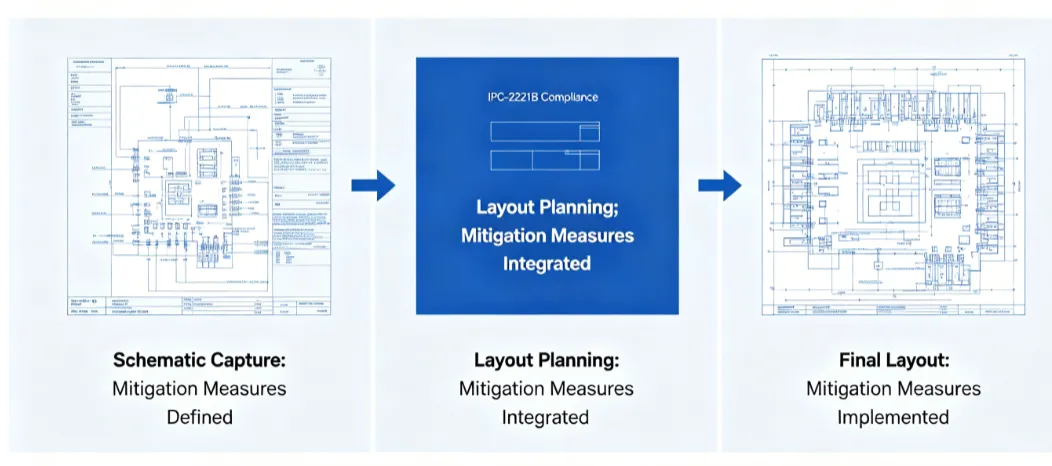
Begin schematic capture by defining clear power domains and assigning appropriate voltage tolerances to each rail. Group components with similar current demands on dedicated planes or wide traces to minimize cross-talk between sections. Place bulk capacitors near the output of each regulator and follow them with smaller ceramic capacitors distributed across the board. Route feedback traces for buck converters away from noisy switching nodes and keep them as short as possible. Review the layout for return current paths that could create unintended loops under the power traces.
Simulation of the power distribution network before layout completion reveals potential resonance points and allows early correction. Maintain adequate copper weight on power layers and use stitching vias to connect planes on different layers. Verify that the total voltage drop from regulator to farthest load stays below the allowable tolerance under maximum current draw. These steps create a foundation that supports both initial functionality and future design expansions without major schematic changes.
Troubleshooting Common Issues in Filtering Noise Power Supply PCB
When unexpected ripple appears on a regulated rail, first confirm that the regulator output capacitor meets both value and equivalent series resistance specifications. Measure the actual switching frequency of any buck converter and compare it against the cutoff frequency of downstream filters. Noise that persists after basic filtering often indicates poor ground plane continuity or insufficient via stitching between layers. In such cases, adding a small series resistor or ferrite bead on the affected rail can provide additional attenuation without introducing excessive voltage drop.
Systematic probing with an oscilloscope at multiple points along the power path helps isolate the dominant noise source. Temperature cycling of the prototype can expose mechanical stress on solder joints that affects power integrity over time. Following these diagnostic steps leads to targeted schematic adjustments rather than broad redesigns.

Conclusion
Effective PCB power supply schematic design combines careful component selection, strategic layout practices, and adherence to established engineering principles. By focusing on low-impedance distribution, proper decoupling, and targeted noise filtering, designers achieve the voltage stability required for reliable system operation. Consistent application of these techniques across projects reduces development time and improves overall product quality. The approaches outlined here provide a practical framework that scales from simple boards to complex multi-rail systems.
FAQs
Q1: How does PCB power supply schematic design affect overall board performance?
A1: Proper PCB power supply schematic design ensures that voltage remains within specified limits under all load conditions. This stability prevents timing errors in digital circuits and reduces noise in analog sections, leading to higher system reliability without requiring extensive post-layout modifications.
Q2: What techniques improve stable power supply PCB performance in high-speed applications?
A2: Stable power supply PCB performance benefits from wide power planes, distributed decoupling capacitors, and careful buck converter schematic PCB layout that minimizes loop inductance. These measures keep voltage ripple low and maintain signal integrity even when multiple high-current devices switch simultaneously.
Q3: Why is filtering noise power supply PCB important for mixed-signal designs?
A3: Filtering noise power supply PCB removes high-frequency interference that can couple into sensitive analog circuits. Effective filtering preserves measurement accuracy and prevents false triggering in control loops while complying with electromagnetic compatibility requirements.
Q4: What role does power distribution PCB schematic play in thermal management?
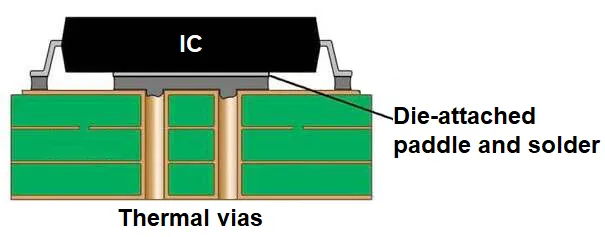
A4: Power distribution PCB schematic decisions influence current density and therefore heat generation within traces and planes. Adequate copper area and proper via placement help dissipate heat, keeping component temperatures within safe operating ranges defined by component datasheets.
References
IPC-2221 — Generic Standard on Printed Board Design. IPC, 2023
IPC-6012E — Qualification and Performance Specification for Rigid Printed Boards. IPC, 2017