ALLPCB


Capacitive Touchscreen Structure
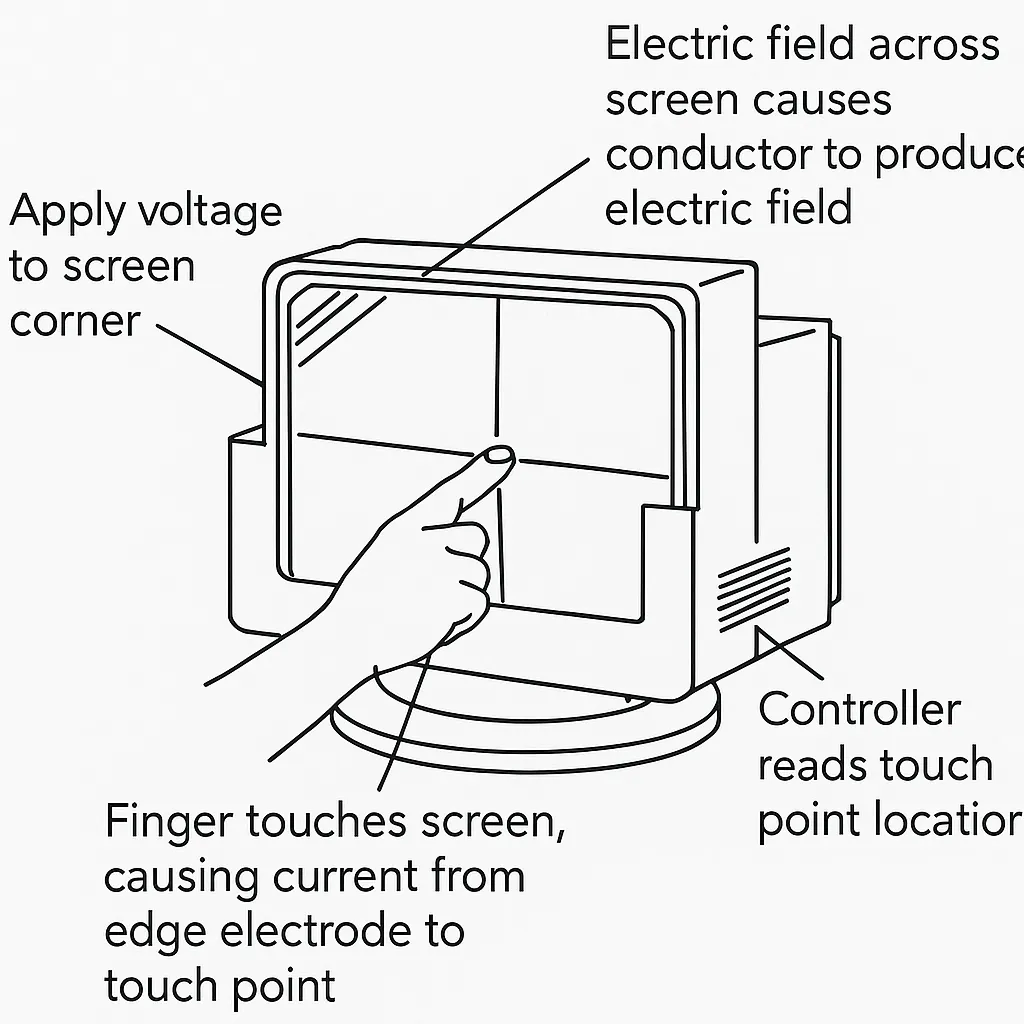
The basic structure of a capacitive touchscreen consists of a single-layer acrylic substrate with a transparent conductive film applied to both the inner and outer surfaces. Narrow electrodes are attached at the four corners of the outer conductive film. When a finger touches the screen, a high-frequency signal is applied to the working surface and the finger forms a coupling capacitance with the surface. This coupling behaves like a conductor at high frequency, so the finger draws a small current from the touch point. That current flows out through the four corner electrodes, and the currents from each electrode are proportional to the straight-line distances from the touch point to the corners. The controller calculates the ratios of these four currents to determine the coordinates of the contact point.
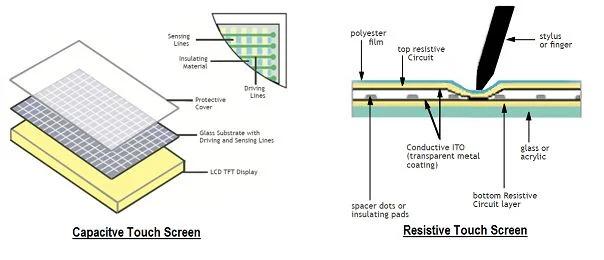
The touchscreen can be viewed as a four-layer composite: an outer protective glass layer, a conductive layer, a nonconductive glass layer, and an inner conductive layer. The inner conductive layer acts as a shield to isolate internal electrical signals. The intermediate conductive layer is the key sensing element, with direct leads at the four corners or along the four edges to detect touch position.
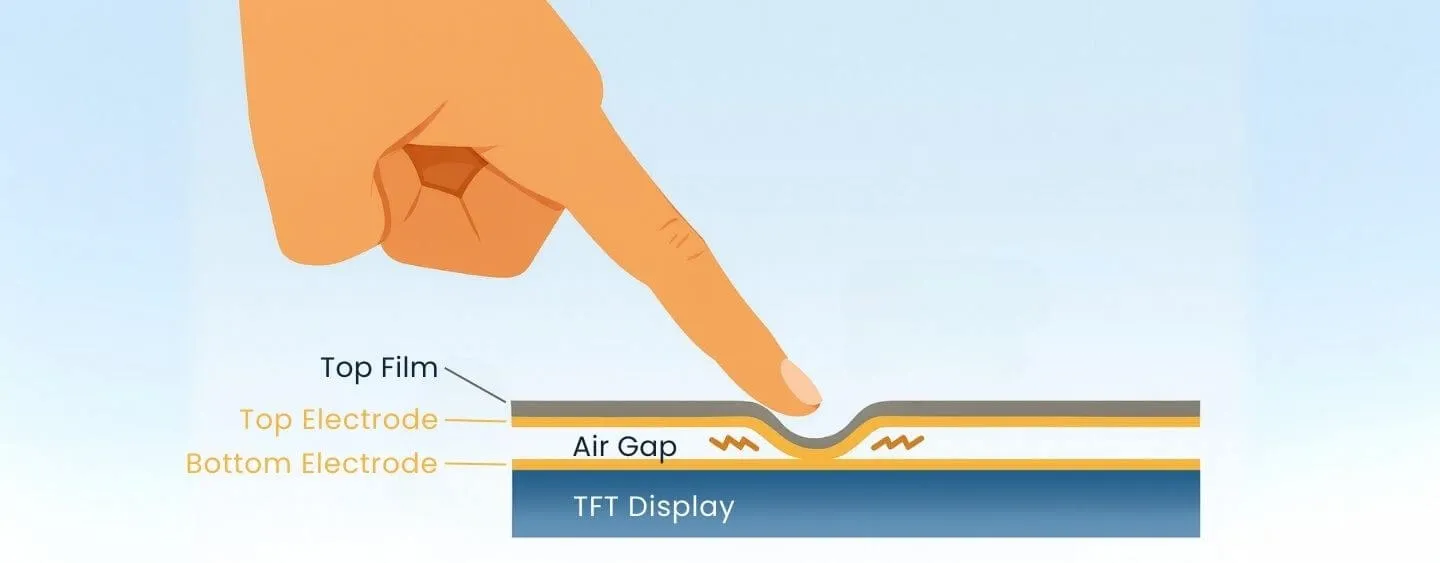
The outer cover is typically tempered glass or polyethylene terephthalate (PET). PET allows thinner screens and is generally less expensive than glass or other plastics. The insulating stack may include glass (0.4-1 mm), organic film (10-100 μm), adhesive layers, and air gaps. A critical layer is the indium tin oxide (ITO) film, typically 50-100 nm thick, with a sheet resistance around 100-300 ohms per square. The ITO microstructure significantly affects two key capacitances: the sensing capacitance (finger to upper ITO) and parasitic capacitances (between upper and lower ITO and between the lower ITO and the display).
Construction usually involves applying a transparent conductive film to the glass substrate and adding a protective glass layer over the conductor. A dual-glass design protects the conductive layer and sensors, improves optical transmittance, and better supports multi-touch capability.
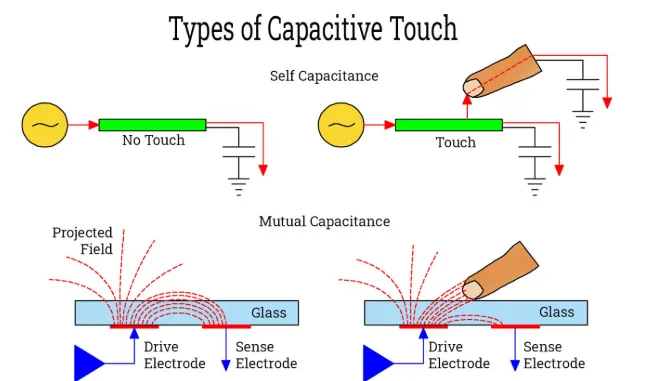
Electrodes deposited along the four edges create a low-voltage AC electric field in the conductive layer. When a finger approaches the surface, the body\'s electric field forms a coupling capacitance with the conductor. The AC current from each edge flows toward the touch point, and its magnitude varies inversely with distance to the electrodes. The controller computes the relative magnitudes of these currents to determine the touch location. The dual-glass structure helps protect the conductors and sensors from environmental factors, so the touchscreen can still determine touch position accurately even if the surface has dirt, dust, or oil.
Because capacitance changes with contact area and dielectric properties, stability can be limited and drift may occur. This type of touchscreen is commonly used during system development and debugging.
Capacitive Touchscreen Principle
Capacitive touchscreen technology operates by sensing the human body\'s effect on an electric field. A capacitive touchscreen is a four-layer composite glass assembly with ITO coatings on the inner surfaces and interlayer. The outermost layer is a thin protective glass. The interlayer ITO serves as the active sensing surface with four electrodes taken from the corners, while the inner ITO layer functions as a shield to ensure a stable operating environment. When a finger contacts the metalized surface, the body and the screen form a coupling capacitance. For high-frequency signals the capacitance behaves as a conductor, so the finger draws a very small current. That current flows out through the four corner electrodes, and the currents are proportional to the distances from the finger to the corners. By precisely calculating the proportions of these four currents, the controller determines the touch coordinates.