ALLPCB


Principle of Operation
A microwave motion sensor switch is a detector for moving objects based on the Doppler effect. It detects movement without contact and triggers corresponding switching actions. The device has strong RF interference immunity and is not affected by temperature, humidity, light, airflow, or dust. It can be installed inside non-metal enclosures of certain thicknesses such as plastic, glass, or wood without affecting detection performance, making it suitable for equipment control, auxiliary lighting control, underground parking, corridor lighting, and similar applications.
When a person enters the detection zone and lighting is required, the sensor switch automatically turns on and the connected load begins operating while a delay timer starts. As long as movement remains within the detection zone, the load continues to operate. When movement leaves the detection zone, the sensor begins the delay countdown; after the delay expires, the sensor switch turns off and the load stops. This provides safe, convenient, and energy-saving operation.
Microwave sensor switches use the Doppler effect and typically employ a planar antenna transmit/receive circuit. They monitor the surrounding electromagnetic environment and automatically adjust operating conditions. Built-in integrated filtering effectively suppresses higher harmonics and other spurious signals, providing high sensitivity and reliable performance. These switches can detect through some non-metallic materials, which makes them suitable for concealed installation inside luminaires. With low power consumption and wide applicability, they can be combined with various standard lamps to create microwave-activated luminaires.
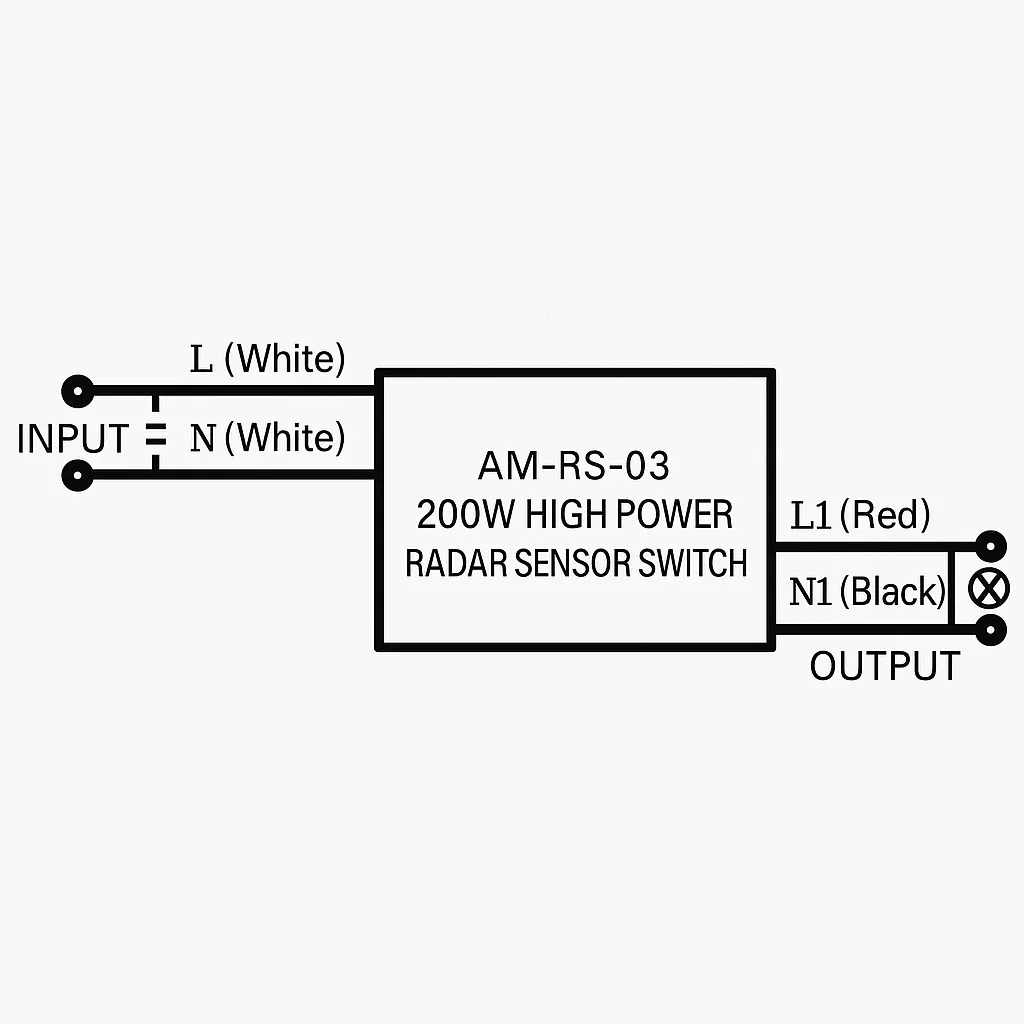
Wiring
The wiring diagram is shown below:
Functions
- High sensitivity: Accurately distinguishes movement of biological and non-biological objects, minimizing false triggers.
- Strong anti-interference: Little affected by external natural factors, providing stable and reliable performance.
- Safe and practical: Uses zero-cross switching with no mechanical contacts, avoiding sparks and electromagnetic interference. Low self-consumption and long service life help extend the life of the connected load.
- Automatic light detection: Automatically senses ambient light level so lighting activates only when illumination is below the set threshold and presence is detected.
- Fully automatic detection: Lights turn on when presence is detected and turn off after absence, conserving energy and resisting interference from external noise or objects.
- Automatic timing delay: The switch remains on while motion is within the detection area and turns off automatically after the area is vacated.
- Operates correctly at low light levels or low power without flicker.