ALLPCB


Overview
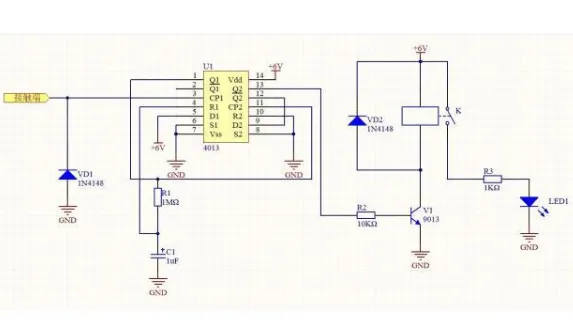
This is a touch switch circuit built with a 4013 dual D flip-flop. A single touch turns the switch on; touching it again turns it off. Because CMOS inputs use MOSFET structures, which are voltage-controlled devices with very high input impedance (on the order of tens of megaohms), the inputs draw almost no current. The small induced voltage from a human touch is sufficient to toggle the circuit. The circuit diagram is shown below.
Circuit composition
In the circuit, U1 together with R1 and C1 forms a monostable stage used for timing and to suppress interference and contact bounce during touch. The diode VD1 connected to input pin 3 provides input protection, discharging accumulated charge and protecting against excessive reverse voltage. U1 is configured as a bistable flip-flop to control relay K for on/off switching.
Working principle
When pin 3 of the 4013 is touched, the human-induced signal is applied to U1's CP1 input. U1 toggles so that Q1 goes high. This high level is fed to U1's CP2 input, causing U1 to toggle again and making Q2 (pin 13) go high. Through R2 this drives the base of V1, energizing relay K; LED1 lights to indicate the switch is on. Another path charges capacitor C1 through resistor R1. Because the capacitor voltage cannot change instantaneously, the high at Q1 is applied to pin 4 via R1, which resets U1 so Q1 returns low and U1's CP2 (pin 11) goes low. After C1 charges for a short time, the voltage at pin 4 returns low and U1 returns to its stable state, waiting for the next trigger.
Since U1 is bistable, when it is triggered again CP2 (pin 11) will receive a high signal, U1 toggles, Q2 (pin 13) goes low, relay K releases, and LED1 goes off, completing an on/off cycle.
Practical notes
The touch terminal can be realized by exposing the bare conductor of a stripped wire. Because CMOS integrated circuit inputs have high input impedance, only a small induced charge is required to trigger, so the touch circuit generally operates reliably.