ALLPCB


What are the innovative applications of 1D ToF? How does it improve the reliability and stability of 3D recognition systems while reducing system power? With core sensor expertise, ams can influence smartphone system design in several technical areas.
In a recent 1D ToF seminar, ams senior technical support manager Bai Yangong addressed these topics along with the 1D ToF working principle and application considerations. The session attracted hundreds of professional viewers and generated over 200 technical questions. Key excerpts follow.
Advantages and Core Points of dToF Technology
1D ToF technology has been widely applied to distance sensing, including robotic vacuum cleaners, proximity sensing for systems such as laptop screen lock/unlock, and safety distance measurement in automated factories where humans and robots collaborate closely. It is also used for trigger sensing in drones for ceiling/floor proximity detection and for activating doors in retail environments. In short, any scenario requiring accurate distance measurement can use 1D ToF.
Technically, 1D ToF has two approaches. Direct time-of-flight (dToF) measures photon flight time by emitting and receiving light to determine distance directly. Indirect time-of-flight (iToF), a mature market approach, measures the phase difference between transmitted and received waveforms to infer flight time. Compared with iToF, dToF offers true-distance measurement, fast response, low power consumption, and precise simultaneous detection of multiple objects.
Leading dToF sensors, such as ams' 1D TMF8xxx series, use ams' single-photon avalanche diode (SPAD) pixel design and narrow-pulse time-to-digital converters (TDC) to measure direct photon flight time in real time, enabling fast and accurate distance determination.
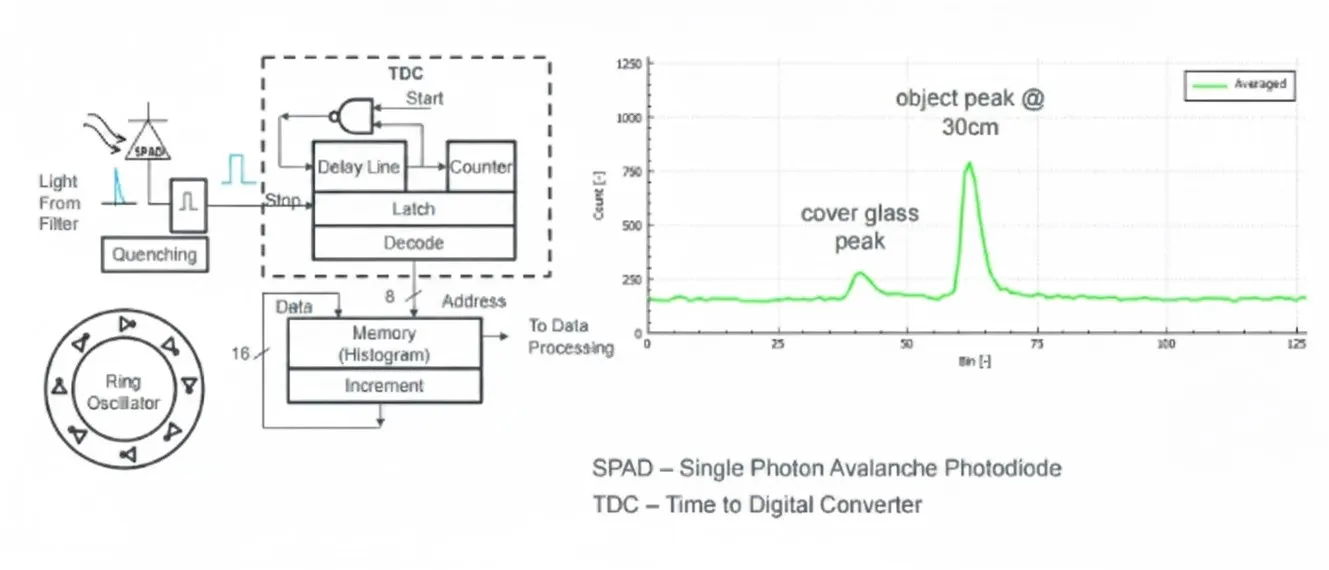
ams 1D ToF Main Products
This section summarizes two ams dToF products: the production-ready TMF8701 and the upcoming TMF8801.
TMF8701 supports two operating ranges: 0–10 cm for proximity detection to wake displays or disable face recognition, and 10–60 cm for accurate distance measurement to trigger higher-power face recognition systems. TMF8801 extends the operating distance up to 2.5 m.
Notably, TMF8701 can run at very low power. In proximity mode sampled at 10 Hz, the proximity module consumes only 940 μA, making it suitable for always-on operation as a wake sensor for smartphone face recognition.
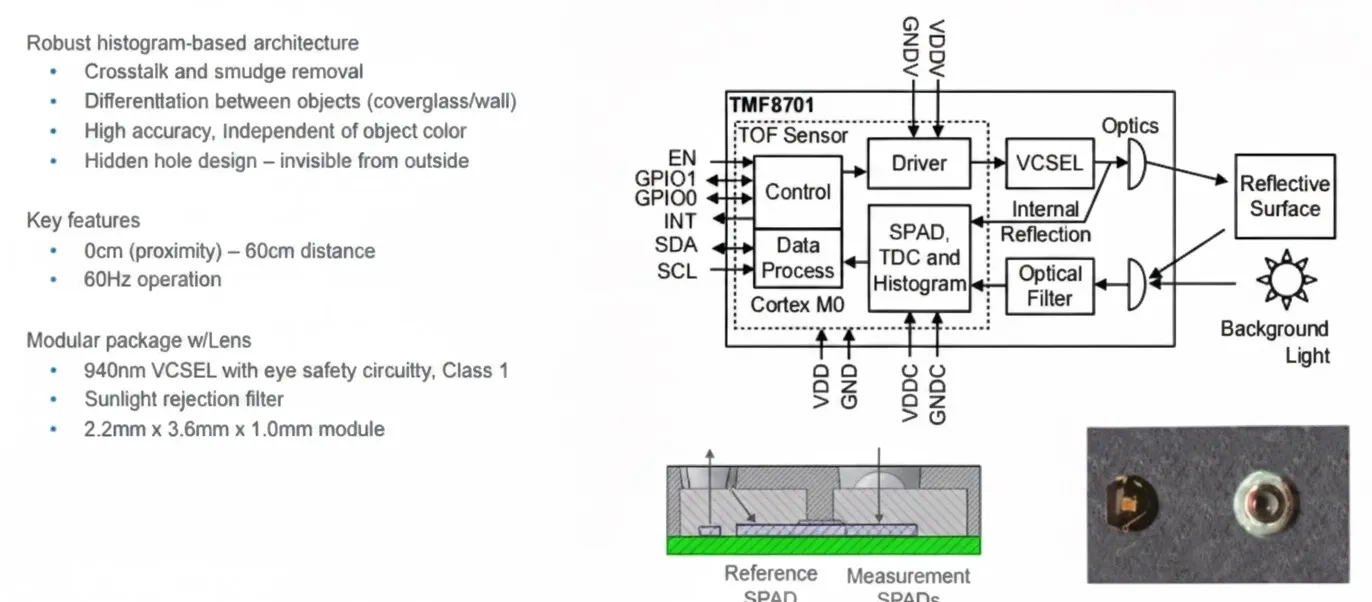
The TMF8xxx series offers five key technical advantages:
- Multipath interference suppression: precise SPAD timing control and a histogram mechanism minimize multipath effects.
- Robust suppression of contamination such as smudging.
- Eye-safety detection: certified for IEC eye safety Class 1.
- High ambient light immunity: integrated optical filters reduce interference from strong light, including sunlight infrared components.
- Small chip size: up to 33% area savings compared with mature market products.
Suppressing optical interference is a challenging photonic design task. ams provides the following TMF8x01 optical design recommendations:
- Air gap (sensor lower surface to cover glass lower surface): 0.3–0.6 mm.
- Cover glass thickness: 0.55 mm.
- Transmit and receive cover-glass aperture diameters: 1.5 mm and 1.1 mm, respectively.
- Baffle wall design.
- Cover-glass ink: infrared ink with 85% transmittance recommended.
- Assembly tolerance: ±0.20 mm.
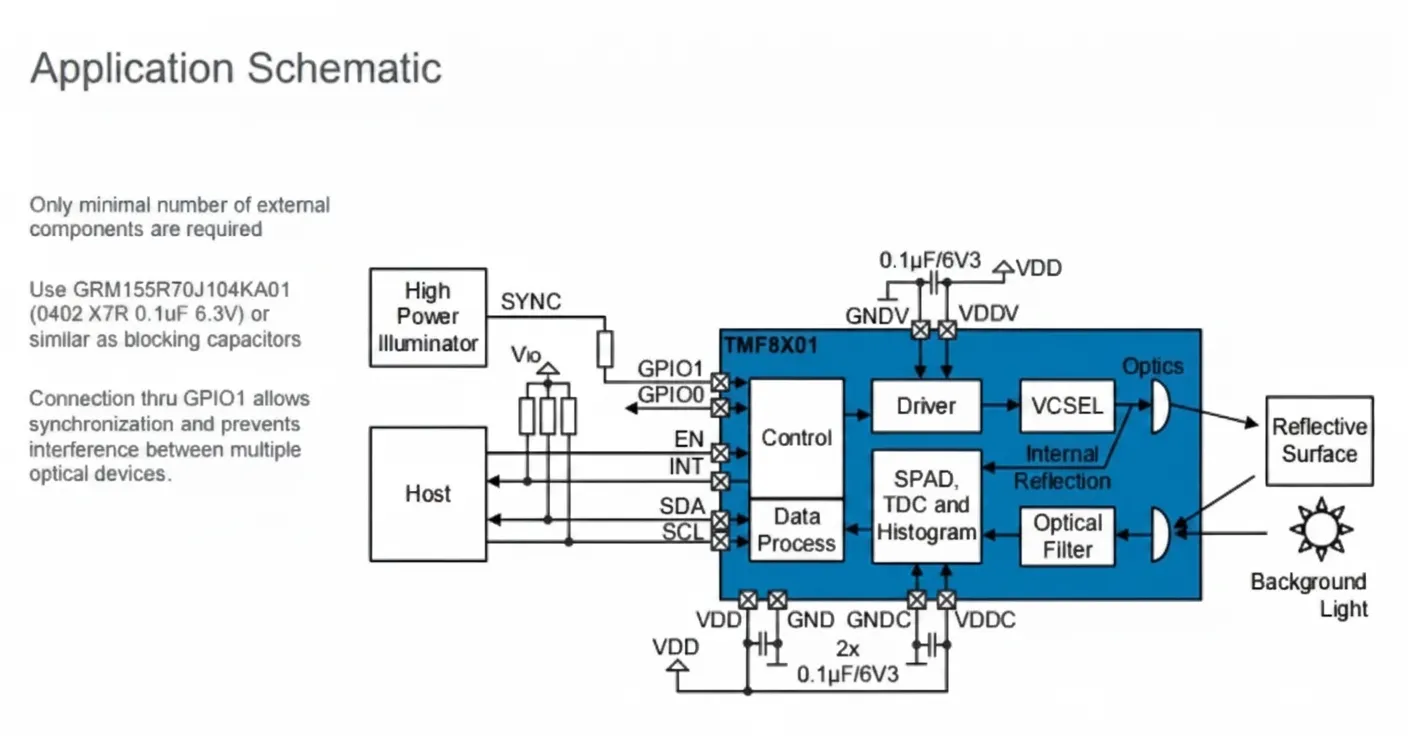
1D ToF Application Case Studies
Beyond common uses, 1D ToF can be integrated into front-facing 3D facial recognition systems. One example is an Attention Aware feature implemented with 1D ToF and other sensors.
Attention Aware tracks user attention time across applications to help optimize time allocation and provide data for application metrics. The operational flow is as follows:
- The phone is unlocked.
- A low-power 1D ToF remains always on for presence detection and face distance measurement.
- If a face is within range, higher-power illuminators and an infrared camera are awakened to perform 2D face and eye monitoring.
- If the monitoring detects no face, gaze diverted away, or prolonged eye closure, the system can determine that user attention is not on the phone and turn off the display after a defined timeout, for example 20 seconds.
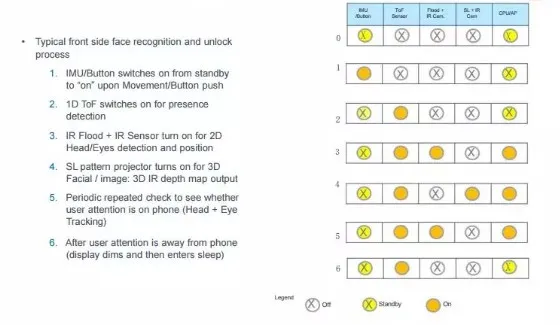
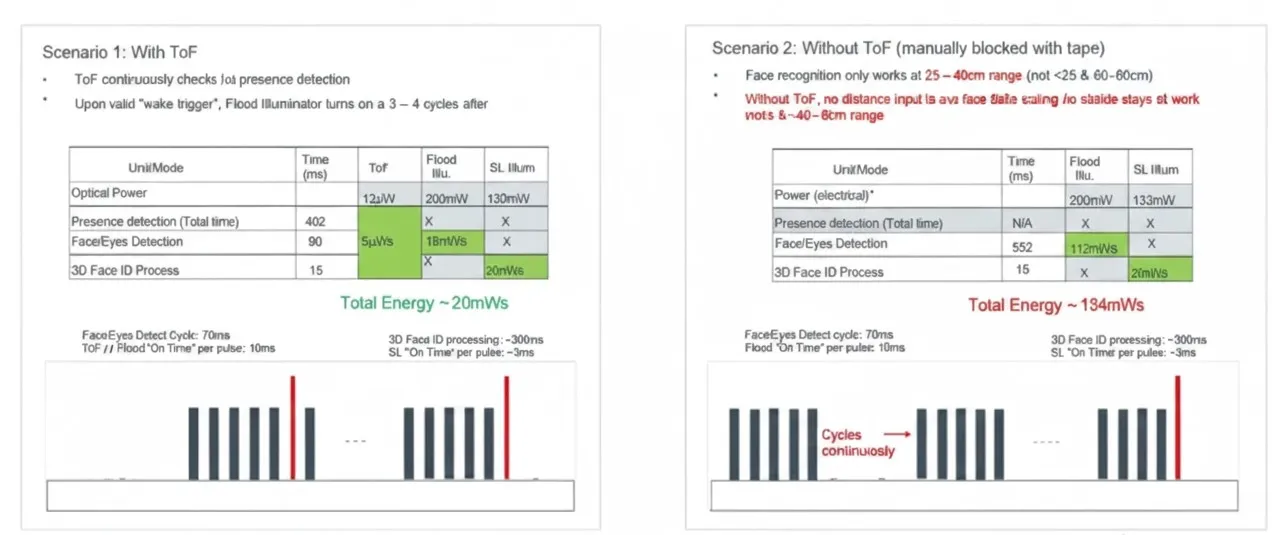
The workflow for 3D face recognition combined with Attention Aware is extended as follows. When the always-on 1D ToF detects presence, it wakes the illuminator and infrared camera for head, eye, and distance checks. Only then is the higher-power 3D imager activated to capture facial depth data for matching and unlock.
During depth and feature verification, 1D ToF still provides distance information so the 3D data can be normalized for any distance-related scaling differences. This normalization improves matching accuracy when the face-to-screen distance during authentication differs from the enrollment distance.
Measured data indicate that integrating 1D ToF into a 3D recognition system can reduce energy consumption per unlock by over 70%. Systems without 1D ToF also exhibit a narrower effective working range, shrinking from a typical 20–60 cm to about 25–40 cm, which degrades user experience.
The seminar covered 1D ToF technical principles, product details, and application scenarios. For the complete presentation, see the video link below.