ALLPCB


What are terahertz waves?
In the Beyond 5G/6G era, what are the terahertz waves expected to enable?
Terahertz waves lie between microwave and visible light in the electromagnetic spectrum. Their frequency range is typically 100 GHz to 10 THz, with wavelengths roughly from 3 mm to 30 μm, representing the overlap region between radio waves and light.
Terahertz waves are electromagnetic waves close to light in behavior, with properties including penetration through and absorption by materials. Those properties can be used to measure absorption characteristics and apply terahertz waves to sensing and imaging across various fields, from material analysis to planetary exploration with unmanned probes. Another important feature of terahertz waves is their photon energy, which is lower than that of visible light, so they do not carry the radiation risks associated with X rays and typically do not require specialized radiation management. Because they do not adversely affect the human body, they can be used for security screening in public spaces such as airport entrances to detect weapons or suspicious items.
*Electromagnetic wave: a form of energy that, like motion and heat, propagates through variations in electric and magnetic fields.
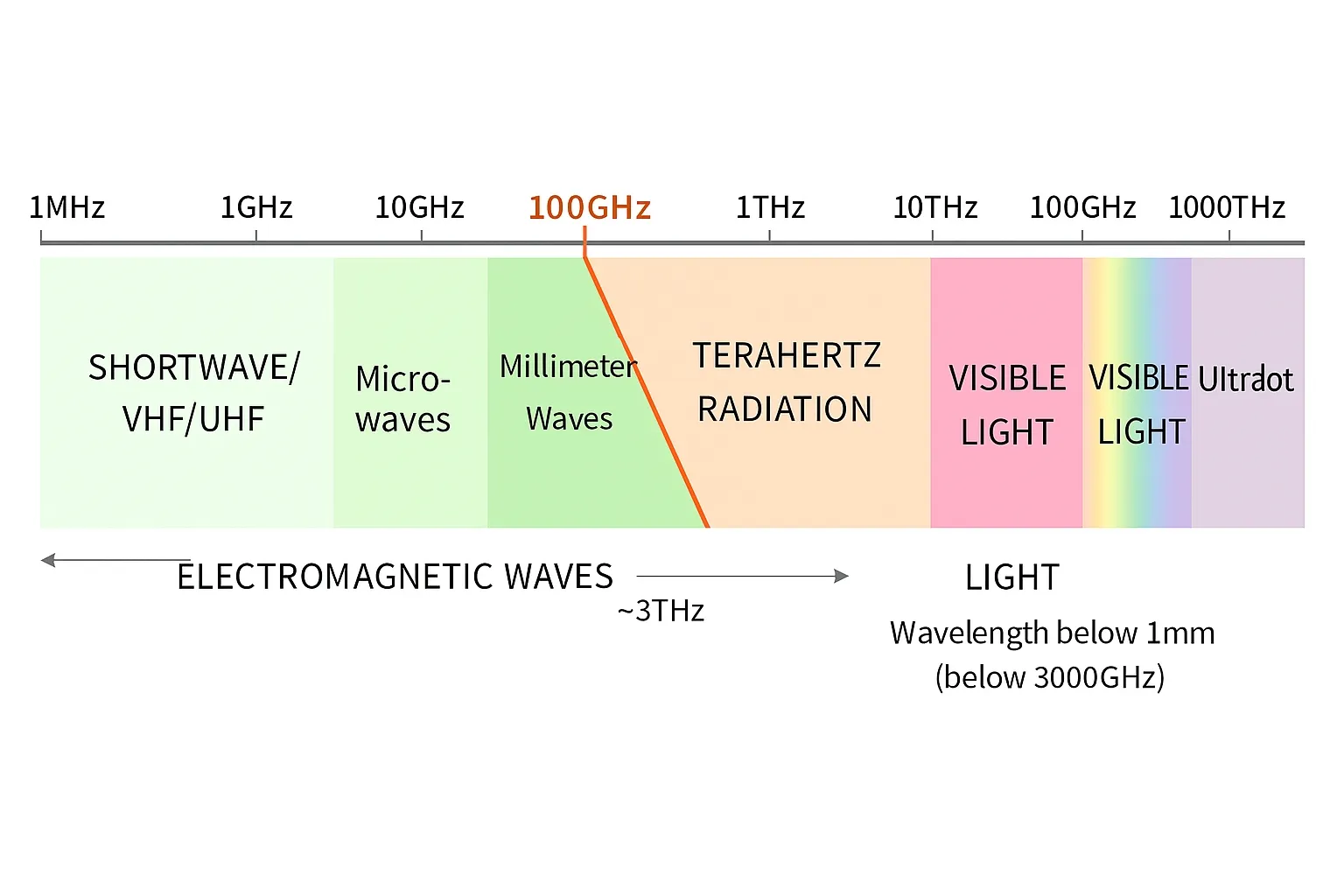
Figure 1. Terahertz region within the electromagnetic spectrum
Regulatory and spectrum considerations for B5G/6G
Regarding terahertz bands for B5G/6G, the Federal Communications Commission (FCC) in the United States has opened spectrum from 95 GHz to 3 THz for research and experimentation. It is expected that terahertz bands will be considered for special uses such as space development, similar to millimeter-wave allocations like 94 GHz.
In Japan, research and discussion on B5G specific experimental stations has focused on bands from 90 GHz to 300 GHz, often referred to as sub-terahertz (sub-THz). The 90 GHz to 300 GHz sub-THz range can provide more than ten times the bandwidth available in 5G millimeter-wave bands. The 100 GHz to 1 THz terahertz band is anticipated as a general-purpose band for B5G/6G during the 2030s, and practical deployment is expected. As devices are developed across the global supply chain, compatibility of equipment specifications and standards will depend on international standardization for the new bands.
In 5G, Sub-6 (3.7 GHz/4.5 GHz) is used for wide-area coverage with higher throughput than 4G, while millimeter wave (28 GHz/39 GHz) provides much higher speeds over shorter ranges. For B5G/6G, it is expected that multiple bands will be used for different purposes to achieve efficient spectrum utilization.
Terahertz sensing potential in wireless networks
As noted above, terahertz waves are being studied for devices that detect and analyze materials. Current research is also exploring remote sensing techniques that treat the communication network itself as a sensor, using terahertz-band communication infrastructure to detect objects and people.
Infrared and LiDAR are existing remote sensing technologies that use light and radio-wave reflection and are already applied in vehicles and other systems. Terahertz waves, as radio waves nearer to light, are expected to offer both wider sensing capabilities and high-speed, high-capacity data transmission. For example, using the penetration and absorption characteristics of terahertz waves, a network of multiple base stations could function similarly to imaging sensors, enabling through-material sensing or spatially resolved imaging.
If a terahertz wireless network composed of ground base stations is used for remote sensing, it would be possible to rapidly acquire detailed information about weather, traffic volume, road obstacles, and human movement. Large volumes of sensing data collected by remote sensing terminals could be processed by AI to provide finer predictions of congestion and crowding and to enable route selection for avoidance. Remote sensing can also detect unauthorized intrusions, serving as a security sensor and supporting multiple applications.
Terahertz waves are strongly absorbed by water, which poses challenges, but that same property can be used to detect trace moisture on celestial bodies. At ground level, changes in propagation loss caused by moisture allow sensing of rainfall, enabling lower-latency and high-precision local precipitation measurements. In summary, leveraging terahertz networks for both communication and sensing could be a key step toward more intelligent, instrumented societies.
Challenges and required technologies for terahertz wireless networks
Practical deployment of terahertz wireless networks still faces many technical challenges. Terahertz waves are more line-of-sight than millimeter waves and are more affected by water (rain and atmospheric humidity) and obstacles (buildings, trees, humans). These effects cause significant propagation loss, absorption, blockage, penetration loss, and diffuse scattering. While those same characteristics enable sensing of rainfall and the presence of objects or people, they present major challenges for propagating signals over distance in wireless networks.
In addition, B5G/6G transceivers require system and software technologies such as communication control, algorithms, device management, and AI capable of extracting useful information from sensing data or optimizing control. Hardware components for base stations and terminals include antennas, filters, amplifiers, mixers, and local oscillators that support high frequencies and wide bandwidths. Developing these components requires addressing propagation-related issues in sub-THz and terahertz bands while achieving miniaturization, low power consumption, thermal management, and stability.
Near-term research and technological advances for B5G/6G are expected to bring new user experiences across industries in the 2030s, and they are being explored as potential solutions for societal challenges such as demographic change, environmental shifts, and natural disasters.