ALLPCB


Introduction
A year has passed since we began studying satellite standards (FCC part 25). During that time the satellite communications field has seen several high-profile developments. Besides items previously discussed in FCC satellite frequency allocation Part 25.202, such as the iPhone 14 with Globalstar support and the Mate 50 with BeiDou, more recent examples include the Mate 60 Pro and Tiantong. These developments are notable for two reasons. First, they are not the traditional, bulky dedicated satellite terminals; they are consumer cellular smartphones that support satellite communications. Second, while some of these examples simply bring traditional satellite-phone functions to smartphones, recent laboratory demonstrations of 5G NR NTN base stations capable of Mbps peak rates point to a different development path for satellite communications.
To follow this emerging area, this article summarizes the 3GPP NTN (Non-terrestrial Networks) RF standards.
1. 3GPP NTN Overview
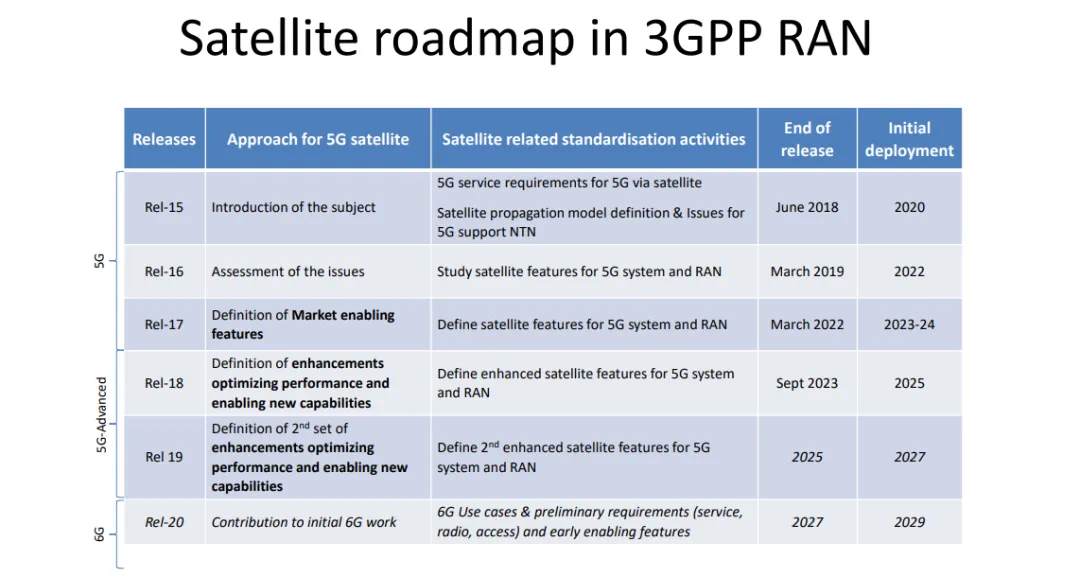
Communication systems are increasingly converging, for example cellular access, satellite integration, and sensing. NTN aims to integrate cellular and satellite systems, supporting the goal of global 5G access and potentially driving significant growth in the satellite sector. 3GPP work on NTN began in Release 15 (2017) and has progressed toward incorporating satellite technologies into 3GPP specifications.
Definition:
Non-terrestrial networks (NTN): networks, or segments of networks, that use an airborne or space-borne vehicle to host transmission equipment, a relay node, or a base station.
Release 17 was completed in 2022 and includes two main tracks: satellite access based on 4G LTE NB-IoT and eMTC (IoT NTN), and satellite access based on 5G NR (NR NTN). IoT NTN targets large-scale IoT use cases in sectors such as agriculture, transportation, and logistics. It focuses on FDD systems with a transparent payload architecture and assumes UEs have GNSS capability so that they can estimate and pre-compensate for time and frequency offsets for uplink transmissions. The specifications cover physical and access layers, RAN and system architecture, radio resource management, and RF requirements for satellite networks operating in low, medium, or geostationary orbits. NR NTN can use wider bandwidths and narrower beams to provide higher target service rates, with target devices such as handheld or smart devices.
From Release 18 onward, RF technical requirements and test methods for satellite communication equipment related to IoT NTN were separated into distinct standards and further enhancements for NR-NTN and IoT-NTN were defined. This includes support for NR-based satellite access above 10 GHz to serve fixed and mobile platforms (for example aircraft, ships, and unmanned aerial systems) as well as building-mounted equipment. The objectives are to further optimize satellite access performance, meet specific regulatory requirements for new bands, and support new features and services as 5G evolves.
This work is expected to continue into Release 20 and the 6G era.
2. NTN RF Standards for IoT (36-series)
The 36-series covers 4G NB-IoT and eMTC NTN. Similar to terrestrial 4G and 5G RF standards separating UE and base station requirements, NTN defines RF technical requirements and conformance test methods for satellite UEs and satellite access nodes. The following standards apply to satellite access nodes:
TS 36.102 E-UTRA; User Equipment (UE) radio transmission and reception for satellite access; TS 36.108 E-UTRA; Satellite Access Node radio transmission and reception; TS 36.181 E-UTRA; Satellite Access Node conformance testing; TS 36.521-4 E-UTRA; User Equipment (UE) conformance specification; Radio transmission and reception; Part 4: Satellite access Radio Frequency (RF) and performance Conformance Testing;
Definition:
Satellite Access Node (SAN): a node that provides E-UTRA user plane and control plane protocol terminations toward NTN-capable UEs and connects via the NG interface to the 5G core. It encompasses a transparent NTN payload on board an NTN platform, a gateway, and gNB functions.
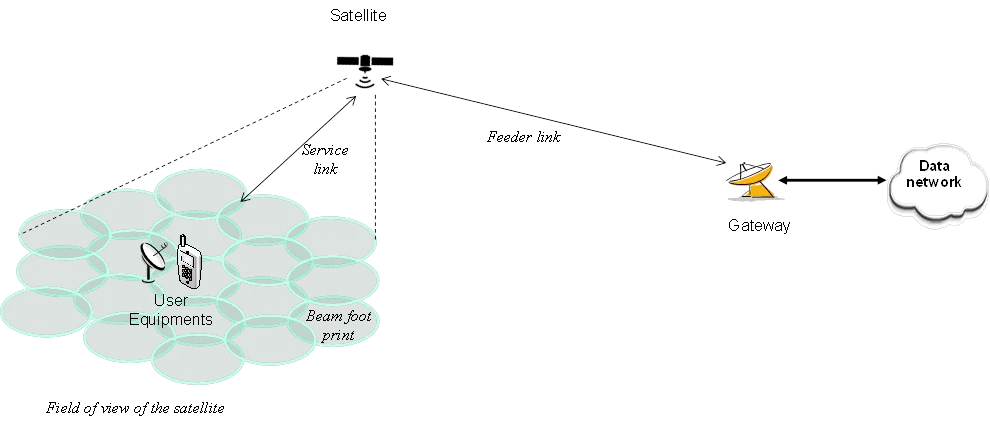
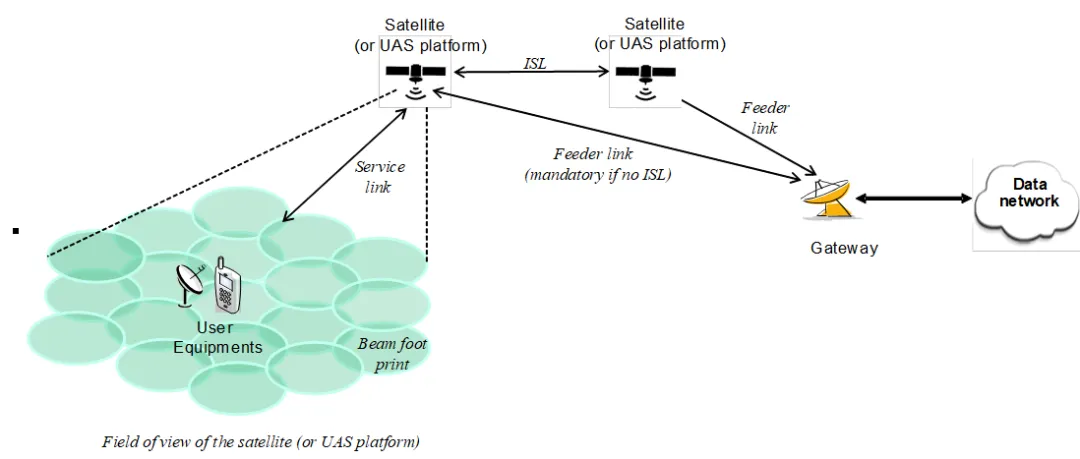
The figure below shows a typical non-terrestrial network scenario based on a transparent payload.
3. NTN RF Standards for NR (38-series)
The NR-based NTN RF standards are defined in four 38-series documents. Two specify technical requirements for satellite UEs and satellite access nodes, and two specify conformance test methods:
TS 38.101-5 NR; UE; Part 5: Satellite access Radio Frequency (RF) and performance requirements; TS 38.108 NR; Satellite Access Node radio transmission and reception; TS 38.181 NR; Satellite Access Node conformance testing; TS 38.521-5 NR; UE conformance specification; Part 5: Satellite access Radio Frequency (RF) and performance;
Key differences between NR NTN and IoT NTN include support for additional platforms and payload modes. For transparent-payload deployments, the satellite reference can also include UAS platforms.
Definition:
Unmanned Aircraft Systems (UAS): systems that include tethered UAS (TUA), lighter-than-air UAS (LTA), and heavier-than-air UAS (HTA), typically operating at altitudes between 8 km and 50 km, including high-altitude platforms (HAPs).
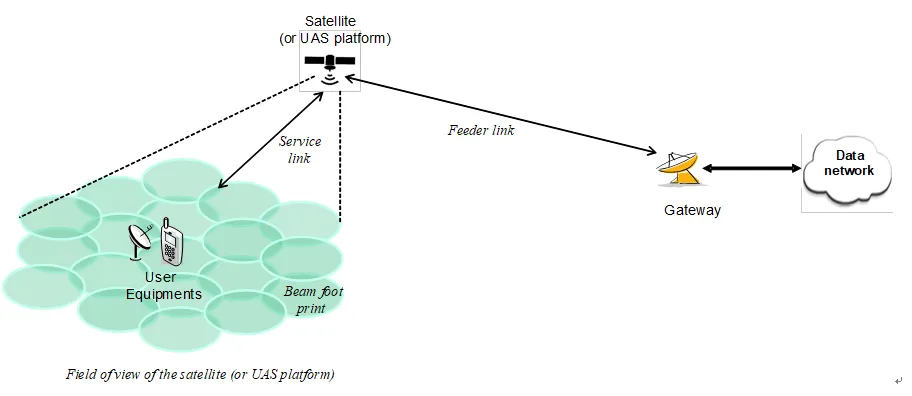
NR NTN also defines support for regenerative-payload modes, where the satellite or platform includes onboard processing.
Mode descriptions:
Transparent payload: provides RF filtering, frequency conversion, and amplification only. The waveform is not altered; the payload transparently forwards the signal.
Regenerative payload: provides RF filtering, frequency conversion, amplification, and onboard processing such as demodulation/decoding, switching and/or routing, and encoding/modulation. This effectively implements all or part of base station functions (for example gNB) on the satellite or UAS platform.
Beams generated by the satellite or UAS platform typically cover specific service areas within the platform's field of view and consist of multiple beams. Beam footprints are generally elliptical. The platform's field of view depends on the onboard antenna pattern and the minimum elevation angle.
Inter-satellite links (ISL) are optional in constellation deployments but require regenerative payloads on the satellites. ISLs can operate in RF or optical bands. User equipment is served by the satellite or UAS platform within the intended service area.