ALLPCB


Background
To improve product quality, industry has focused on manufacturing lighter, stronger, and higher-performance products. Over the past decade, fiber-reinforced plastic (FRP) has been widely used in consumer electronics, automotive, shipbuilding, aerospace, and wind power applications because of its high mechanical strength and low weight. Resin transfer molding (RTM) is a promising liquid composite molding method suited for producing large, geometrically complex parts while meeting high mechanical strength, tight dimensional tolerances, and surface appearance requirements.
RTM is also one of the more efficient and economical processes, due to lower equipment cost, closed mold operation, low injection pressure, controlled mechanical properties, the ability to integrate metal inserts and attachments, suitability for large complex parts, and relatively low labor cost. However, RTM faces challenges: large local variations in fiber volume fraction can strongly influence mold flow behavior, making resin flow difficult to predict accurately. On-site RTM operators cannot always determine these effects precisely nor verify whether a part is fully wetted before the infusion process completes. If a part is not fully wetted, dry spots or porosity may occur, which leads to scrap and repeated manufacturing attempts until defect-free parts are produced.
Need for Reliable Permeability Measurement
Using trial-and-error to produce large RTM structures such as industrial-scale turbine blades is costly. Effective CAE simulation tools can predict RTM flow behavior for complex structures, which is important given the growing market demand from fiber material suppliers and mold manufacturers. Software capable of simulating RTM remains limited. Fabric permeability is a key input parameter that affects RTM CAE simulation quality. Permeability characterizes the porous medium, indicating the ease with which a fluid or gas can penetrate the medium; higher permeability means the fluid can pass through more quickly. Traditional measurement methods such as vacuum-assisted resin transfer molding (VARTM) require sealing an open mold with a vacuum bag to create a vacuum environment, a time-consuming and error-prone process that depends on operator skill.
Measurement Setup and Instrumentation
To improve composite material measurement capability, the Moldex3D materials science research center introduced EASYPERM. EASYPERM, which won the 2015 JEC Innovation Award, measures fabric permeability by using pressure sensors to record local pressures at different fabric locations and maps permeability on internal and external planes. Fabric permeability is calculated from equilibrium flow rate and local pressure using Darcy's law. In this study, we simulated the non-equilibrium filling behavior of oil during the permeability measurement to validate the simulation tool. In the non-equilibrium stage the system has not reached steady state and local pressure can sometimes increase.
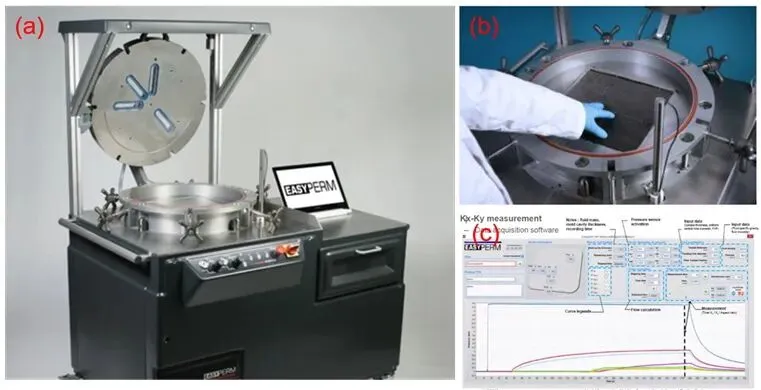
Figure 1 (a) EASYPERM; (b) mold; (c) data acquisition and analysis interface
Validation Method
Pressure sensors not only record local pressure variation over time but also detect the arrival time of the flow front. When the flow front reaches a sensing point, local pressure rises from zero. For cross-validation, an EASYPERM cavity was recreated in the Moldex3D RTM module and the same injection conditions used in the experiment were reproduced in the simulation. This case compares flow front arrival times and pressure rise trends between simulation and experiment. The simulated flow front shown in Figure 3(a) closely matches the experimental results, indicating high solver accuracy in the Moldex3D RTM module.
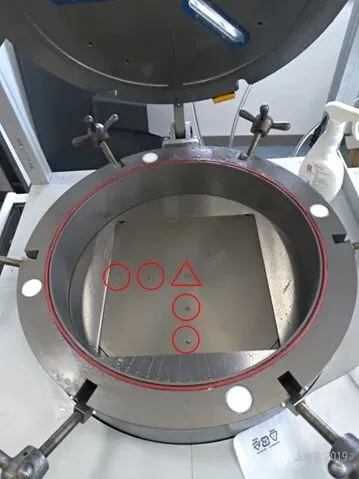
Figure 2 Pressure sensor locations within the mold cavity plane geometry (△ indicates the original sensor position; ○ indicates other sensor positions in the plane)
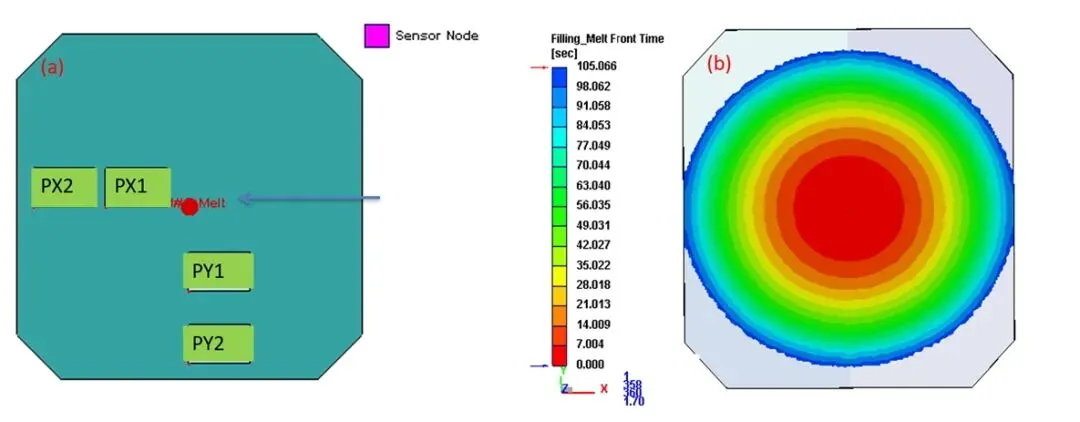
Figure 3 Simulation setup based on actual molding conditions: (a) inlet and pressure sensor locations; (b) flow front times
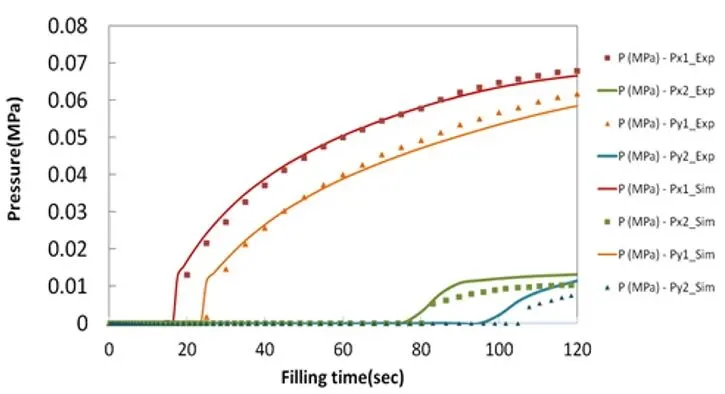
Figure 4 Comparison of EASYPERM experimental data and simulation results. Both are closely matched and show pressure increases from zero when the flow front reaches sensing nodes.
Conclusion
In RTM simulations, material properties such as fabric permeability strongly influence simulation accuracy. Permeability data measured by traditional VARTM methods can vary with operator technique. To address this, Moldex3D expanded its material measurement capabilities by introducing EASYPERM to meet industry needs for composite material simulation data.