ALLPCB


Overview
This article reviews common DC current sensing methods and their typical uses:
- 1. Low-side current sensing
- 2. High-side current sensing
- 3. Integrated digital power meters (for example INA229)
- 4. Hall-effect current sensors
1. Low-side current sensing
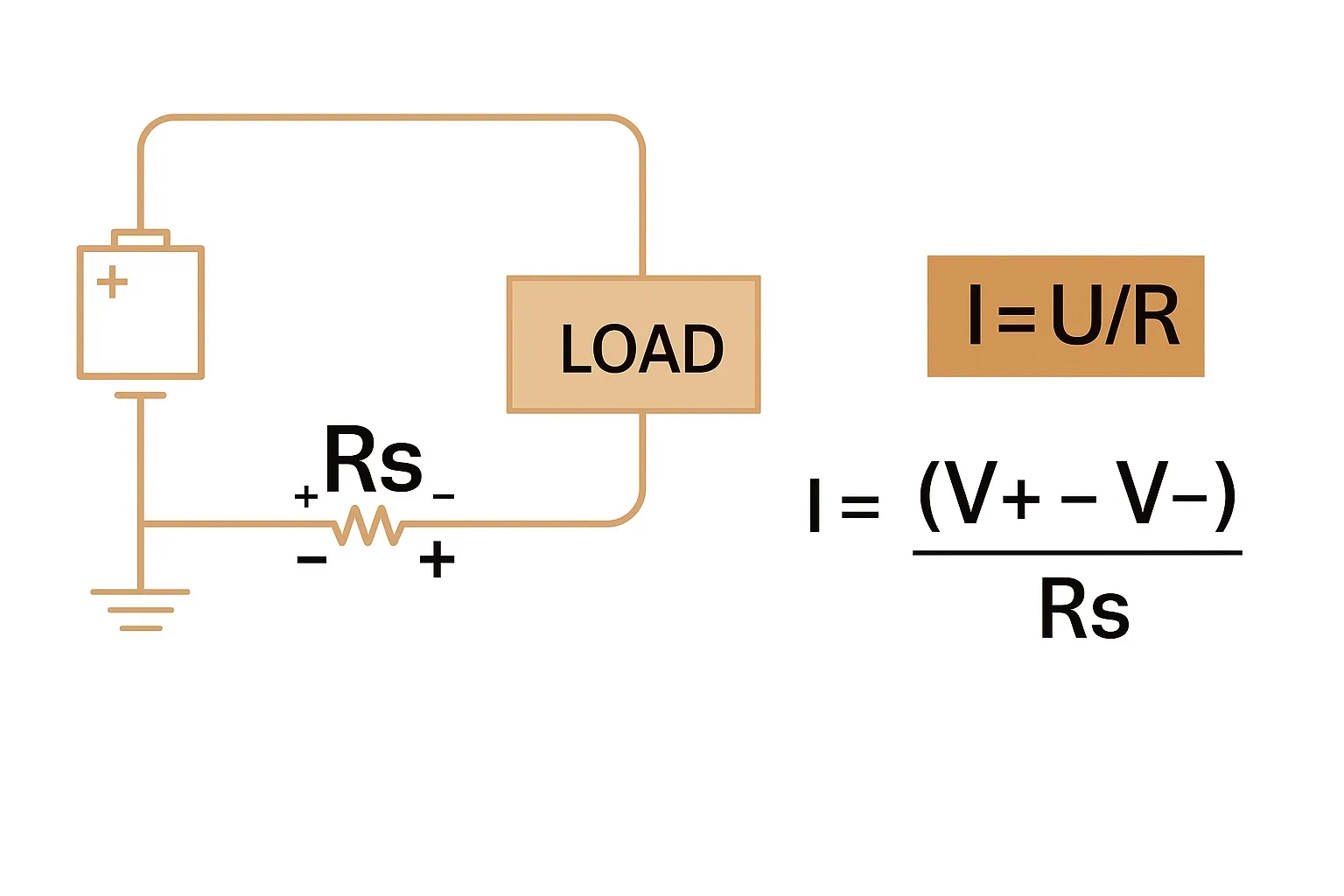
A precision resistor produces a voltage difference across its terminals. By Ohm's law (I = U / R), dividing the voltage drop across the shunt resistor by its resistance yields the circuit current.
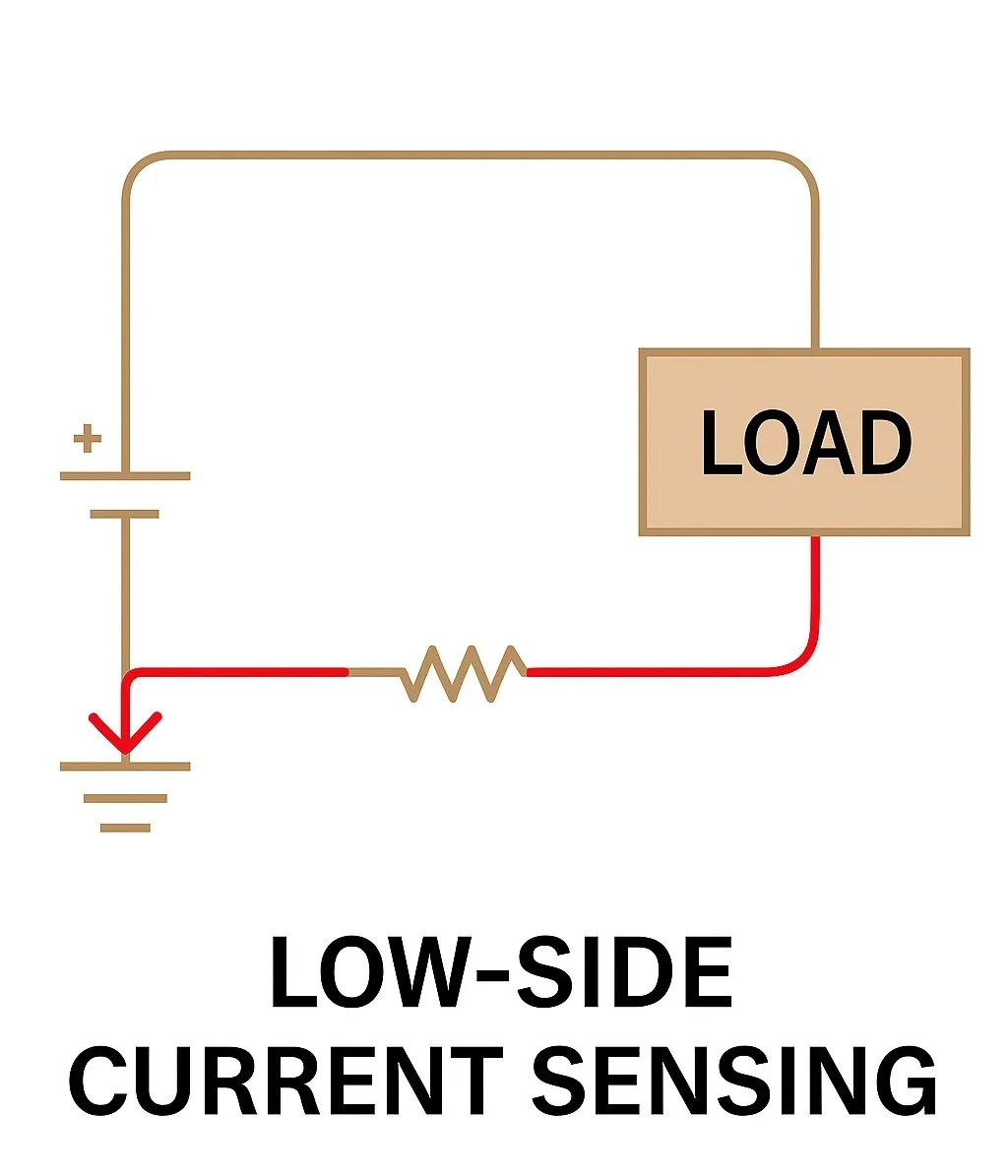
Example schematic:
The shunt resistor (for example 25 mΩ) is placed between the load and ground. If load current is 1 A, the voltage across RS1 is 25 mV. The current returns to ground through the shunt resistor. With an amplifier gain of 21, the output is Uout = 25 mV * 21 = 525 mV.
The amplified signal is then buffered and measured by the MCU ADC input. Measured values will differ from ideal calculations due to resistor tolerance, ADC reference error, and other component tolerances. To improve accuracy, choose higher-precision components and a stable voltage reference.
Advantages:
- Low cost and simple circuit topology.
- Suitable for small currents or cost-sensitive consumer electronics.
Disadvantages:
- Low-frequency interference: large currents may introduce noise.
- Safety limitations: cannot detect a load-to-ground short circuit.
- Accuracy limits: ADC reference and component tolerances affect measurement accuracy.
Typical applications: low-cost devices such as battery chargers and LED drivers.
2. High-side current sensing
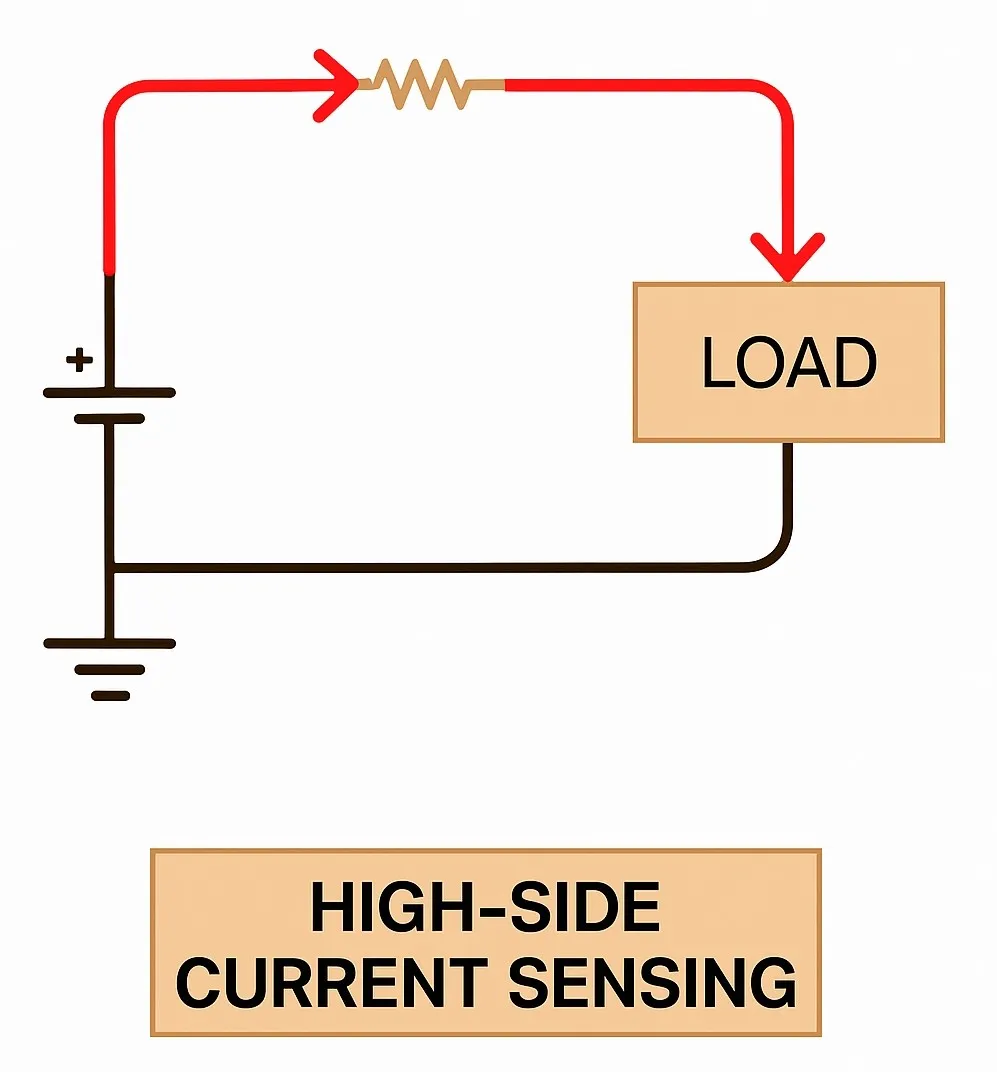
Example schematic:
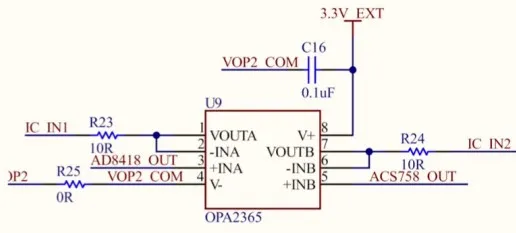
The shunt resistor is placed between the supply positive terminal and the load. Current flows from the supply positive terminal → shunt resistor → load.
An AD8418 current-sense amplifier is used in this example. The AD8418 is a high-voltage, high-resolution current-sense amplifier. Initial gain is set to 20 V/V, with a maximum gain error of ±0.15% across the temperature range.
High-side sensing requires attention to the common-mode voltage range. The AD8418 provides strong input common-mode rejection and supports bidirectional or unidirectional current measurement on the shunt.
With a 25 mV shunt drop and gain of 20, Uout = 25 mV * 20 = 500 mV.
Advantages:
- Higher safety: can detect load-to-ground fault conditions.
- Better interference rejection: high common-mode rejection ratio suits noisy environments.
Disadvantages:
- Higher cost: requires high-voltage amplifiers and precision components.
- Greater circuit complexity: must handle high common-mode voltages from the power rail.
Typical applications: high-reliability systems such as industrial control, electric vehicle BMS, and power management.
3. Integrated digital power meters (for example INA229)
Integrated precision devices contain a shunt resistor, ADC, and computation engine on-chip.
Using an SPI interface, after configuring the shunt, bus voltage, and measurement parameters, the device directly outputs current, voltage, and power data without external operational amplifiers.
Features:
- High-precision internal shunt (for example 50 mΩ).
- Bidirectional current measurement support.
Advantages:
- Simplified design: fewer external components required.
- High accuracy: typical error around ±1% with calibration support.
- Digital output: SPI interface enables direct MCU communication.
Disadvantages:
- Interface dependency: requires MCU support for SPI.
- Higher cost compared to some discrete solutions.
Typical applications: systems requiring digital monitoring, such as smart meters, server power supplies, and IoT devices.
4. Hall-effect current sensors
Hall-effect sensors measure magnetic field and derive current indirectly.
Typical device: Allegro ACS758L supports bidirectional AC/DC current sensing with low internal resistance and around ±1% accuracy.
Output behavior: at zero current the output equals VCC/2. With VCC = 3.3 V, the zero-current output is theoretically 1.65 V. With forward current the output approaches VCC; with reverse current the output approaches 0 V.
Typical applications: scenarios requiring high voltage isolation or high isolation between primary and measurement circuits, such as photovoltaic inverters, motor drives, and electric vehicles.