ALLPCB


This article examines the impact of Wolfspeed power modules on three-phase low-voltage industrial motor drives, with a focus on losses, thermal behavior, and system-level tradeoffs for a 25 kW embedded drive.
Motivation: motors and energy efficiency
Conservative estimates indicate that electric motors account for more than 50% of industrial electricity consumption and about 45% of global electricity use. Even small efficiency improvements in industrial motor-drive systems can significantly affect global energy consumption and emissions. Stricter efficiency standards are increasing design challenges for power electronics engineers.
Higher efficiency with SiC and smaller heatsinks
Replacing silicon IGBT devices with silicon carbide (SiC) devices can yield measurable efficiency gains and enable more compact industrial drives. A 25 kW drive that adopts SiC instead of conventional IGBT devices can achieve a 2.4% or greater efficiency improvement in some designs. Further redesign using SiC can enable tighter integration of the drive and motor, producing smaller and lighter embedded industrial drives.
Wolfspeed WolfPACK power modules can reduce losses significantly while enabling smaller, lighter, and more thermally stable embedded 25 kW three-phase low-voltage industrial drives.
Typical motor drives consist of an AC-DC active front end (AFE) stage and a DC-AC inverter stage. In a 25 kW drive with a six-switch AFE using 45 kHz switching, compared with a 20 kHz silicon-switch baseline, the front-end efficiency can improve by about 1.3%. In a conservative benchmark comparing a Wolfspeed 30 A rated power module with a 100 A rated silicon IGBT module (both at 8 kHz switching), the inverter sees a similar improvement. Combined, these changes yield approximately a 2.6% system-level efficiency increase and a large reduction in system losses, enabling an integrated motor to meet IE4 efficiency where the original system only met IE3.
An important system-level benefit of SiC in the inverter is the substantial reduction in heat generation, which allows designers to use smaller heatsinks and design overall smaller and lighter motor-drive systems.
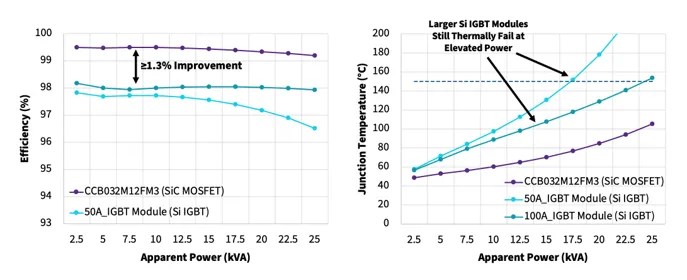
Figure 1: 25 kW inverter, Fsw = 8 kHz. SiC MOSFET heatsink reduced 77%: 0.31 L (1.6°C/W) vs 1.37 L (0.73°C/W).
For example, in a 25 kW inverter configuration with a 0.8 L heatsink, replacing a traditional silicon IGBT module with a Wolfspeed SiC six-device integrated WolfPACK module improves efficiency. At higher power levels the junction temperature of 50 A and 100 A silicon IGBTs rises to failure thresholds, while a Wolfspeed 32 A SiC MOSFET remains stable and well below failure temperature.
These efficiency gains appear not only at peak load but also at partial loads, and in some partial-load regions the gains are larger, matching typical machine load profiles. The tested SiC devices in this comparison are lower current-rated parts; at maximum load their junction temperature reached about 105°C, providing a significant thermal margin. In contrast, the 50 A IGBT module exceeded allowable limits, and the 100 A IGBT slightly exceeded the maximum load limit. Here, the limit is defined as 150°C, a commonly allowed maximum junction temperature for power modules in drive applications.
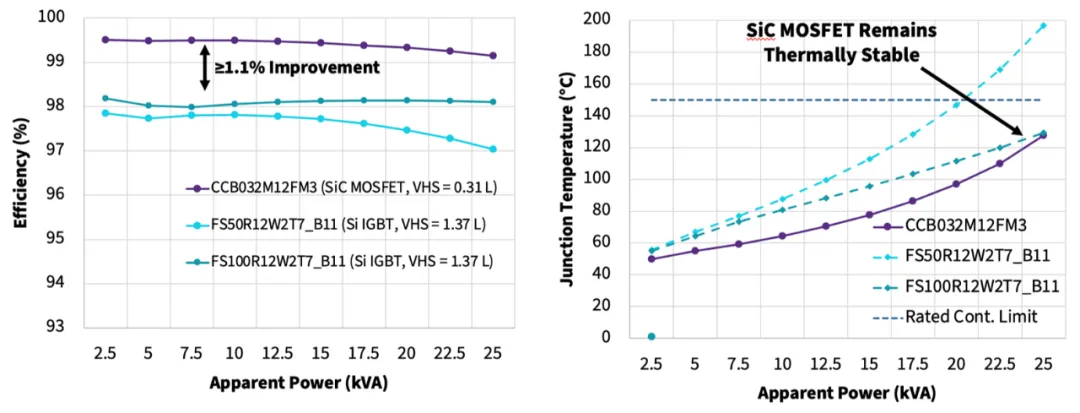
Figure 2: 25 kW inverter, Fsw = 8 kHz. Larger silicon IGBT heatsink: 1.37 L (0.7°C/W); smaller SiC heatsink: 0.8 L (0.99°C/W).
To validate system feasibility and optimization, heatsink sizes were adjusted: the IGBT heatsink was increased from 0.8 L to 1.37 L, while the SiC heatsink was reduced by 61% to raise its junction temperature and reduce margin. Even after these changes, the SiC solution reduced total heatsink volume by 77%. Despite these modifications, the 50 A IGBT still exceeded the 150°C limit, whereas the 32 A SiC part and the 100 A IGBT both settled around the same junction temperature near 129°C. The SiC inverter also showed a 1.1% efficiency increase in this case. Overall, using a streamlined and optimized SiC heatsink in a three-phase 25 kW system produced about a 2.4% efficiency improvement and a 600 W loss reduction, enabling a drive that began as an IE3 system to meet IE4 when integrated with the motor.
System losses reduced up to 50%
SiC brings significant system-level benefits to low-voltage industrial motor drives. Although SiC devices may have higher upfront component costs than silicon IGBTs, their ability to operate at higher switching frequencies and lower losses reduces the required investment in passive components and heatsinks.
For the 25 kW system analyzed, the optimized SiC configuration saves up to 605 W. Assuming 8,200 operating hours per year and a representative load profile, and based on electricity rates in China as of November 2023, the annual energy cost saving is about 1,297.8 RMB, accumulating to approximately 19,000 RMB over 15 years. While replacing IGBTs with SiC devices can increase initial device cost, the overall system cost can be offset by reductions in passive components and heatsinks while delivering higher system efficiency.
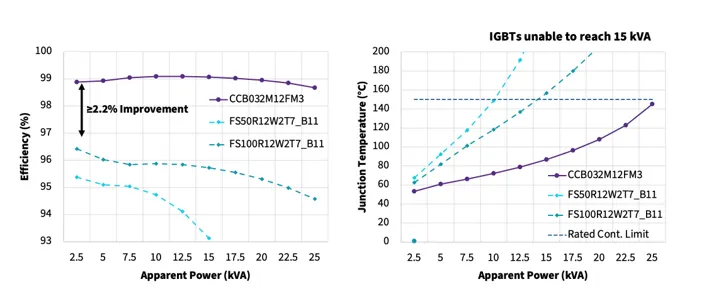
Figure 3: 25 kW inverter, Fsw = 16 kHz. SiC MOSFET heatsink reduced 41%: 0.80 L (0.99°C/W) vs 1.37 L (0.73°C/W).
At higher switching frequencies, SiC continues to demonstrate advantages. With Fsw raised from 8 kHz to 16 kHz and using a heatsink 41% smaller than a comparable IGBT heatsink, a Wolfspeed FM3 six-device integrated power module maintains an efficiency close to 99% and approaches the 150°C junction limit at peak load. For 50 A and 100 A IGBTs, increased switching losses lead to thermal failures at roughly 10 kW and 15 kW respectively. To make higher-rated IGBTs perform as well as the Wolfspeed FM3 SiC module, designers would need larger heatsinks or parts with higher current ratings. Notably, a SiC inverter at 16 kHz can still be more efficient than an IGBT-based inverter at 8 kHz.
Conclusion
Replacing conventional silicon IGBT devices with SiC in a 25 kW low-voltage industrial motor drive can deliver up to a 2.6% system efficiency improvement. Efficiency gains are realized across the load curve and at higher power levels, reducing energy consumption. SiC also enables smaller passive components and heatsinks, improving power density and enabling overall system cost and size optimizations. The higher allowable junction temperatures, improved thermal behavior, and lower losses of SiC devices allow designers to build more compact integrated drive-and-motor solutions.