Panel For Example Panel For Example Panel For Example

What Is Base64 and How to Encode/Decode

Author : Adrian September 16, 2025

Base64 encoding

Overview

Base64 is an encoding method that converts binary data into ASCII characters. It uses 64 distinct characters to represent arbitrary binary data, typically used to transmit or store binary data in text-based protocols.

How Base64 Works

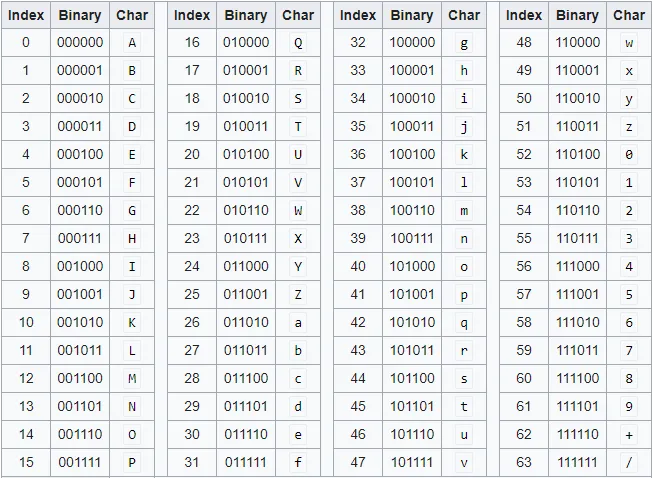
Base64 divides the input data into fixed-length blocks, usually 3 bytes, and converts each block into 4 Base64 characters. The character set consists of uppercase letters A-Z, lowercase letters a-z, digits 0-9, and two symbols, + and /. The encoded output is a text string composed of these Base64 characters.

Common Use Cases

  • Transmitting attachments in email: Some mail systems only support plain text and cannot directly carry binary files. Base64 converts binary files to text for transmission.
  • Passing parameters in URLs: Certain binary data or special characters may be misinterpreted in URLs. Base64 ensures the transmitted data consists only of safe ASCII characters.
  • Storing binary data: Base64 converts binary data to text strings, making it easier to store and retrieve in text files or databases.

Example in Python

import base64 # Data to encode data = b'Test Base64 Encoding' # Encode encoded_data = base64.b64encode(data) print("Base64 encoded:", encoded_data.decode()) # Decode decoded_data = base64.b64decode(encoded_data) print("Base64 decoded:", decoded_data.decode())

Notes

When performing Base64 encoding and decoding, provide input data in the required format. In the example above, a bytes object is used as input for encoding, and the encoded result is decoded to a string. Specific usage may vary depending on the programming language and library.
Recommended Reading
Deploying Deep Learning Gait Recognition on Allwinner V853

Deploying Deep Learning Gait Recognition on Allwinner V853

March 23, 2026

Gait recognition on an embedded Allwinner V853 board using NPU acceleration, detailing PyTorch-to-NB model conversion, CPU preprocessing/postprocessing and CASIA-B evaluation.

Article
Differences: DSP vs Microcontroller vs Embedded Microprocessor

Differences: DSP vs Microcontroller vs Embedded Microprocessor

March 20, 2026

Compare DSP, microcontroller, and embedded microprocessor designs: DSP signal processing optimizations, microcontroller peripheral integration, and power/performance tradeoffs.

Article
Choosing Peripherals for Embedded Systems

Choosing Peripherals for Embedded Systems

March 20, 2026

Guide to selecting peripherals in embedded systems: compare memory, clock sources, timers, communication interfaces, I/O and ADCs with factors like speed, power, and stability.

Article
Two Embedded Microprocessor Architectures and Their Pros and Cons

Two Embedded Microprocessor Architectures and Their Pros and Cons

March 20, 2026

Overview of embedded microprocessor architectures (CISC vs RISC), trade-offs, advantages and limitations for embedded system design, power, performance, and integration.

Article
Three Main Components of an Embedded Microprocessor

Three Main Components of an Embedded Microprocessor

March 20, 2026

Technical overview of the embedded microprocessor architecture, summarizing its three cooperating subsystems and how the compute unit enables arithmetic and logical execution.

Article
Tesla Cuts Prices $2,000 on Three Main Models

Tesla Cuts Prices $2,000 on Three Main Models

March 20, 2026

Analysis of Tesla's recent price cuts, FSD subscription reduction and 14,000 layoffs after Q1 delivery declines, and competitive pressure from Chinese EV makers like BYD.

Article