ALLPCB


Overview
If you wear gloves or your finger is wet, a phone may not respond when you try to swipe the screen. Why do touchscreens often require skin contact to register a slide? First, it helps to understand the current screen technology used in most phones.
How capacitive touchscreens work
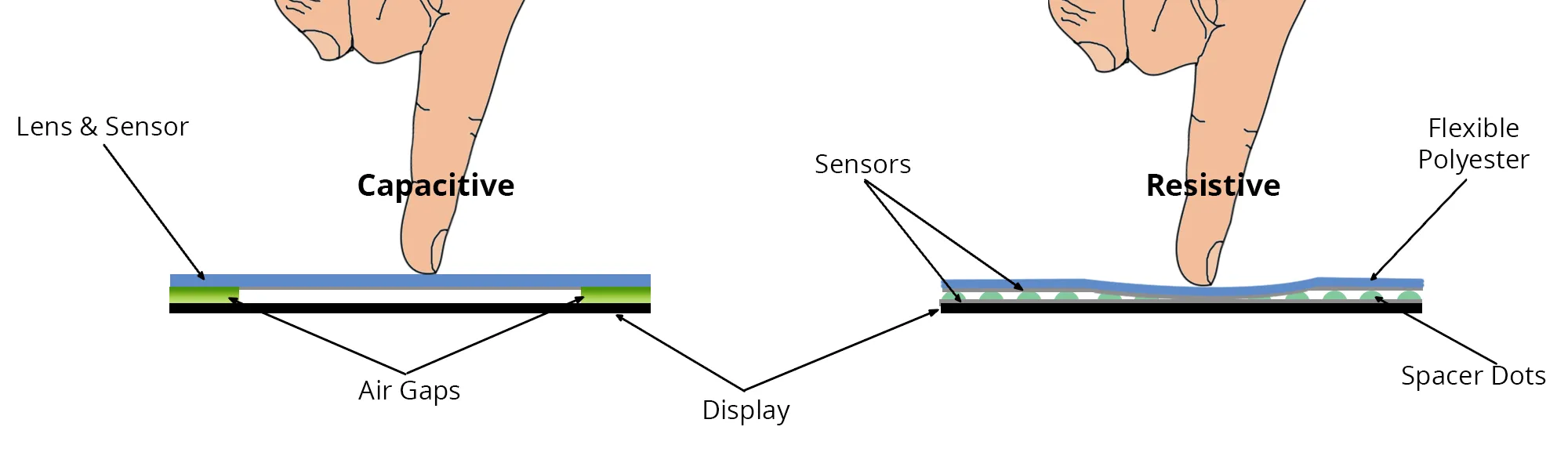
Most modern phones use capacitive touchscreens, which detect the body's electric field. This is why sliding usually requires skin contact: it is related to the operating principle of capacitive screens.
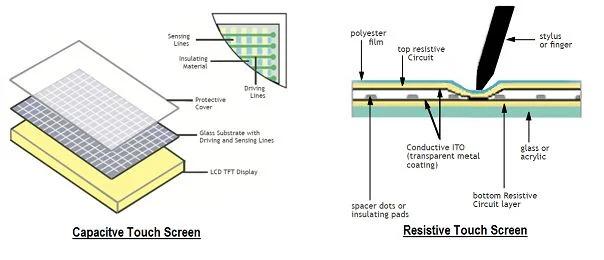
A capacitive touchscreen consists of a four-layer composite glass. Between these layers and on the inner surfaces is a coating of indium tin oxide (ITO), an n-type oxide semiconductor. The ITO layer is the active surface, and the four corners of the screen provide four electrodes. The outermost layer is a thin protective glass layer, about 0.0015 mm thick.
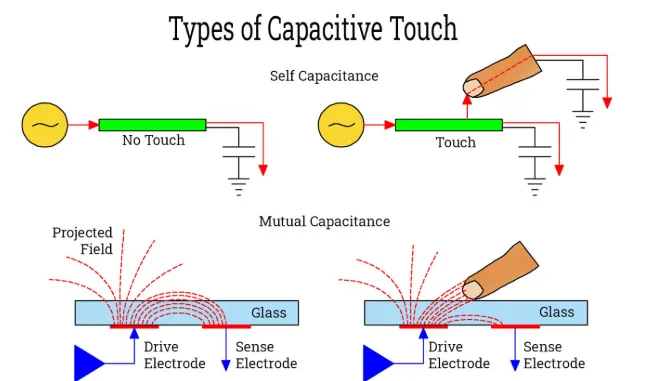
The human body has an electric field and is conductive. When a finger touches the screen, a coupling capacitance is formed between the screen and the user, allowing different potential circuits to couple through the capacitor and creating a high-frequency signal path. For such high-frequency signals the capacitor behaves like a conductor. The fingertip draws a small current, and the phone's controller calculates the position of that current and responds to the input.
Resistive touchscreens and styluses
Some devices can be operated without skin contact. Older feature phones with touch functions often included a stylus that could be removed and used instead of a finger. Those screens used resistive technology, which operates differently from capacitive screens.
A resistive touchscreen is a pressure-sensitive assembly whose main component is a resistive film with a conductive layer on the surface. When an object presses the screen, the sensor detects the touch. Because of this difference in principle, resistive screens can register input without direct skin contact.
Alternatives and capacitive coupling
Capacitive touchscreens do not strictly require direct skin contact; they only require sufficient capacitive coupling to register input. As a result, various tools and styluses have been developed to operate capacitive screens, providing alternative input methods.