ALLPCB


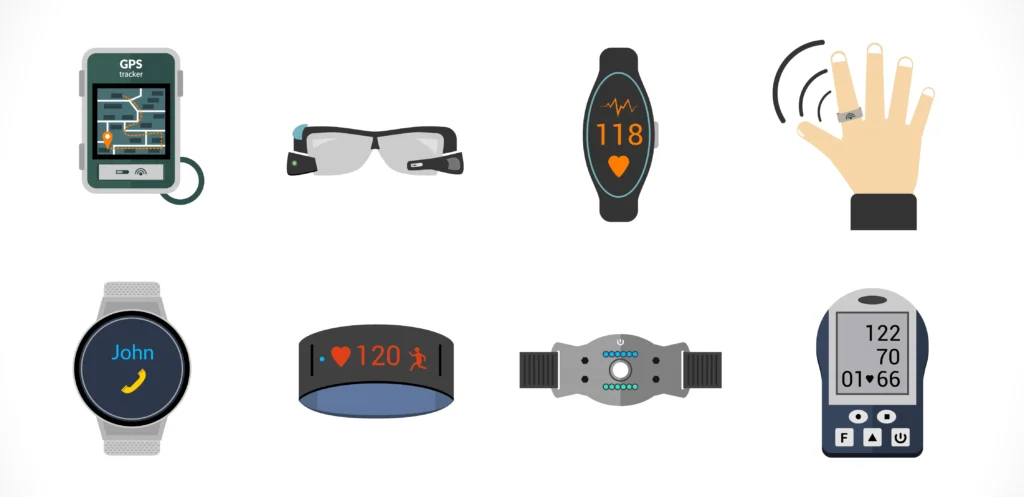
Wearable devices on the market take many forms, but they can be grouped into two main categories: medical wearables and fitness wearables. Medical wearables directly support clinicians in monitoring and treating patients and must be approved by medical regulators before market release. Fitness wearables are primarily used for health and activity tracking and typically do not require medical approval before launch. Common examples include fitness bands and smartwatches, which track various vital signs such as heart rate, body temperature, blood oxygen saturation, and blood pressure. As miniaturization and biological sensing technology advance, sensors could eventually be implanted under the skin and connected to personal phones to transmit collected biological data.
MEMS and market trends
MEMS devices offer advantages including low weight, small size, low cost, and low power consumption, which favor their use in telecommunications and consumer electronics. In recent years, MEMS technology has also been increasingly adopted in the automotive sector, especially in vehicle safety systems such as airbag deployment.
Smart wearables penetrating the medical field
According to a Research and Markets report titled "Wearable Sensors Market Forecast and Analysis to 2028", the wearable sensor market is projected to grow from about $1.9 billion in 2021 to $5.76 billion in 2028, at a compound annual growth rate of 17.1% from 2021 to 2028. Smart wearables such as smartwatches, fitness trackers, VR headsets, smart wristbands, activity trackers, and sports watches, when integrated with augmented reality (AR), artificial intelligence, and the Internet of Things (IoT), allow users to access health-related information on smartphones, tablets, or connected computers. This integration is one important driver of the wearable market's strong growth.
As consumer awareness rises, the use of smart wearables for healthcare has increased significantly. Smartwatches and pulse oximeters combine with optical sensors to provide real-time health tracking. Photoplethysmography (PPG) sensors, which help monitor heart and respiration rates, have shown especially strong market performance. PPG detects the variation in reflected light intensity caused by blood and tissue absorption to trace changes in vascular volume across the cardiac cycle, from which pulse waveforms and heart rate are derived. Several recent smartwatches include built-in PPG sensors. Examples include certain smartwatch models that offer a range of health functions such as blood oxygen monitoring and high-end PPG heart-rate sensing.
According to the American Heart Association, approximately 17 million people die annually in the United States from cardiac abnormalities, a figure projected to rise to 23 million by 2030. This underscores the market potential for wearables with PPG functionality.
Portable sensors usher a new era for wearables
Sensors today are much smaller, lower cost, and more energy efficient than in the past, enabling expanded use in portable devices. In the wearable category, "smart garments" and other accessories equipped with biosensors can collect biological data and transmit it to smartphones or computers for analysis and health monitoring.
For example, sensors embedded in clothing can analyze subtle changes in skin color to perform contactless heart-rate monitoring. Portable wearable sensors are generally categorized as either implanted subcutaneous sensors or externally worn sensors. Development in portable sensor technology over recent years has been rapid, with most new applications focused on medical use. The proliferation of portable-sensor-based devices could fundamentally change current healthcare delivery models.
Recent advances in portable sensor technology emphasize miniaturization and low power consumption. One notable invention enabled by miniaturization is the digital pill. These pills include miniature sensors used for imaging, drug monitoring, gas sensing, and electrochemical gas detection. Once ingested, the sensor is activated by gastric fluids and generates electrical signals that are captured by a patch worn on the chest and then transmitted to a smartphone for analysis. Health checks that once required expensive medical equipment can now be performed with digital pills, wearables, smartwatches, and smartphones.
Sensor technology has progressed from measuring heart rate, blood glucose, and blood oxygen saturation only with complex medical machinery to making such measurements available on a personal smartwatch. The dual focus has been on clinical accuracy and product miniaturization. Miniaturization is a key trend for health-monitoring wearables and has opened a new era in wearable devices, enabling real-time self-monitoring of health.
Medical wearable device adoption is expected to exceed 1 billion devices in 2022. IDC reported that global wearable shipments surged 28.4% year over year in 2020 and grew a further 9.9% by the third quarter of 2021, with medical wearables contributing significantly to that growth.
Sensors used in wearables
Sensors are not new to consumer electronics design, but as they become smaller, cheaper, and more energy efficient, their use in portable electronics continues to expand. The appeal of smartphones, tablets, and wearables largely depends on the quality of their sensor solutions. ReportLinker analysis estimates the global smart sensor market will grow from $45.8 billion in 2022 to $104.5 billion in 2027, at a CAGR of 17.9% from 2022 to 2027. Growth is driven by demand for smart sensors in IoT devices and consumer electronics such as smart appliances and wearables.
Wearables incorporate many types of sensors, including pressure, optical, proximity, motion, temperature, acoustic, touch, and image sensors. Unlike other sectors, wearables place particular constraints on sensor size and power consumption in addition to functionality. Below are representative sensors commonly used in typical wearable products.
#01 Accelerometer
Accelerometers are widely used in wearables. For example, runners can access peak speed and acceleration metrics, and accelerometers can track sleep patterns. When selecting accelerometers for ultra-low-power applications, it is important to consider whether parameters such as bandwidth and sampling rate will drop below levels needed to measure relevant acceleration data under the stated power consumption. Many accelerometers conserve power by duty-cycling, turning on and off multiple times per second, which reduces effective sampling rate and can miss critical acceleration events. Designers must balance these parameters.
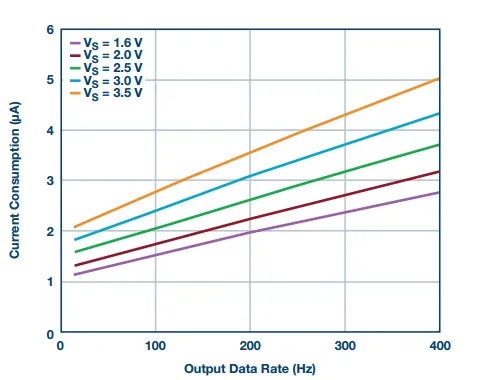
ADI's ADXL362 and ADXL363 sample the sensor bandwidth at full data rate so they do not alias input signals through undersampling. They can sample up to 400 Hz while consuming only 3 μA, enabling features like single-click and double-click detection in wearables. When inactive, the sampling rate of ADXL362 and ADXL363 can drop to 6 Hz so the device wakes on pickup or motion, yielding an average current of just 270 nA. These characteristics make ADXL362 and ADXL363 suitable for implanted applications where battery replacement is difficult. ADI also developed a demo VSM watch to showcase the potential of ultra-low-power devices like the ADXL362 in battery-powered, space-constrained applications.
#02 Gyroscope
Gyroscopes are another common wearable sensor that measure angular acceleration. In some designs, accelerometers are used to infer rotational motion, but many systems combine gyroscopes and accelerometers to minimize measurement error.
TDK InvenSense ICG-1020S is a dual-axis MEMS angular rate sensor designed for optical image stabilization (OIS) in smartphone camera modules and other mobile devices. It supports output data rates up to 32 kHz and is backward compatible with other InvenSense OIS gyro products. The ICG-1020S features very low RMS noise and noise density, high resolution, fast sampling up to 32 kHz, a low-latency 20 MHz SPI interface, and a very low rate noise of 4 mdps/√Hz. Precise sensitivity control allows an uncalibrated deployment strategy, which can reduce production cost.
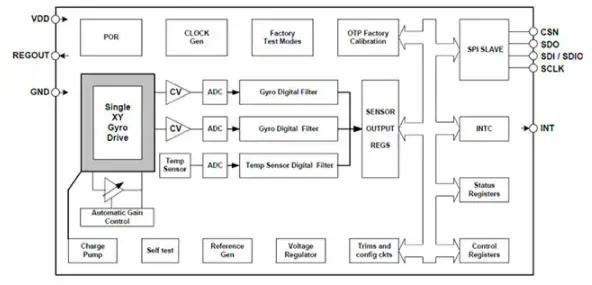
Figure 2: ICG-1020S dual-axis MEMS gyroscope block diagram (Figure source: TDK)
#03 Magnetic sensors
Magnetic sensors are used in consumer electronics to measure speed, direction, position, alignment, proximity, or rotational position without physical contact between the sensor and target. These sensors can be enclosed in rugged housings for harsh environments or packaged on small circuit boards to minimize space. Hall-effect sensors are a common type of magnetic sensor, integrating a Hall element with peripheral circuits.
Hall sensors can detect magnetic fields through nonferrous materials, allowing sensors to be embedded within a system and detect targets on the opposite side of enclosures. Hall sensors are widely used in consumer electronics, sports equipment, home appliances, digital cameras, smartphones, toys, and electronic instruments.
Bosch BMM150 is a low-power, low-noise 3-axis geomagnetic sensor designed for compass applications. Coupled with sensor fusion software tailored for hardware, the BMM150 provides accurate, high-dynamic spatial orientation and motion vectors for indoor navigation, step counting in combination with accelerometers, and precise navigation support for drones. Its compact package and flat profile make it suitable for size-sensitive applications such as wearables.
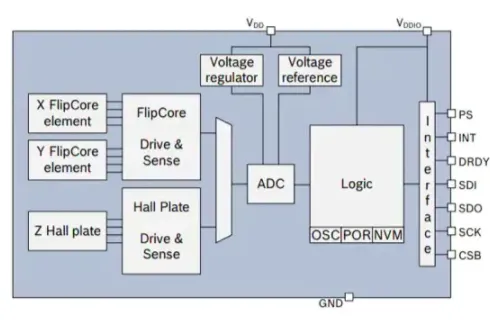
Figure 3: BMM150 geomagnetic sensor block diagram (Figure source: Bosch)
#04 Global Navigation Satellite System (GNSS)
GNSS modules such as GPS are common in smartphones and smartwatches to determine user location.
u-blox ZED-F9T integrates the F9 multi-band platform in a compact 22 mm x 17 mm package, providing 5 ns (1 sigma) timing precision and very low power consumption. The ZED-F9T features parallel GNSS receivers capable of receiving and tracking multiple GNSS systems. The module supports GPS, Galileo, GLONASS, and BeiDou and uses a multi-band RF front end to receive signals simultaneously.
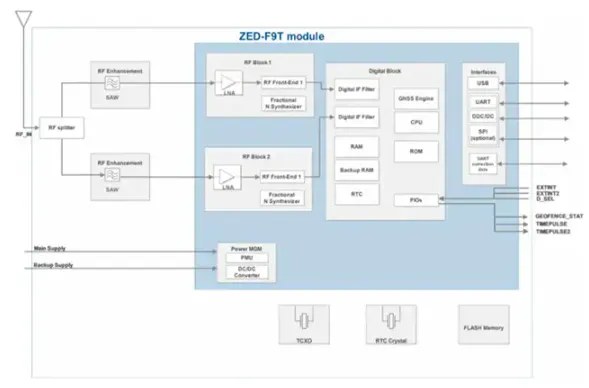
Figure 4: ZED-F9T module internal architecture
#05 Pressure sensors
Pressure sensors usually operate via strain gauges: applied pressure changes resistance, which is often measured using a Wheatstone bridge to detect static or dynamic resistance changes.
TE MS5837-02BA is an ultra-small, gel-filled pressure sensor optimized for altimeter and barometer applications, targeting fitness trackers, drones, and wearables. The MEMS-based sensor includes a highly linear pressure element with ultra-low-power 24-bit digital output (I2C) and a sea-level altitude resolution of 13 cm, enabling high-resolution measurements such as counting stair steps.
Mutual driving of wearables and sensor technology
Fitness wearable technology has been widely adopted, and as consumers increasingly demand self-monitoring and tracking of vital signs, wearable usage more than doubled over the past four years. Research from Insider Intelligence indicates that over 80% of consumers are willing to use fitness technology. In the United States, about one quarter of the population was expected to use a wearable for fitness or health monitoring by 2022.
Market forecasts estimate the global consumer electronics sensor market will reach $41.34 billion by 2027, at a CAGR of 16.32%. Smart, reliable, low-power, low-cost, and highly integrated sensors are the main drivers enabling mass adoption in consumer electronics.
Future wearables will include advanced information processing and connectivity hardware, and the information technology market that supports these devices is expected to grow rapidly, with major hardware upgrades occurring every few years. Portable sensors and wearables are likely to experience similarly rapid development. On one hand, sensor miniaturization has created a new era for wearables; on the other hand, strong market demand for wearables will continue to drive advances in sensor technology.