ALLPCB


Introduction
Thermistors serve as essential components in modern electronic devices, functioning primarily as temperature sensors for precise monitoring and control. These devices exhibit significant changes in electrical resistance in response to temperature variations, enabling effective thermal management across various applications. In power supplies, battery systems, and industrial equipment, thermistors help maintain optimal operating conditions, preventing overheating and enhancing reliability. Electrical engineers rely on them for their cost-effectiveness and sensitivity compared to other temperature sensors. This article explores the principles, applications, and best practices for integrating thermistors into electronic designs, with a focus on NTC thermistor and PTC thermistor variants.
What Is a Thermistor and Why Does It Matter?
A thermistor is a temperature-sensitive resistor constructed from semiconductor materials, designed to detect and respond to temperature changes in electronic circuits. Unlike linear resistors, thermistors provide nonlinear resistance variations that offer high sensitivity over narrow temperature ranges. The two primary types include NTC thermistors, where resistance decreases as temperature rises, and PTC thermistors, where resistance increases with rising temperature. These characteristics make thermistors ideal for temperature sensing in compact devices where space and precision are critical.
In electronic devices, effective thermal management is paramount to ensure longevity and performance. Overheating can lead to component degradation, reduced efficiency, or complete failure in systems like motor drives and LED lighting. Thermistors enable proactive temperature control, allowing circuits to adjust power levels or activate cooling mechanisms. Compliance with standards such as IEC 60539 for NTC thermistors ensures consistent performance in demanding environments. By integrating thermistors, engineers achieve reliable protection against thermal excursions, optimizing system safety and energy use.
Technical Principles of Thermistor Operation
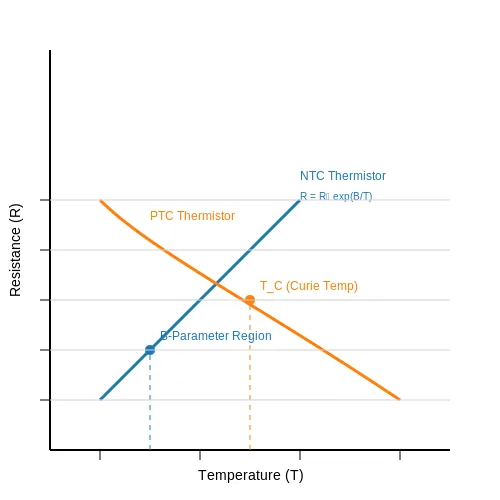
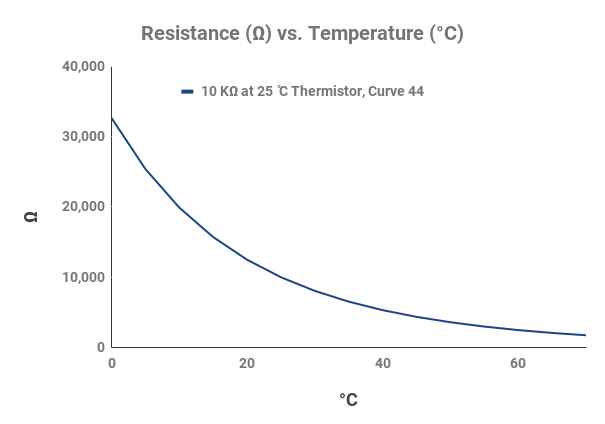
NTC thermistors operate on the principle of negative temperature coefficient behavior, where their resistance drops exponentially with increasing temperature due to enhanced charge carrier mobility in the semiconductor material. This makes them suitable for precise temperature sensing applications requiring high accuracy over specific ranges. The resistance-temperature relationship follows the Steinhart-Hart equation for linearization in measurement circuits, allowing microcontrollers to compute actual temperatures accurately. Material composition, typically oxides of manganese, nickel, or cobalt, influences the beta value, which quantifies sensitivity.
PTC thermistors, conversely, display positive temperature coefficient characteristics, with resistance rising sharply at a Curie temperature due to a phase transition in the ceramic structure. This self-limiting property suits them for overcurrent protection and inrush current suppression in power circuits. Engineers model PTC behavior using transition temperature specifications to predict switching points. Both types require consideration of self-heating effects, where operating current influences measured temperature.
Key Applications in Temperature Sensing
In consumer electronics, NTC thermistors function as core temperature sensors in battery management systems, monitoring cell temperatures to prevent thermal runaway during charging and discharging cycles. Their fast response time allows real-time feedback to control circuits, ensuring safe operation. Automotive electronics employ NTC thermistors for engine management, where they sense coolant or exhaust gas temperatures to optimize fuel injection and emissions control. Industrial automation uses them in HVAC systems for precise air temperature detection, integrating with feedback loops for efficient climate regulation.
PTC thermistors complement sensing roles in hybrid applications, such as LED drivers, where they monitor junction temperatures to modulate current and extend lifespan. In medical devices, thermistors provide non-invasive temperature sensing for patient monitoring equipment, prioritizing accuracy and stability. These applications underscore the versatility of thermistors in thermal management, where they interface seamlessly with ADCs and microprocessors for data acquisition.
Temperature Control Applications Using Thermistors
For active temperature control, NTC thermistors integrate into proportional-integral-derivative controllers, adjusting heater elements or fan speeds based on sensed deviations from setpoints. In power supplies, they enable closed-loop regulation to maintain stable output voltages under varying thermal loads. PTC thermistors excel in passive control scenarios, acting as resettable fuses to limit inrush currents during startup, protecting capacitors from stress. Their inherent recovery after cooling eliminates the need for replacement, unlike traditional fuses.
In motor control circuits, PTC thermistors provide over-temperature protection by increasing resistance to reduce drive current when windings overheat. This application is common in appliances and robotics, where continuous operation demands robust thermal safeguards. Engineers design these systems to align PTC trip points with device safe operating areas, enhancing overall reliability.
Best Practices for Thermistor Integration in PCBs
Selecting the appropriate thermistor involves matching the beta value and tolerance to the application's temperature range and accuracy needs. Surface-mount NTC thermistors suit high-density PCBs, while leaded types offer flexibility for through-hole designs requiring mechanical robustness. During PCB layout, position temperature sensors away from high-heat-generating components like power ICs or voltage regulators to minimize measurement errors. Use thermal relief pads and avoid large copper pours under the thermistor body for ambient air sensing, ensuring accurate representation of target temperatures.
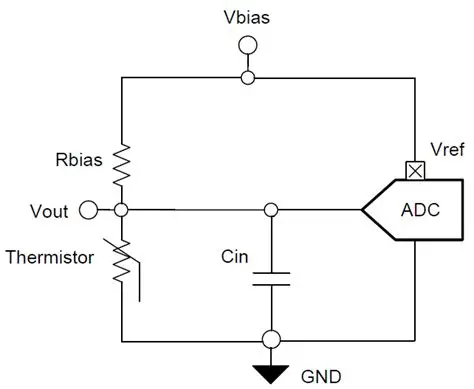
Soldering processes must adhere to guidelines in IEC 60738-1 for PTC thermistors to prevent damage from excessive heat exposure. Implement voltage dividers or Wheatstone bridges for linearization, reducing nonlinearity impacts in analog circuits. Calibration against reference standards verifies performance post-assembly. Environmental sealing protects against humidity and vibration in harsh deployments.
For troubleshooting, monitor for self-heating by limiting excitation currents below 1 mA in precision sensing. Aging effects can shift resistance curves over time, necessitating periodic checks in long-life applications. Open-circuit failures manifest as infinite resistance, while shorts cause zero reading; diagnostic routines using pull-up resistors aid fault isolation. PCB contamination or poor solder joints often mimic these issues, resolved by visual inspection and reflow rework.
Conclusion
Thermistors remain indispensable for temperature sensing and control in electronic devices, offering unmatched sensitivity and versatility through NTC thermistor and PTC thermistor configurations. Their integration supports advanced thermal management strategies, safeguarding performance in diverse sectors from consumer gadgets to industrial machinery. Engineers benefit from structured design practices that align component selection, placement, and circuitry with operational demands. Adhering to established standards ensures reproducibility and reliability. As electronic systems grow more compact and powerful, thermistors will continue to play a pivotal role in maintaining thermal equilibrium.
FAQs
Q1: What is the difference between an NTC thermistor and a PTC thermistor in temperature sensing?
A1: NTC thermistors decrease resistance with rising temperature, ideal for precise temperature sensors in battery packs and HVAC systems. PTC thermistors increase resistance, suiting protection roles like overcurrent limiting. Selection depends on whether the application prioritizes measurement accuracy or self-regulating control. Both enhance thermal management but differ in circuit integration.
Q2: How do thermistors contribute to thermal management in power electronics?
A2: Thermistors act as temperature sensors to monitor hotspots in power supplies and inverters, enabling dynamic adjustment of switching frequencies or cooling. NTC types provide feedback for fan control, while PTC variants limit currents during overloads. Proper PCB placement ensures reliable readings, preventing failures from overheating.
Q3: What are best practices for mounting thermistors on PCBs for accurate temperature control?
A3: Position thermistors distant from heat sources, using minimal copper under the body for true ambient sensing. Apply low-current excitation to avoid self-heating errors. Follow soldering per relevant standards to maintain integrity. Test post-assembly for linearity in control loops.
Q4: Can thermistors replace other temperature sensors in high-reliability applications?
A4: Thermistors offer superior sensitivity for narrow ranges, making them suitable for temperature control in automotive and medical devices. However, for wide-range linearity, pair with linearization circuits. Their cost and size advantages support thermal management where precision outweighs RTD stability.
References
IEC 60539 — NTC thermistors. IEC.
IEC 60738-1:2022 — Thermistors, insulated and non-insulated types. IEC, 2022.
J-STD-020E — Moisture/Reflow Sensitivity Classification. JEDEC, 2014.