ALLPCB


Overview
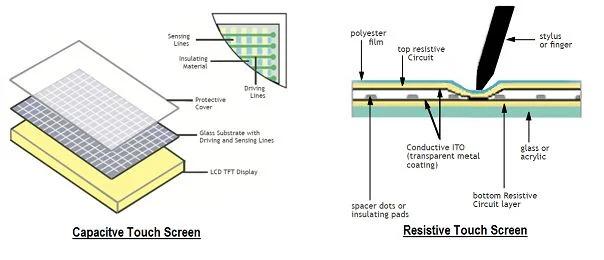
Capacitive touch panels (CTP) detect touch by sensing the human body's electric field and the resulting current induction. A typical capacitive panel is a four-layer composite glass structure: the inner surface and an interlayer are coated with ITO, and the outermost protective layer is a thin silica glass about 0.0015 mm thick. The interlayer ITO coating forms the working surface with four corner electrodes, while the inner ITO layer functions as a screen layer to stabilize operation.
How Capacitive Touchscreens Work
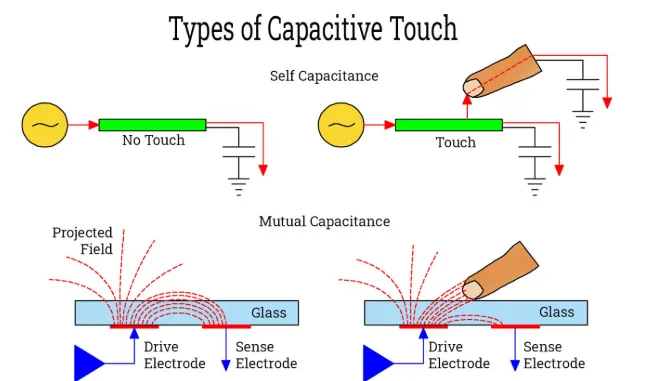
When a user touches a capacitive screen, the finger forms a coupling capacitance with the working surface. A high-frequency signal is applied to the working surface, so the finger draws a very small current that flows out through the four corner electrodes. The current flowing through each electrode is theoretically proportional to the distance from the finger to that corner. The controller computes the touch position by precisely calculating the ratio of the four currents, enabling high positional accuracy and response times below 3 ms.
There are two main capacitive types: self-capacitance and mutual-capacitance. In mutual-capacitance designs, drive electrodes and receive electrodes form a matrix. The drive electrodes emit a low-voltage, high-frequency signal that is projected to the receive electrodes, creating a stable current. When a finger contacts the screen, it forms an equivalent capacitance to ground, allowing some of the high-frequency signal to leak to ground and reducing the charge received at the receive electrode. The closer the finger is to a particular drive electrode, the greater the reduction in received charge at the corresponding receive electrode, so the controller determines the touch point from the measured current levels.
Multi-touch on capacitive screens is implemented by increasing the number of mutual-capacitance electrodes and arranging them in a matrix of independently operating modules. Each zone can be detected separately, which allows straightforward multi-touch recognition after processing.
Structurally, capacitive touchscreens use a transparent conductive layer deposited on glass, with a protective glass sheet over the conductor layer. The dual-glass design protects the conductor and sensors while maximizing light transmission.
How Resistive Touchscreens Work
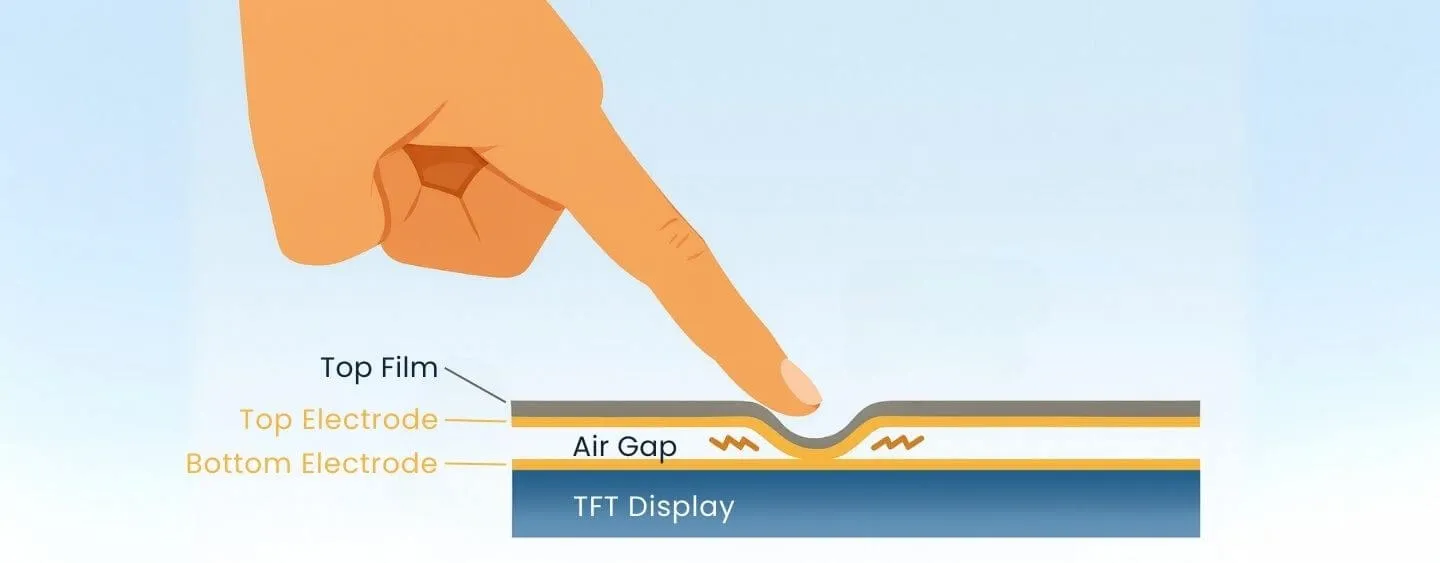
Resistive touchscreens locate touch by sensing pressure. They are typically composed of flexible and rigid layers that make contact under pressure to register input. Most resistive screens do not support multi-touch, though some models or software solutions can provide limited multi-touch recognition. A practical test: if a touch works using a fingernail, a plastic stylus, or other nonconductive pointed objects, it is likely a resistive screen.
Because resistive screens rely on pressure, they can be operated with gloved hands or insulators and with most styluses, unlike capacitive screens which generally require conductive contact.
Piezoelectric Touchscreens
Piezoelectric touchscreens combine characteristics of capacitive and resistive designs: they can offer multi-touch-like responsiveness while maintaining stable, precise input. Unlike capacitive screens, piezoelectric panels can be operated with gloves or wet fingers. Compared with resistive screens, piezoelectric panels tend to have a harder surface. Piezoelectric usage remains relatively uncommon; most products use either resistive or capacitive solutions.
Practical Considerations
Choosing between resistive, capacitive, and piezoelectric touchscreens depends on desired user experience and control requirements. Capacitive screens are widely used in modern consumer devices because they support multi-touch and offer fast, accurate input. Examples of devices that popularized capacitive multi-touch include the Apple iPod touch, iPhone, and iPad.
Resistive touchscreens have been in use the longest and have evolved more slowly. They are cost-effective and suitable for low-cost products or devices with simple, single-point control needs, such as basic MP3 or MP4 players.
An example of a Chinese-made device using a piezoelectric screen demonstrates a middle ground between capacitive and resistive approaches, showing how different technologies trade off hardness, touch recognition method, and environmental tolerance.