ALLPCB


The explosive growth of embedded AI, video, and control applications is increasing demand for heterogeneous processing to accelerate end-to-end computation within tight area and power budgets. Multi-chip solutions introduce significant power, area, and complexity overheads. Designers instead require single devices that support flexible, real-time preprocessing, efficient AI inference, and high-performance post-processing.
Versal Gen 2: Single-chip intelligence for embedded systems
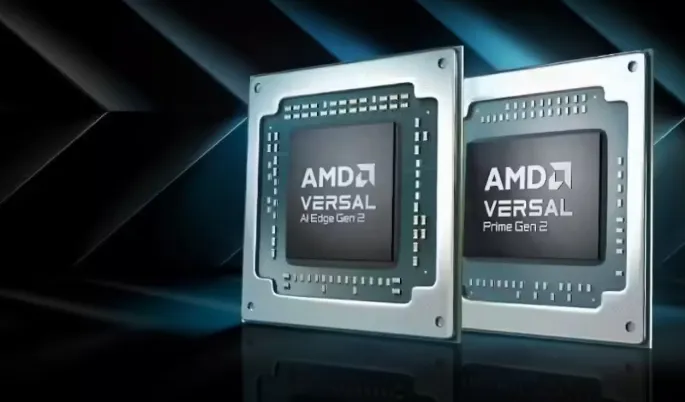
AMD is expanding its Versal product family to address these evolving needs. The AMD Versal AI Edge Series Gen 2 and AMD Versal Prime Series Gen 2 adaptive SoCs provide single-chip intelligence for AI-driven and traditional embedded systems, balancing performance, power, area, functional safety, and information security features.
End-to-end acceleration for AI-driven embedded systems
Versal AI Edge Series Gen 2 devices deliver end-to-end acceleration through the tight integration of heterogeneous processors, covering the three stages of embedded compute:
- Preprocessing: sensor handling, fusion, and data conditioning
- AI inference: execution of deep learning algorithms
- Post-processing: decision making and result handling
During preprocessing, programmable logic provides high performance and flexibility, supporting custom sensor combinations and low-latency processing pipelines to reduce system response time. In the AI inference stage, the AI Engine uses the AIE-ML v2 compute-tile architecture in Versal AI Edge Series Gen 2 for efficient inference. Compared with the AIE-ML compute-tile architecture in first-generation Versal AI Edge devices that used INT8 data types, the MX6 datatype in AIE-ML v2 delivers up to 3 times the TOPS per watt.[1] In post-processing, the Gen 2 AI Edge devices handle complex decision and control algorithms using enhanced integrated CPU systems. Scalar compute capacity in Versal AI Edge Series Gen 2 and Versal Prime Series Gen 2 is 10 times higher than the first-generation products.[2]
The second-generation AI Edge family includes a range of devices that enable engineers to meet performance and safety targets for applications such as autonomous driving, sensor-fusion smart cameras, and medical imaging.
Higher performance for traditional embedded systems
Versal Prime Series Gen 2 devices deliver high performance in a small footprint with flexible real-time sensor-processing capabilities for complex embedded workloads. These adaptive SoCs combine leading programmable logic with a 10-fold increase in scalar compute capacity compared with first-generation Versal Prime devices,[2] raising performance expectations for traditional embedded systems that do not require AI.
Versal Prime Series Gen 2 devices include new hard IP for high-throughput video processing, supporting multi-channel 8K workflows, and are suitable for UHD streaming and recording, robotics, and flight computers.
Tools, ecosystem, and lifecycle support
Selecting AMD Versal AC/ACIT SoCs provides access to a broad device portfolio and an established partner ecosystem with experience in high-safety, high-reliability, long-lifecycle, and safety-critical applications. Productivity is an important consideration in these designs; the adaptive SoC design tools, libraries, and embedded software ecosystem reduce development time and simplify design cycles. Combined with the latest Versal devices, these resources give designers and system architects the tools needed to design, develop, and scale embedded systems for current and future requirements.
Target applications
Versal Gen 2 solutions support advanced AI, control, and video applications. As compute demands increase for both AI-driven and traditional embedded systems, delivering end-to-end acceleration on a single device is increasingly important. Adaptive solutions that balance performance, power, area, functional safety, and information security are critical to meeting evolving requirements. These solutions target automotive, industrial, vision, healthcare, aerospace and defense, broadcast, and professional AV markets.
More information on Versal AI Edge Series Gen 2 and Versal Prime Series Gen 2 devices is available.
Notes
1. Based on AMD internal performance and power projections for the Versal AI Edge Series Gen 2 AIE-ML v2 compute-tile architecture using the MX6 datatype, compared with performance specifications and AMD Power Design Manager power results for the first-generation Versal AI Edge Series AIE-ML compute-tile architecture using the INT8 datatype. Assumption: 2-row by 8-column subarray. Operating conditions: 1 GHz Fmax, 0.7 V AIE operating voltage, 100 C junction temperature, typical process, 60% vector utilization, activation percentage < 10%. Final product performance may vary. Performance projection as of March 2024. (Revision 023)
2. Based on pre-silicon estimates of combined total DMIPs for the processing systems in Versal AI Edge Series Gen 2 and Versal Prime Series Gen 2 when configured with eight 2.2 GHz Arm Cortex-A78AE application cores and ten 1.05 GHz Arm Cortex-R52 real-time cores, compared with total DMIPs for the first-generation Versal AI Edge and Versal Prime Series. Versal AI Edge Series Gen 2 and Versal Prime Series Gen 2 operating conditions: highest available speed grade, 0.88 V PS operating voltage, split-mode operation, and supported maximum frequencies. First-generation Versal AI Edge and Versal Prime Series operating conditions: highest available speed grade, 0.88 V PS operating voltage, and supported maximum frequencies. Final product DMIP performance may vary. (Revision 027)