ALLPCB


Overview
As radar is used increasingly across product categories, technology and cost analysis firm System Plus Consulting performed a teardown of a radar chip to understand its implementation. For several reasons, the firm selected Vayyar's first-generation RF system-on-chip (SoC) for the analysis. The report focused on how Vayyar implemented a highly integrated single-chip RF SoC and on the SoC's capability to generate high-resolution 4D images.
Radar Market Context
Radar adoption has accelerated beyond traditional military use, driven by automotive and consumer applications. Imaging radar in particular has attracted attention as automakers and consumer-device designers pursue new sensing capabilities. Radar is moving into homes, passenger vehicles, and even some smartphone applications. For automotive use cases, OEMs and tier-one suppliers are investigating imaging radar for ADAS and in-cabin occupant detection.
System Plus Consulting Interest
Radar technology suppliers are watching smartphone opportunities as well. For example, Infineon and Google previously announced work on radar-based gesture control for the Google Pixel 4. Whether every smartphone will adopt radar remains unclear, but use cases are expanding rapidly.
Vayyar and the Walabot Product Line
Vayyar uses its RF SoC in the Walabot product family. The Walabot Home fall-detection system uses radar to monitor occupants and detect falls without requiring the monitored person to wear a device; it can sense through walls and curtains. Vayyar's chip analyzes many signals transmitted and received by integrated transceivers and processes them with a high-speed on-chip DSP. This integration attracted System Plus Consulting's interest.
Design and Integration
System Plus Consulting's cost analyst explained that Vayyar designed a small board containing the RF SoC and an MCU. The RF SoC can be paired with any external application processor selected by system integrators.
Vayyar's first-generation chip, the subject of this teardown, is a 3-10 GHz RF SoC. Because frequency regulations differ by region, Vayyar later developed variants operating in 57-64 GHz and 77-81 GHz bands to increase bandwidth and resolution.
The RF SoC integrates an on-chip DSP and multiple SRAM blocks within the transceiver die. The SoC supplies data to the Walabot board MCU, whose role is to convert SRAM data into a USB data stream. This architecture gives the RF SoC neutrality and flexibility so it can work with any external CPU or application processor chosen by the system designer, and, if required, can execute complex imaging algorithms on the on-chip DSP.
Beyond Walabot Home
Vayyar has also pursued automotive applications. In 2018, Vayyar partnered with tier-one supplier Valeo on radar sensors to monitor infant breathing and trigger alerts for potentially life-threatening situations, such as when a baby is left alone in a car. In November 2019, Vayyar raised $109 million in a Series D round led by Koch Disruptive Technologies, which became a strategic investor. In early 2020, Vayyar announced a partnership with Japanese automotive supplier Aisin Seiki to develop high-resolution 4D short-range external sensors for blind-spot detection and related use cases.
Walabot Home System Architecture
Walabot Home tracks occupant activity, detects falls, and determines whether assistance is needed. The compact sensor system processes low-power radio waves similar to Wi-Fi signals to determine occupant position. The RF SoC at the system core combines a 3-10 GHz transmitter and receiver with an on-chip DSP capable of high-speed processing. By analyzing transmitted and received signals, the SoC creates high-resolution 4D images without requiring an external CPU.
Using Walabot Home, Vayyar's technology can identify size, position, and motion of people and objects in real time without cameras, reducing potential privacy concerns associated with video.
UWB Operation
The system uses UWB signaling, sending and receiving very short RF energy pulses, from tens of picoseconds to a few nanoseconds, to detect occupants and their spatial position. UWB enables gigabit-per-second bandwidth when the band exceeds 500 MHz or fractional bandwidth exceeds 20%. Short pulses reduce sensitivity to interference caused by reflected waves.
System Plus Consulting noted that Vayyar's single RF SoC transmits and receives signals over the 3.3-10 GHz range. The Walabot Home solution uses two boards: one for the RF transceiver, SRAM data capture, and USB-class data streaming, and a second board for application processing and Bluetooth/Wi-Fi connectivity.
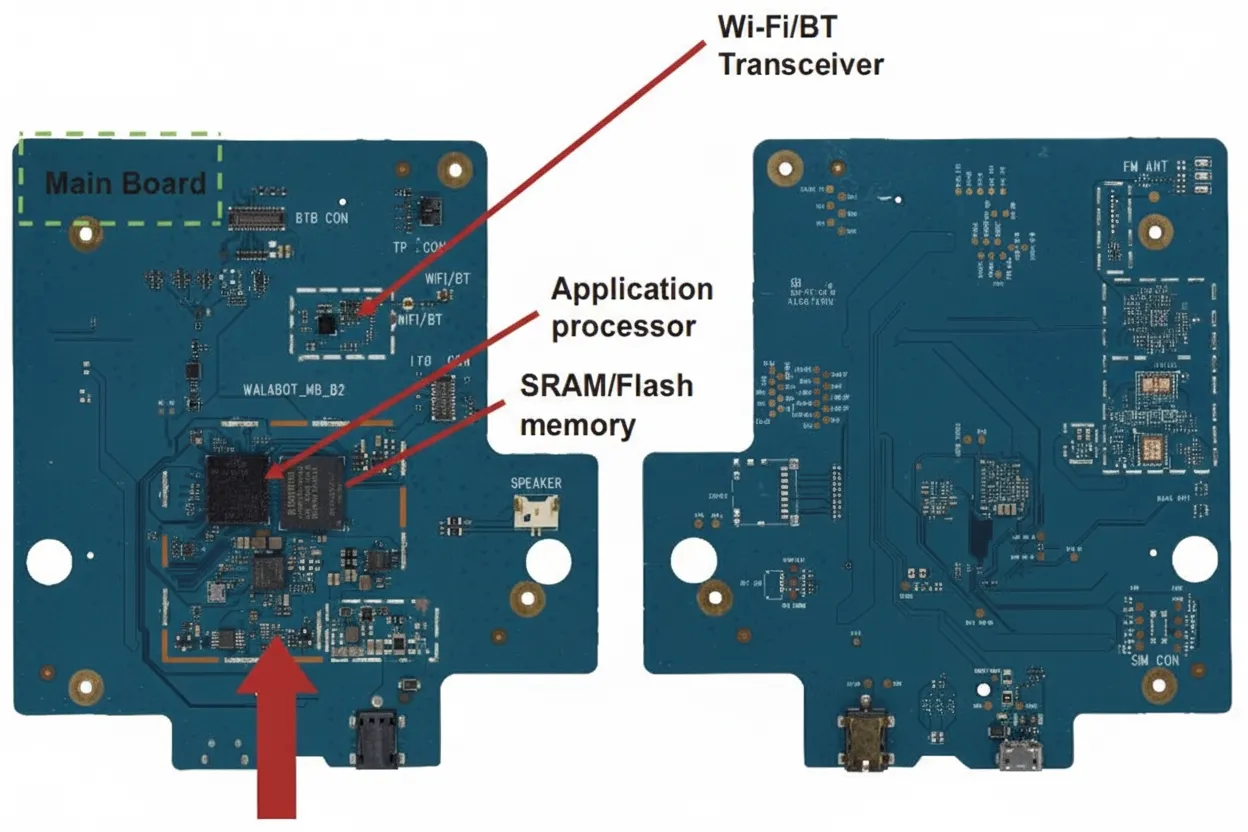
The two boards are connected by a flex PCB structure to improve flexibility and reduce space, weight, and cost compared with rigid-base solutions. Thermal management is implemented in two places: on the application processor and directly on a heatsink. System Plus Consulting speculated that the heatsink is cast from A380 aluminum alloy. A380 is a commonly used aluminum alloy with good fluidity and resistance to thermal cracking, enabling cost-effective, durable die-cast parts.
RF SoC Packaging and Function
The RF SoC provides 48 I/O paths from die to solder balls beneath the package; 42 of those are used to connect antennas. The transceiver die integrates a DSP and multiple SRAM memories that provide data to the MCU. Because the DSP is on-chip, complex imaging algorithms can be executed without an external CPU.
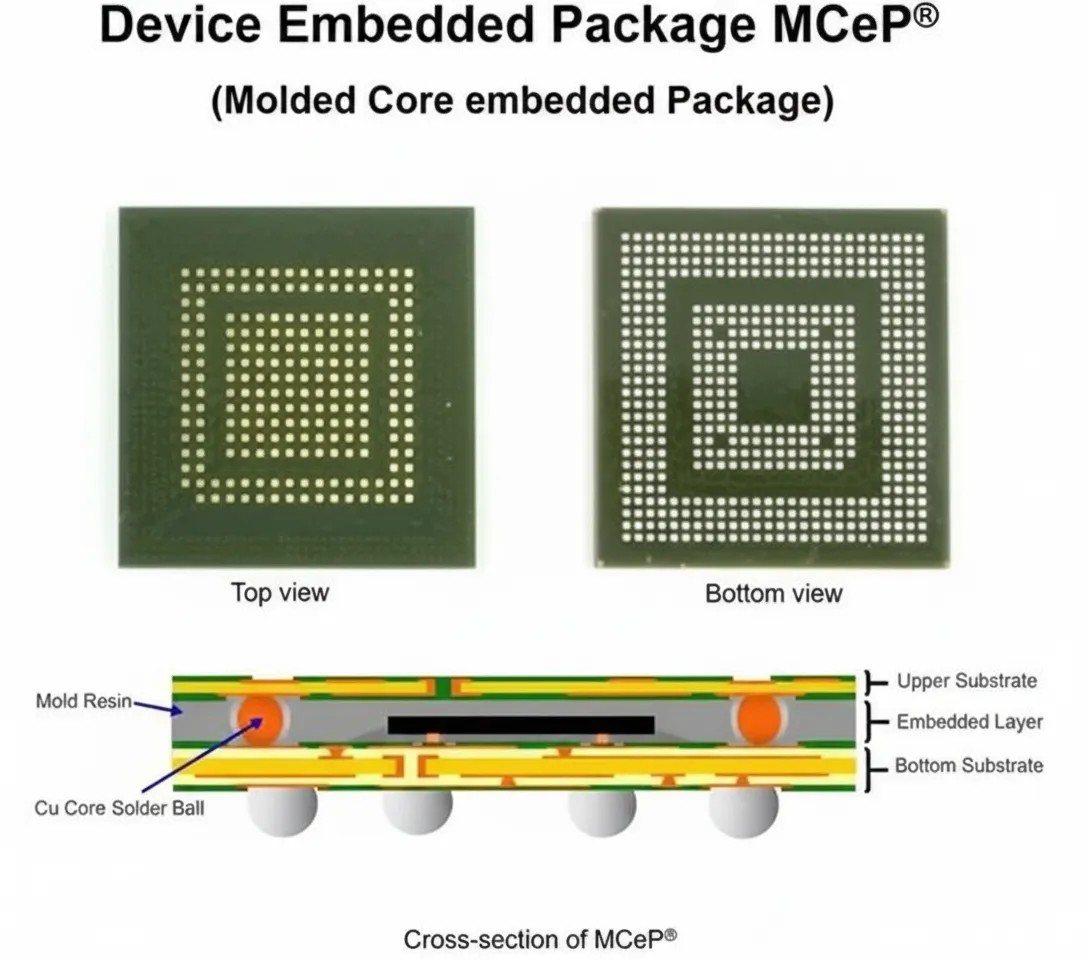
The RF SoC uses a lidless FCBGA package mounted on a 6-layer PCB substrate, which is soldered onto a 10-layer PCB substrate. The MMIC contains two orthogonal oscillators that generate an intermediate-frequency signal on-chip, which is processed directly by analog-to-digital converters (ADCs).
Supporting Components
In addition to the VYYR2401-A3 RF SoC, the system block diagrams show a Qualcomm MSM8909 processor for emergency communications and a Qualcomm codec/audio device for speaker and microphone management. The Qualcomm Snapdragon 210 MSM8909 is an entry-level SoC with four 1.1 GHz ARM Cortex-A7 CPU cores and integrated Bluetooth 4.1 + BLE, 802.11n (2.4 GHz) Wi-Fi, and Cat4 4G-LTE modem functionality.
The Cypress CYUSB2014 controller is a SuperSpeed peripheral controller that converts SoC RF analysis data to USB protocol. It features a fully configurable parallel GPIF II interface that can connect to any processor, ASIC, or FPGA. GPIF II is an enhanced version of the GPIF used in Cypress's FX2LP USB 2.0 product.
Antennas
The radar signal management board includes 21 antennas to ensure high resolution. Because the system operates in the 3-10 GHz range, antenna elements are relatively large (quarter wavelength approx. 15 mm). Larger antenna size necessitates a sizable RF board to support 21 elements, and multiple antennas improve resolution. The system's peak operating frequency is approximately 9.6 GHz, and antenna size depends on the bow-tie shape dimensions.
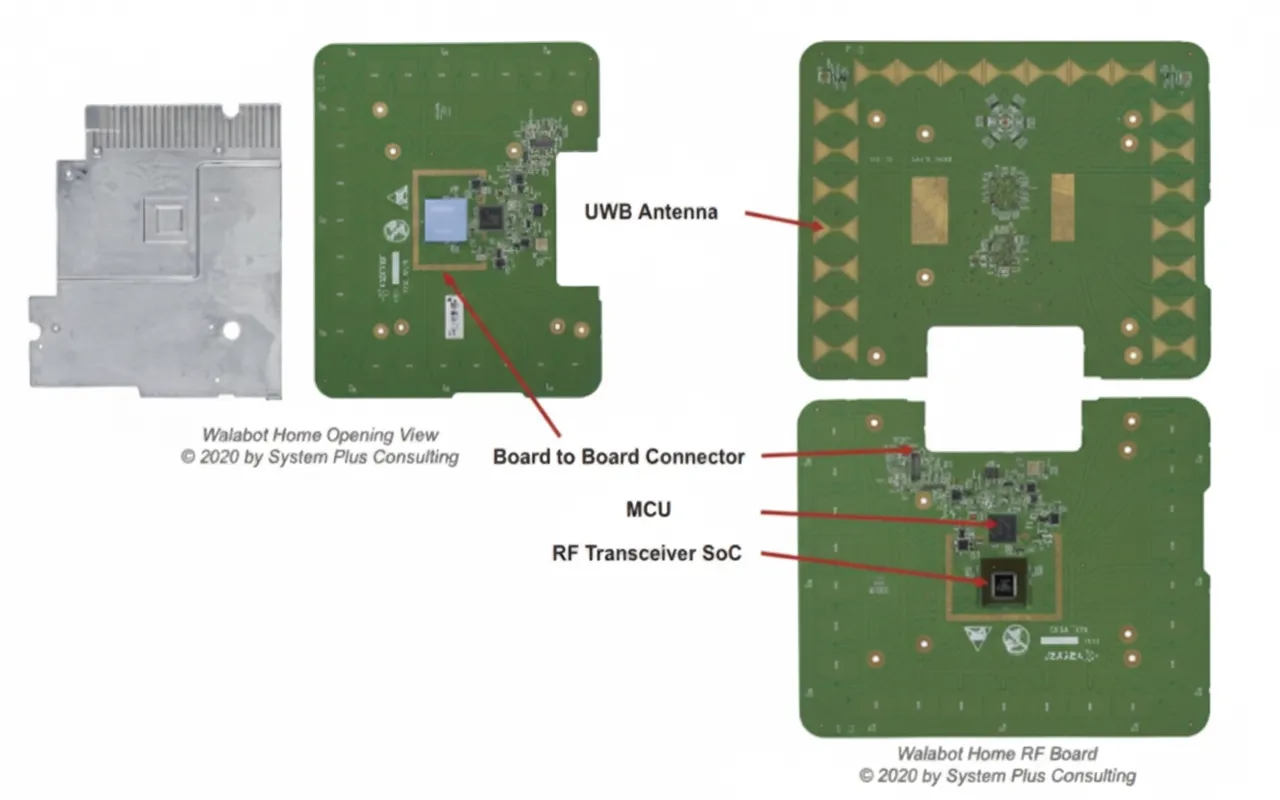
Bow-tie (butterfly) antenna designs are widely used in imaging, radar, Wi-Fi access points, and pulsed antennas due to their compact shape, wide bandwidth, low loss, and high radiation efficiency.
The bow-tie is a planar approximation of a biconical dipole topology. The design offers simple geometry and robust performance, enabling controlled input impedance and ease of manufacture at reasonable size and cost.
Cost Analysis
System Plus Consulting evaluated the system cost and analyzed why the RF SoC represents only about 10% of total system cost.
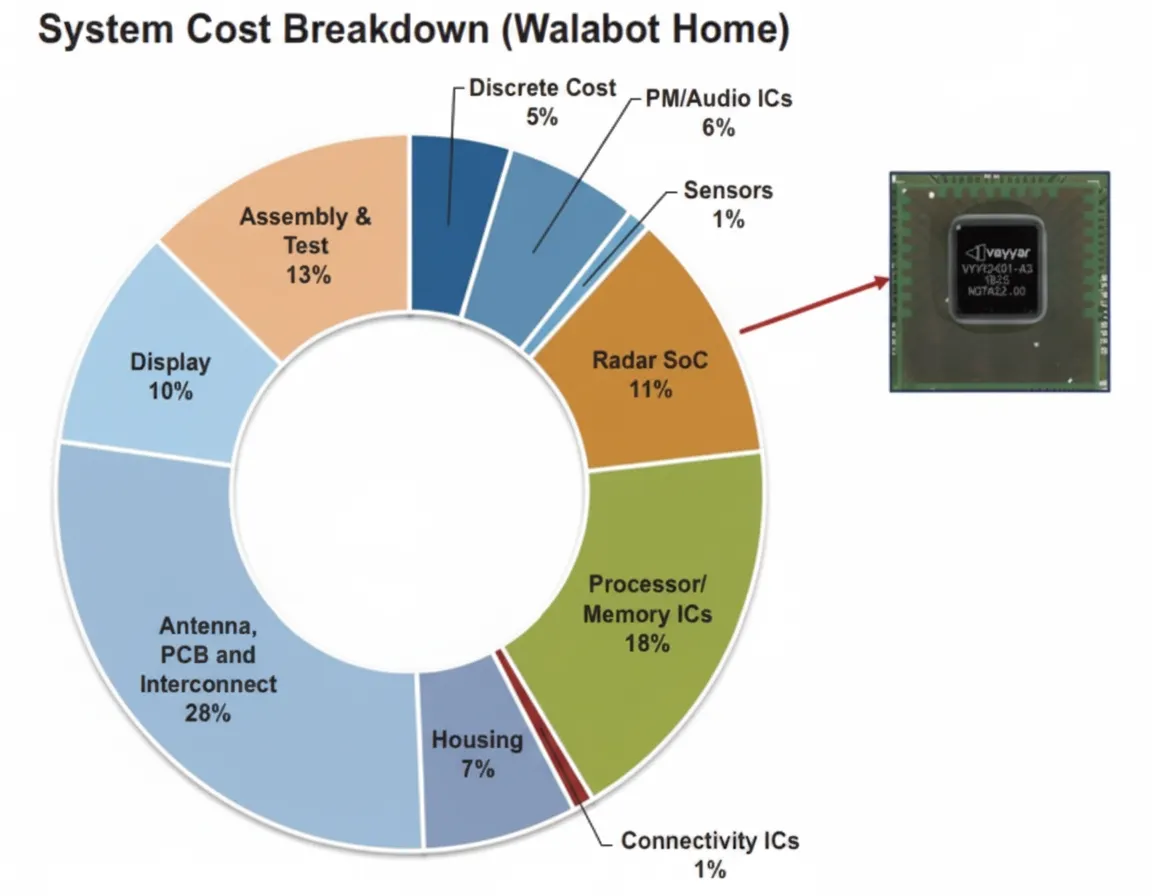
Because the system is large, nearly 30% of cost stems from printed circuit boards and interconnects (RF board, Wi-Fi/BT antennas, etc.). Memory (RAM, flash) and the application processor (Qualcomm Snapdragon 210) account for nearly 20% of cost. About 30% of cost comes from sensors, PMICs, RF front-end discretes, and other discrete components. The display contributes about 10% of the total.
Other VYYR SoC Variants
Vayyar developed other versions operating at 60-80 GHz that are now on the market. The VYYR7201-A0 operates at 57-64 GHz and is used in the Vayyar V60G-Home; it includes 46 linearly polarized PCB-embedded antennas for gesture recognition, indoor occupant detection, and in-car infant monitoring. The VYYR7202-A1 operates at 77-81 GHz and is used in the Vayyar V80G; it includes 40 linearly polarized antennas for in-cabin and exterior automotive sensing and intrusion detection.