ALLPCB


Introduction
In the daily work of electronics engineers, refrigerant leak detection in cooling systems is a key design area. This article examines Telaire's T3400 series refrigerant leak detection sensors and their distinguishing features.
File download: Amphenol Advanced Sensors T3400 A2L refrigerant detection sensor and evaluation kit.pdf
Operating principle and advantages
The T3400 series detects refrigerant gas leaks by evaluating the thermal conductivity of specific gas mixtures. When refrigerant is released, the resulting change in concentration alters the thermal conductivity of the air mixture, and a micro TCD sensing element measures that change. Compared with other detection technologies, thermal-conductivity-based detection offers long-term reliability and robust performance in harsh environments.
The series uses a second-generation MEMS thermal conductivity sensor with a patented "heat transfer cavity" that minimizes natural convection inside the cavity, enabling high sensitivity and repeatable thermal conductivity measurements. Thermal conductivity measurement is fully integrated on the sensor die, supporting device-level miniaturization. To compensate for the effects of humidity and pressure on thermal conductivity, the T3400 series also integrates relative humidity and pressure sensors.
Dimensional drawing
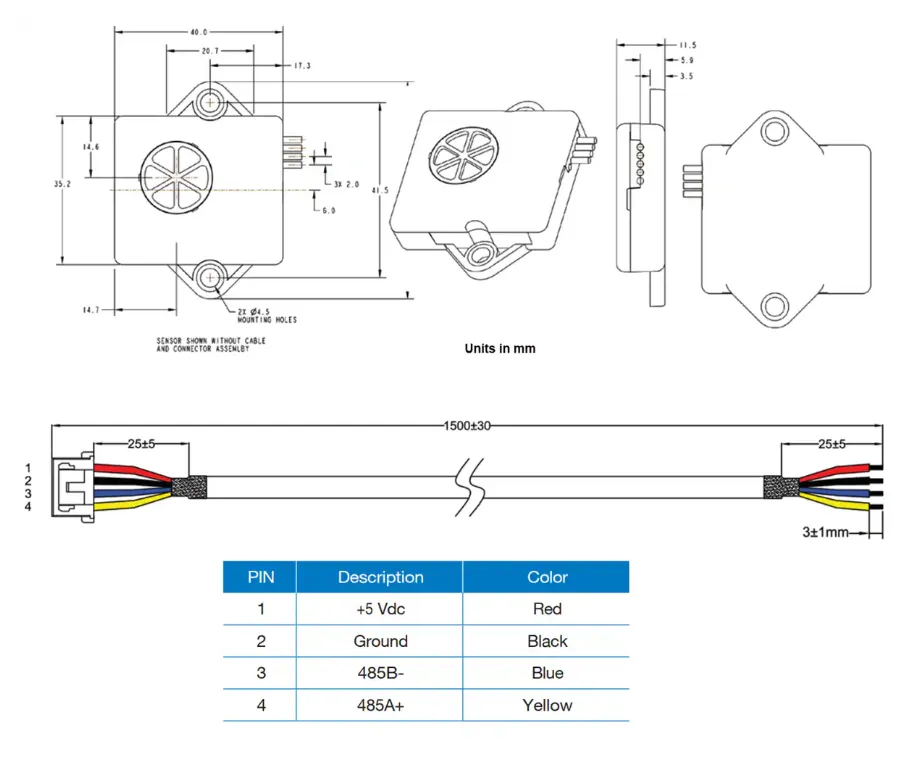
Product features
Long service life and stability
The T3400 series sensors have a service life exceeding 15 years, supporting long-term monitoring in residential and commercial HVAC systems, heat pumps, and refrigeration equipment.
Compact design and fast response
The sensors are compact, with a response time under 15 seconds. The small form factor facilitates installation in space-constrained equipment, while the fast response enables timely detection of refrigerant leaks to reduce safety risks and potential equipment damage.
High-accuracy measurement
The sensors provide accurate, stable, and repeatable measurements across different environments. In 15–25°C and 30–70% RH conditions, accuracy is ±2.5% LFL; across the full operating range, accuracy is ±5% LFL.
Technical specifications
Performance parameters
- Target gases: Primarily R454B and R32; other gases available on request.
- Measurement range: 0–100% LFL.
- Warm-up time: Typical 5 s.
- Response time: Typical 15 s (in accordance with UL 60335-2-40 Annex LL.3.2DV).
- Accuracy: See "High-accuracy measurement" above for details.
- Alarm setpoint: Typical 10% LFL, configurable.
- Communication: RS485 Modbus RTU.
- Compliance: UL 60335-2-40 certification (ETL Intertek 5032462).
Electrical and environmental parameters
- Supply voltage: 3.3–5.5 V dc, typical 5 Vdc.
- Peak operating current: Maximum 22 mA.
- Operating temperature: -40°C to 60°C.
- Storage temperature: -40°C to 90°C.
- Operating relative humidity: 0–100% RH.
- Operating pressure: 70–120 kPa.
- Ingress protection: IP54.
Installation notes
The T3400 series sensors must always be exposed to the measured air. Install the sensor where air exchange is maximized and avoid dead spaces. The module's vent openings should face downward; if downward orientation is not possible, maintain vertical orientation and never face the vent openings upward to prevent dust and water accumulation.
Evaluation kit
Telaire provides an evaluation kit for the T3400 series that can be operated from a standard PC interface. The kit includes a USB driver, an RS485-to-USB adapter, a T34xx refrigerant leak detection sensor, software, and user documentation, providing engineers with a development tool for system evaluation and testing.
Summary
With thermal-conductivity-based detection, integrated compensation sensors, and defined performance characteristics, the T3400 series provides a solution for refrigerant leak detection in cooling systems. Engineers designing related systems may consider this sensor for applications that require long-term monitoring, compact size, and fast response.