ALLPCB


As the most noticeable part of in-vehicle human-machine interaction, AR-HUD has developed rapidly. Driven by consumer demand and technology upgrades, AR-HUD systems now offer wider fields of view, clearer images, and richer functions. However, some AR-HUD or partial AR-HUD designs suffer from reduced performance, such as small image size, blurry imaging, or poor virtual-real integration. Stray light is a critical issue because it directly affects visual experience.
Stray Light: Optical "Noise" That Is Hard to Eliminate
In AR-HUDs, stray light refers to light from the external environment or the AR-HUD itself that reaches the display area via non-imaging paths. It is unintended system light, effectively optical noise. Drivers may tolerate tire or wind noise, but visual interference such as occlusion or stray reflections is typically unacceptable because visual processing and reaction are faster and more sensitive than auditory processing.
On the road, external lighting conditions are complex and variable. Stray light generated by the AR-HUD itself is not as controllable as in laboratory conditions. Even if the imaging path is well designed, unexpected stray light can still degrade image quality. In safety-critical situations such as high-speed driving, the impact of stray light is magnified. Therefore stray light can be a showstopper for AR-HUD optical design and must be addressed carefully.
Eliminating stray light tests both the supplier's technical capability and project experience.
Types of Stray Light and Mitigation Methods
External stray light sources for AR-HUD systems include mirror-edge stray light, glare from the outside of the dust cover, and stray light from surrounding interior trim. Internal stray light sources include multiple reflections between the LCD and the combiner mirror, LCD ghost images, edge reflections from the combiner mirror, stray light on the inner side of the dust cover, sunlight backflow, and reflections from structural components.
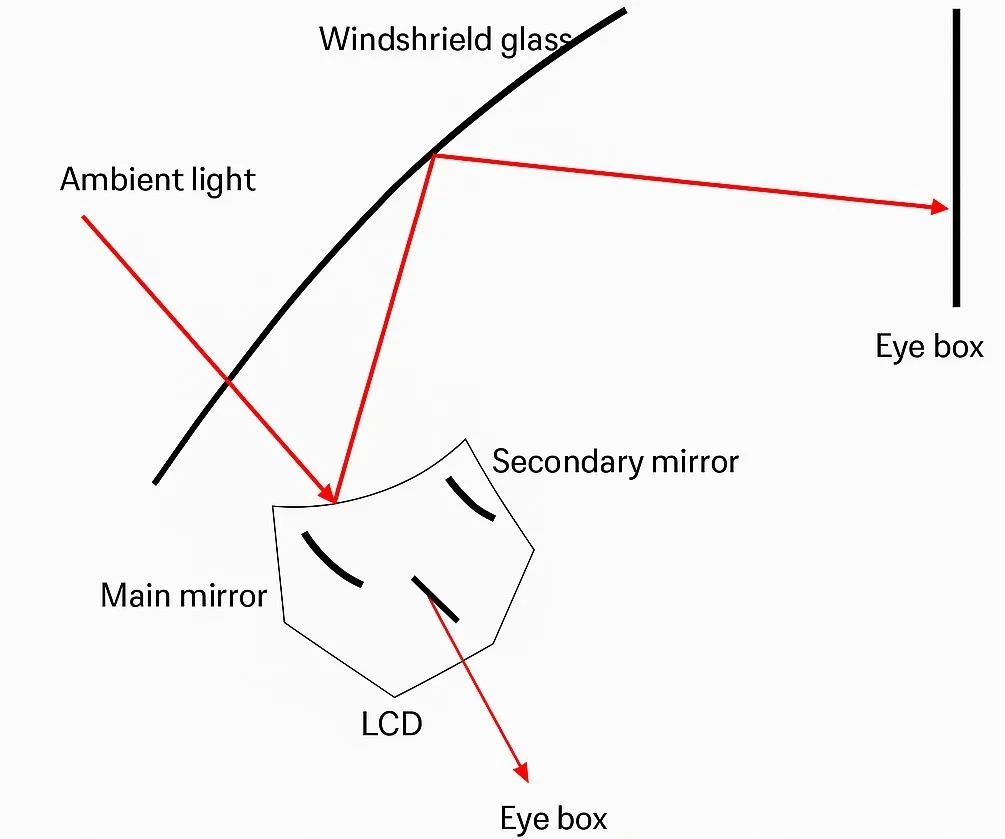
Diagram of glare formed by the outer side of the dust cover
External System Stray Light Mitigation
External light can enter the eye box through mirror-edge burrs or reflections from the outside of the dust cover, creating glare or ghost images on the windshield.
Mirror-edge stray light can be addressed by edge baffling or coating. Glare from the outside of the dust cover can be mitigated by adjusting the dust cover curvature so that reflections entering the eye box are blocked by the instrument panel (IP) platform, keeping external reflected light below the eye box.
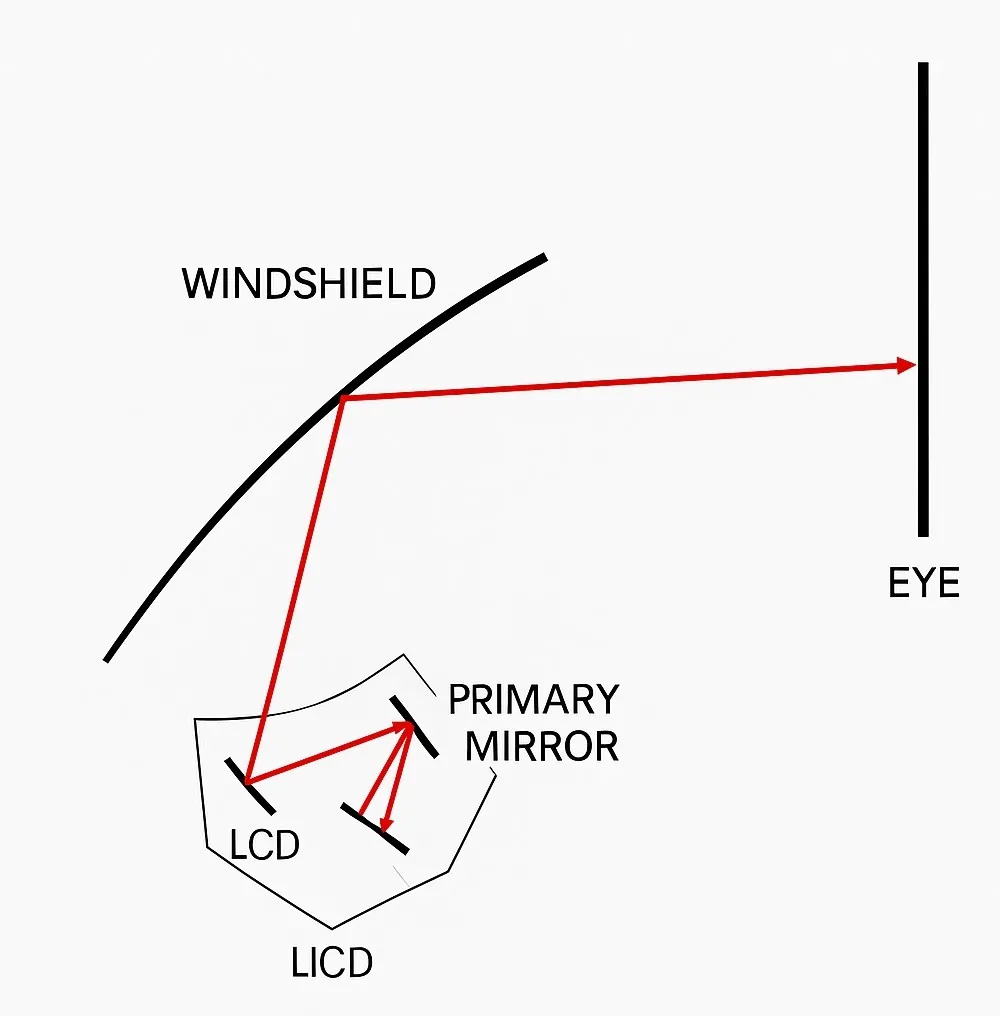
Stray light caused by multiple reflections between the LCD and the mirror
Internal System Stray Light Mitigation
Because the LCD is a light source, emitted light can follow non-design paths to the eye, producing internal stray light.
Multiple reflections between the LCD and the mirror, as well as sunlight backflow, can be mitigated by adjusting the LCD tilt angle. Stray light on the inner side of the dust cover can be reduced by adjusting the relative position and angle of the combiner mirror and by addressing reflective structural surfaces.
In optical design, stray light is difficult to capture in a single theoretical model. Ray-tracing analysis and successive design iterations do not yield a universal solution; eliminating stray light requires continuous analysis and accumulation of project experience to identify effective measures.
Design Practice
Based on these challenges, Jiangcheng established an optical design team early to explore stray-light mitigation methods that do not increase system volume, complexity, or affect imaging quality. The team has accumulated optical design experience and implemented solutions in production.