ALLPCB


Overview
For clinicians, accurate diagnosis and treatment depend on a clear picture of an individual's health. Routine checks performed at clinics or hospitals typically provide only static snapshots of a patient’s dynamic health status. For individuals, this can conflict with the need to continue working or to manage treatment at home, often making it difficult to follow prescribed care plans.
Remote Monitoring and Clinical Impact
The ability to view health data remotely via wearable devices has advanced healthcare delivery. A study conducted in the United States by the Global System for Mobile Communications Association (GSMA) on patients with chronic heart failure found that remote monitoring reduced hospitalizations and shortened hospital stays. An independent study reported that remote monitoring of chronic heart failure patients lowered the likelihood of readmission by 72%. An industry nonprofit similar to GSMA, composed of healthcare providers and technology companies, views remote monitoring and telemedicine as key tools to address the rising costs associated with chronic disease management.
How Wearables Improve Clinical Data
Wearable electronics provide patients and clinicians with continuous trend data that directly addresses the limitations of isolated clinical measurements. Unlike occasional statistics obtained in healthcare settings, wearable health products deliver long-term views of a person’s physiological state. Advanced wearables can even reflect health status in real time or enable remote diagnosis and limited interventions.
Next-generation Wearables
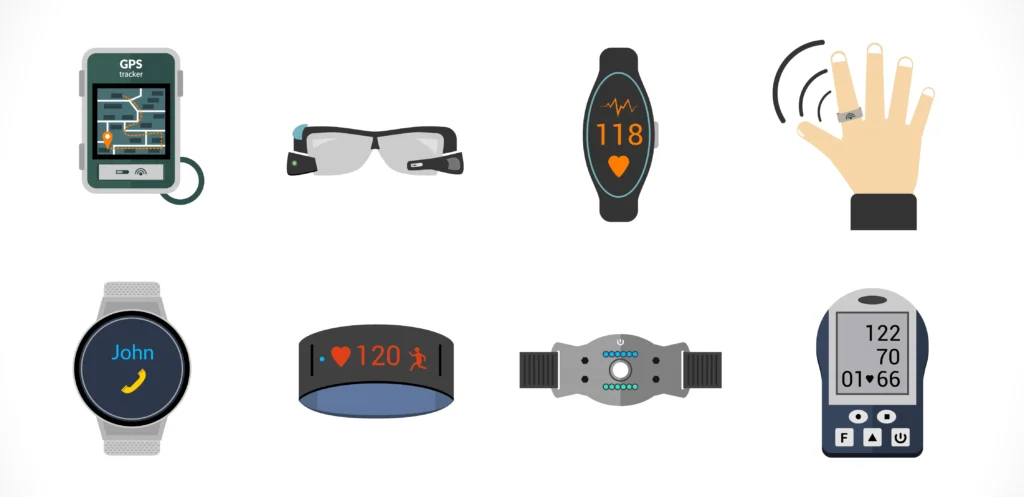
Simple fitness monitors have long tracked heart rate around the clock, but more sophisticated wearables are emerging to provide continuous diagnostic data. Examples such as iHealth Lab’s ambulatory blood pressure monitors, wireless ambulatory ECG devices, and wearable pulse oximeters combine wearable sensor systems and transmit data wirelessly via Bluetooth to a smartphone. The ambulatory blood pressure monitor is designed to be worn on undergarments for continuous monitoring without disrupting daily life. ECG electrodes and monitors are integrated into a lightweight unit that adheres to the chest and pushes data to the cloud for clinician access. Similarly, wearable pulse oximeters use finger-clip sensors connected to a comfortable wristband to provide continuous SpO2 measurements.
Fitness trackers are compact and designed for continuous, comfortable, unobtrusive wear. Devices such as Garmin Vivofit, LG Lifeband Touch, and Sony Core offer more powerful features and richer data for complex health and fitness applications, enabling additional guidance for wellness and training.
Embedded Sensors
The rise of next-generation wearables has been accompanied by rapid advances in sensors, ultra-low-power processors, wireless communications, flexible electronics, and packaging. Integrating sensor arrays into garments has been a significant development, enabling comfortable and discreet wearable diagnostic devices.
For example, AiQ smart clothing weaves ultra-fine stainless steel into fibers to form conductive meshes that monitor skin temperature and ambient humidity and that measure ECG, EEG, and EMG signals. Such sensor arrays can be embedded in clinical garments such as patient gowns and blankets to provide continuous, noninvasive streams of vital statistics for clinicians.
To reduce false negatives in current screening processes, First Warning Systems has embedded sensor technology into a smart bra to provide nonradiative, noninvasive diagnostic data while maintaining typical bra form. Multiple embedded sensors collect data that are analyzed by software to flag potential abnormalities in real time for clinicians. Clinical trials indicate the technology can detect tissue changes prior to the discovery of breast cancer, offering an early-warning capability that could improve screening effectiveness.
Wearable Medical Devices
Beyond monitoring, wearables are being applied therapeutically. Thimble Bioelectronics is developing a small patch that delivers transcutaneous electrical nerve stimulation (TENS) and electrical muscle stimulation (EMS) to provide localized therapy for pain. TENS/EMS devices connect individuals to home units or to equipment in a therapist’s clinic. Mobile patches capable of long-term, immediate therapy can help alleviate chronic pain.
Insulet’s OmniPod is a wearable insulin-delivery system paired with a personal diabetes manager (PDM). The PDM integrates a meter with wireless control of insulin delivery and manages a small wearable insulin pod. Unlike traditional infusion systems, the waterproof OmniPod can remain in place during swimming or showering without interrupting therapy or limiting an active lifestyle.
Designing wearables for medical, health, and fitness applications introduces unique challenges. Engineers must integrate advanced sensors, ultra-low-power embedded systems, and wireless communications within extremely small, biocompatible packages. Consumer-facing wearables such as wristbands also require attractive, comfortable, and modern accessories while maximizing battery life between charges.
Ultra-low-power MCUs
One of the biggest design challenges is reconciling power and performance. Highly integrated ultra-low-power microcontrollers are often at the core of wearable designs. For example, Insulet’s OmniPod uses an ultra-low-power S08 core architecture from Freescale Semiconductor. These MCUs integrate on-chip RAM, flash, timers, ADCs, and multiple interface options while offering very low-power modes with shutdown currents as low as 20 nA. With such low MCU power requirements, Insulet designed the OmniPod to run on two AA batteries.
For the Misfit Shine activity monitor, power constraints were even more stringent. Misfit determined that frequent recharging would undermine the device’s value as a sustainable wearable monitor. The Shine is powered by a user-replaceable CR2032 lithium battery and is expected to support feature-rich wireless operation for at least four months.
Given the limited power budget, Shine must run a set of complex algorithms on data from a 3-axis accelerometer while driving an LED-based user interface and maintaining wireless communication with a smartphone app. Misfit selected the Leopard Gecko MCU, a Silicon Laboratories ultra-low-power ARM Cortex-M3 variant. Features such as the low-power sensor interface (LESENSE) and the peripheral reflex system (PRS) allow LESENSE to collect sensor data while the MCU core sleeps and use PRS to enable peripheral autonomous communication, thereby reducing overall system power.
Intel’s Quark MCU targets wearables and highly embedded applications where low power and small size matter more than raw performance. The initial Quark X1000 integrated a 400 MHz 32-bit core, 512 KB SRAM, a DDR3 memory controller, and multiple connectivity options. Intel later added on-chip boot ROM to provide a hardware root of trust for authentication as wearable applications increased their security requirements.
Through the Edison development board, Intel offered a very small form-factor platform (roughly SD card size) that integrated a dual-core 400 MHz Quark, LPDDR2 and NAND flash, and both Wi?Fi and Bluetooth Low Energy connectivity.
Reference Designs
As more efficient electronic components and packaging formats appear, designers face the task of assembling hardware and software into practical wearable systems. To help engineers address wearable design challenges, manufacturers provide reference designs, development kits, and platforms. The Wearable Reference Platform (WaRP) is an example of a comprehensive open-source, extensible wearable design solution. WaRP combines a Freescale i.MX 6SoloLite ARM Cortex-A9 application processor, the Xtrinsic MMA955xL intelligent motion-sensing platform, the FXOS8700CQR1 6-axis digital sensor, Kyne tics software, and Rvolution Robotics hardware.
Texas Instruments offers the Chronos personal area network (PAN) and MSP430-based sensor node reference design with integrated sub-GHz radio transceivers. The Chronos platform uses a watch form factor and can wirelessly pair with heart-rate monitors, pressure sensors, and other measurement units.
Movea, in partnership with TI and Xm-Squared, introduced the G-series wearable wristband reference design for monitoring activity, posture, sleep, and metrics such as speed and cadence. The reference design integrates Movea’s Motionsport embedded library, Xm-Squared’s band design, and Texas Instruments’ low-power CC2541 SoC, which provides Bluetooth Low Energy 2.4 GHz wireless communication. For medical applications, one notable capability of this reference design is support for sleep analysis that approaches the multi-channel results used in clinical sleep studies.
Conclusion
Wearable products address shortcomings in the quality and timeliness of clinical statistics. By providing rapid access to long-term monitoring results, wearable technologies can supply clinicians with data for faster, more accurate diagnosis and help reduce the rising costs of chronic disease management and pain treatment. As advanced sensors, ultra-low-power MCUs, flexible electronics, and new packaging formats continue to appear, wearables will expand beyond high-cost hospital and home devices into broader healthcare, fitness, and wellness applications. Emerging reference designs and development kits offer a practical starting point for developers entering the wearable space.