ALLPCB


Overview
A capacitive touchscreen is essentially a precision leakage sensor. It relies on capacitance, so a gloved hand cannot operate it effectively. Because it senses via electrical coupling, touch positions can exhibit drift.
How capacitive sensing is implemented
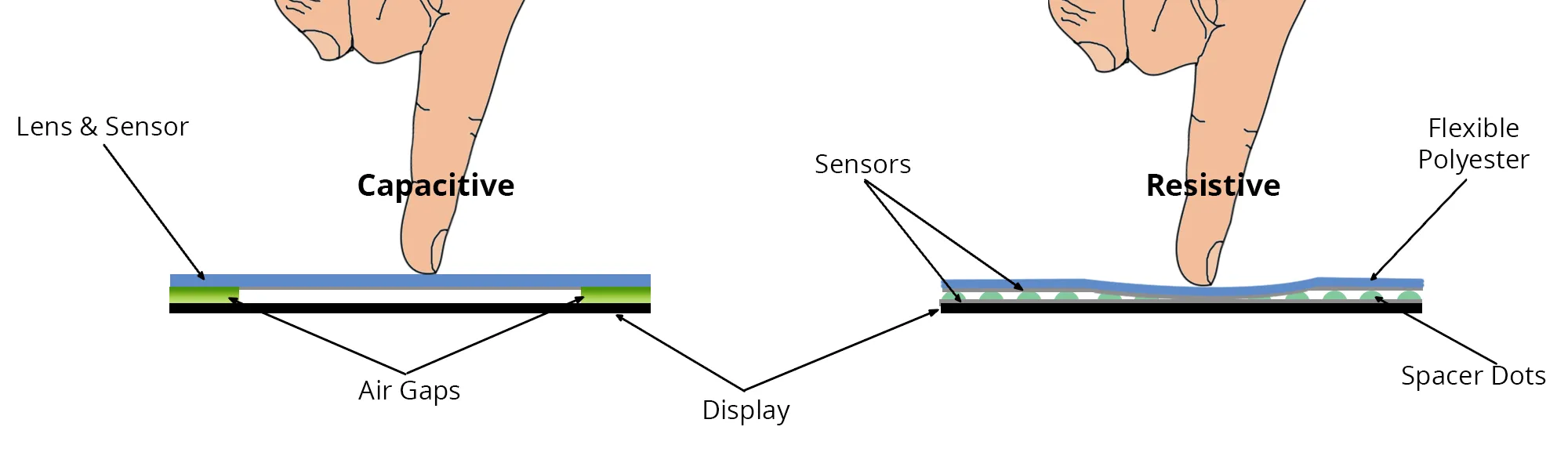
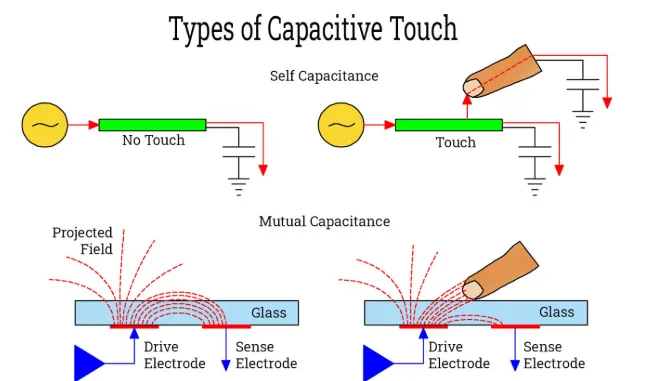
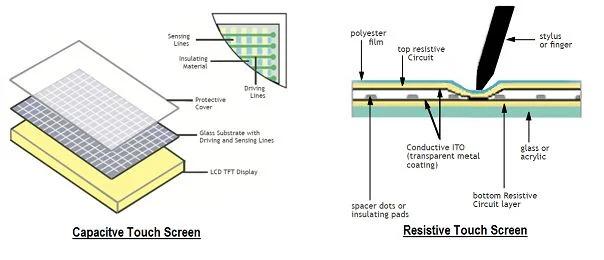
Transparent conductive materials such as ITO are brittle and cannot serve reliably as a bare working layer. To protect them, manufacturers add a very thin, hard cover glass. That glass is nonconductive, so the system uses high-frequency AC signals rather than DC. A user’s fingertip, separated from the sensing layer by the thin glass, forms a coupling capacitance with the sensing surface and draws an AC current. This coupling is the origin of the term "capacitive" in capacitive touchscreens.
Why drift occurs
Drift arises because coupling capacitance is inherently unstable. It is affected by temperature, humidity, finger moisture, the user’s body mass, floor dryness, and the presence of large nearby objects. These environmental and user-dependent variations violate the assumptions of an absolute coordinate system and inevitably produce drift. Some devices attempt to compensate by using extensive calibration procedures, such as 25-point or 96-point calibration, but drift is a consequence of the sensing method. Controller firmware can apply dynamic calculations and lookup tables to mitigate symptoms, but these measures do not eliminate the fundamental cause.
Calibration limitations and multi-touch behavior
Multi-point calibration was originally used for large projection touch panels to correct geometric distortion. Capacitive touch calculation typically assumes ideal proportional relationships between four current measurements and the distances from the touch point to four electrodes. In practice, environmental capacitance, parasitic capacitances in the wiring, and variations between users make those proportional relationships nonideal. Multi-point calibration can correct local linear allocation errors, but it cannot resolve overall system drift caused by nonideal coupling.
Mechanical and optical constraints
The thin protective glass is fragile. Manufacturing requires low-hydrogen conditions because hydrogen can form defects that make the glass brittle; even a small inclusion can lead to cracking. A crack renders a roughly 5 cm diameter region around it unusable. In production, a nonzero fraction of panels may exhibit such defects.
Capacitive screens can also suffer from reflection, color shift, and image softness. However, capacitive touchscreens generally offer better transmittance and visual clarity than four-wire resistive screens, especially in newer designs.
Practical notes
Advances in technology have reduced drift in many products, making capacitive touchscreens suitable for most applications. Variants include standard, ruggedized, and through-glass touch designs. Screen drift on touchscreen phones can result from multiple factors beyond poor chargers. Avoiding unfavorable operating conditions helps protect capacitive screens and extend their service life.