ALLPCB


Overview
With the arrival of virtual reality products such as Oculus and VIVE, the VR industry has gained broader visibility. However, even the most advanced headsets still cannot fully eliminate motion sickness, which remains a serious barrier to wider adoption.
Four main causes of VR motion sickness
1. Sensory conflict: Motion sickness arises when the visual input from the VR display does not match signals from the vestibular system in the inner ear. The brain receives conflicting information about motion and position, which can cause nausea. For example, during a VR "roller coaster" ride the eyes perceive rapid movement while the vestibular system indicates no physical motion, producing dizziness.
2. Latency and lag: Movement observed in the headset can lag behind the user's actual head movement. In a fully immersive display, such delay is a major contributor to motion sickness.
3. Interpupillary and alignment mismatches: Because users have different interpupillary distances, the pupil center, lens center, and image center may not align for some people. This can produce ghosting or double images, which become uncomfortable over time.
4. Depth-of-field mismatch: When rendered depth cues do not match natural focus behavior, discomfort can result. For example, if a user focuses on a nearby cup while a distant object remains equally sharp instead of appearing blurred, the mismatch between accommodation and perceived depth can cause sickness.
Overall, current VR systems do not always simulate reality accurately enough to "trick" the brain; the resulting sensory conflict can overload processing and trigger motion sickness.
Approaches to reduce motion sickness
1. Galvanic vestibular stimulation (GVS)
One approach targets the vestibular system directly. A company called vMocion is developing a solution based on research from the Mayo Clinic aviation medicine and vestibular lab. The technique, known as galvanic vestibular stimulation (GVS), places electrodes at strategic locations (two per ear: one anterior and one posterior) to stimulate perceived motion in sync with visual motion cues. If effective, GVS could make virtual maneuvers such as dives or turns feel consistent with visual input and improve immersion.
2. Reducing system latency
A key metric is the time between a head movement and the corresponding update of the displayed image. Research indicates head-motion-to-photon latency should not exceed about 20 ms; higher latency tends to produce motion sickness.
Meeting a 20 ms budget is technically demanding. The system must precisely measure head rotation speed, angle, and position using sensors such as inertial gyroscopes (fast response but limited accuracy) or optical tracking. The renderer and display must then produce and show the updated frame within that interval. Frame-to-frame intervals exceeding 20 ms are perceptible and can cause discomfort, so VR displays typically target frame rates above 50 fps. Sixty fps is a baseline, but higher rates improve comfort: Oculus Rift CV1 and HTC Vive use 90 Hz, while Sony Project Morpheus targeted 120 Hz.
Another strategy is low-persistence displays. Low persistence reduces perceived motion blur during head movement, making object trajectories appear closer to those in the physical world. LCDs struggle with low persistence, so many VR systems use OLED/AMOLED panels because each pixel is emissive and can achieve lower persistence. Oculus and Valve have used AMOLED displays, and Sony has used OLED.
3. Adjustable lens and image alignment
Early smartphone-based viewers often did not provide adequate adjustments for differing interpupillary distances or image centers. Some manufacturers, starting with Samsung, introduced mechanical adjustment mechanisms to change the distance between lenses. Other designs allow software or controller-based adjustment of the displayed image center, for example via a Bluetooth controller, so that the image center, lens center, and eye center can be aligned. Proper alignment reduces ghosting and related discomfort.
4. Light-field capture and display
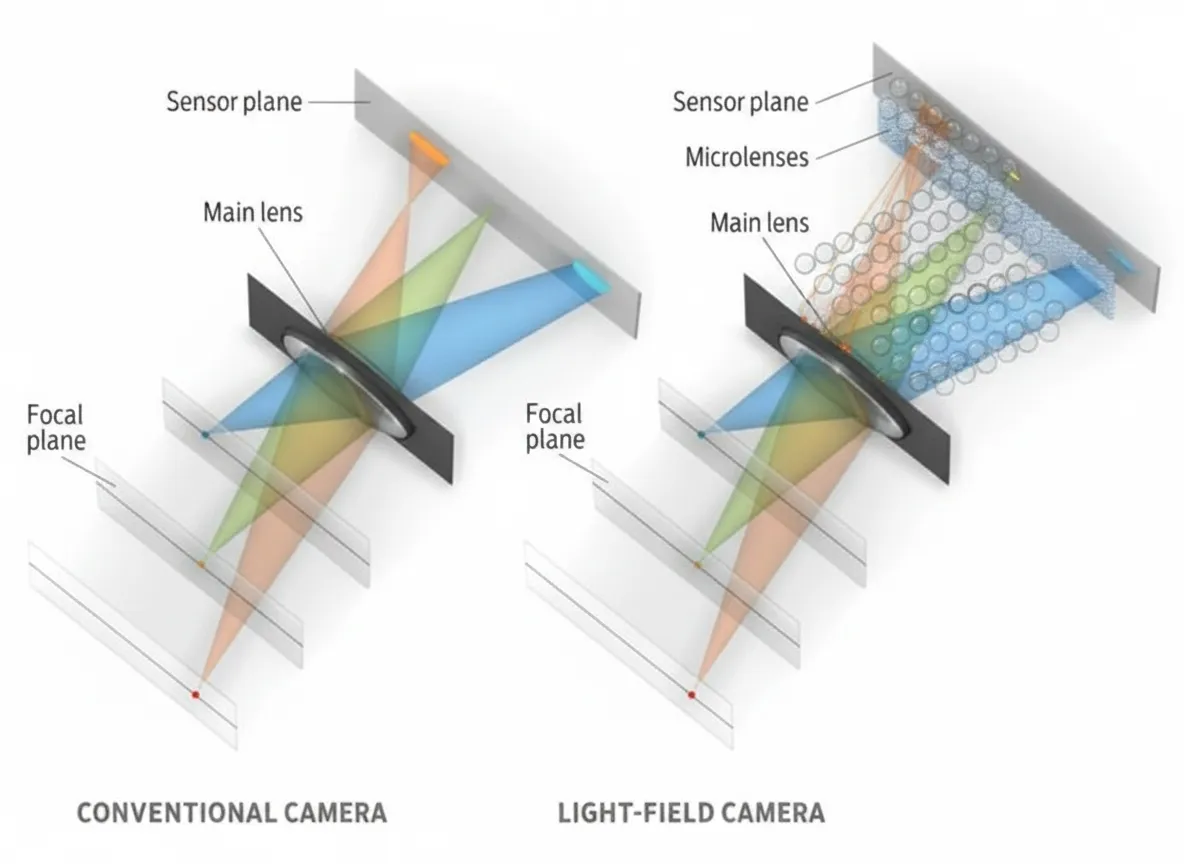
Light-field imaging captures not only the total light intensity at each sensor but also the direction of incoming rays. With that information, a single capture can be refocused, reexposed, and have its depth-of-field adjusted after acquisition. This enables generating different focal planes from the same moment in time, matching how a viewer might refocus between foreground and background.
Some companies, for example Magic Leap, aim to deliver a digital light field directly to the retina so users can select focal points naturally, allowing accurate integration of real and virtual depth cues. This approach addresses accommodation-convergence conflicts from a different angle and may reduce reliance on high refresh rates and conventional resolution improvements.
5. Adding fixed visual references
Researchers at Purdue University found that adding a stable visual reference, such as a virtual nose, inside the VR scene reduces motion sickness. In tests with 41 participants, those presented with a virtual nose tolerated VR scenes for longer periods. Investigators suggest that even adding a stable reference like a vehicle dashboard can provide similar benefits by giving the visual system a fixed anchor.
Conclusion
Motion sickness remains a significant obstacle to broader VR adoption. Multiple technical approaches are being explored, including vestibular stimulation, lower system latency, improved display persistence, optical and alignment adjustments, light-field techniques, and simple visual anchors. Continued research and engineering improvements are expected to reduce these issues over time, enabling more comfortable VR experiences.