ALLPCB


Overview
Fingerprint unlocking is not new. As early as 2013, Apple added Touch ID to the iPhone 5S. Android phones followed, making fingerprint sensors a common smartphone feature. However, as industrial design advanced, traditional fingerprint methods could not meet the stricter requirements of bezel-free displays.
Under-display fingerprint sensing did not appear on the iPhone X, which replaced Touch ID with Face ID. Rumors that Apple has continued under-display fingerprint development persisted, but development timelines have been a factor.
Why under-display fingerprint sensing is difficult
Fingerprint recognition is one of several biometric methods such as face, voice, and iris recognition. Fingerprints are the most widely used. Smartphone fingerprint capture methods are mainly capacitive, optical, and ultrasonic. Capacitive sensors currently have the largest market share in smartphones.
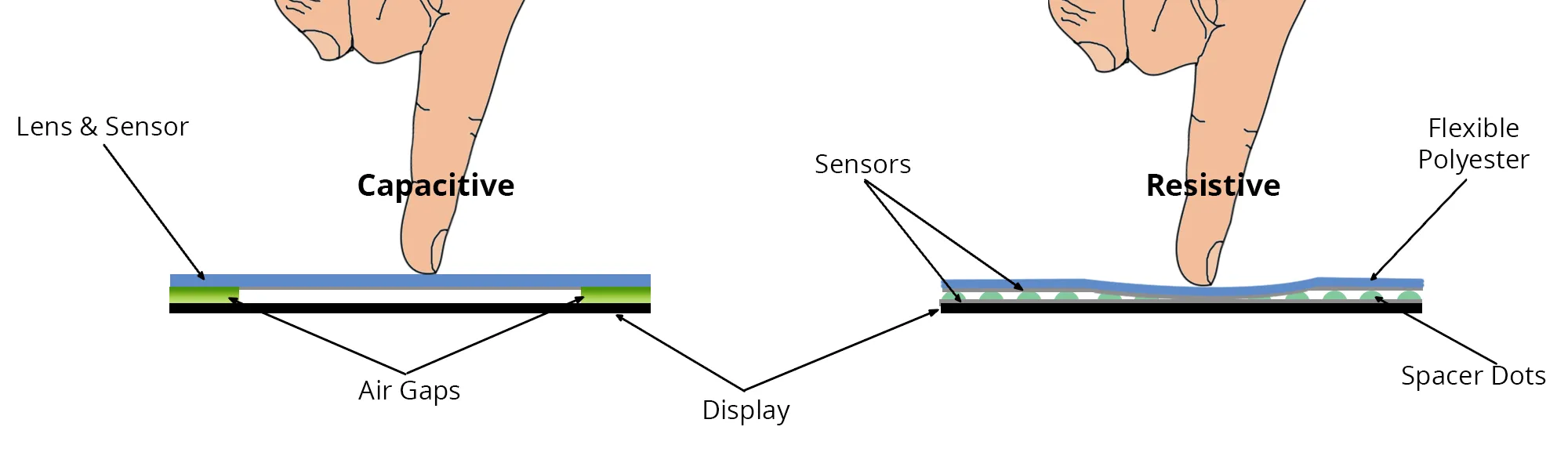
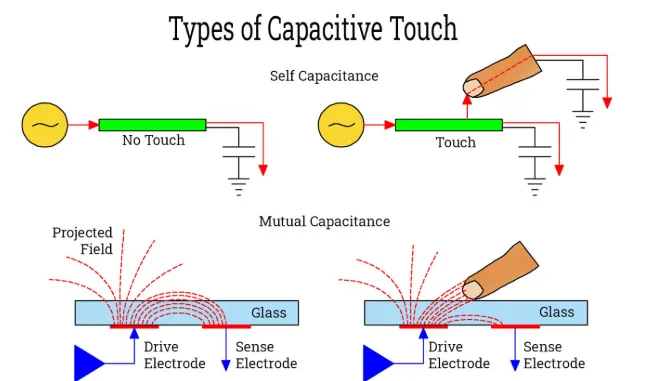
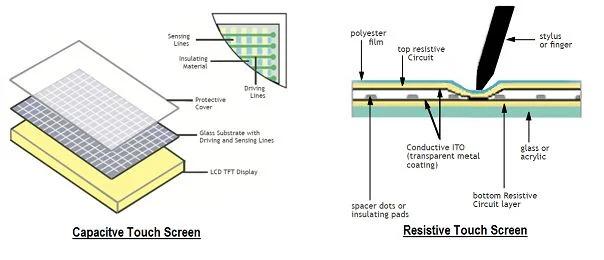
Capacitive sensors measure tiny capacitance differences caused by ridges and valleys on the fingertip. They translate those differences into electrical signals for matching. A key limitation of capacitive sensors is their poor through-display penetration: the thickness of screen modules prevents them from collecting enough usable signal when the finger is placed on the screen. That makes front-facing capacitive fingerprint solutions unsuitable for phones with near-fullscreen designs.
“Full-screen” refers to a phone front largely occupied by the display with narrow bezels and high screen-to-body ratio. Current full-screen phones typically reach about 80% screen occupancy rather than 100%. To move closer to a truly full-screen front, under-display fingerprint sensing must be solved.
Under-display fingerprint sensing, also called invisible fingerprint sensing, performs fingerprint capture beneath the display glass using optical, ultrasonic, or other through-material sensing techniques. It collects fingerprints without direct contact between the finger and the fingerprint module, preserving the display surface and reducing the impact of dirt, oil, and sweat on recognition.
Main under-display approaches
Known under-display solutions are mainly optical implementations that leverage OLED displays, and ultrasonic solutions. Optical systems place an optical sensor under the display and illuminate the finger, often using infrared. Ultrasonic systems use ultrasound sensors under the display to image fingerprint features.
Under-display sensing positions the fingerprint sensor beneath the display module to support both a full-screen front and fingerprint recognition. “In-display” fingerprint sensing is a further evolution in which the sensor is integrated within the OLED pixel matrix, which is more complex.
Because capacitive sensing has limited penetration, optical and ultrasonic approaches are the most viable for under-display and in-display fingerprint sensing.
Optical approach and industry maturity
Optical under-display solutions are represented by companies such as Goodix and CrucialTec, while ultrasonic solutions are represented by Qualcomm. Optical sensing relies on light reflection to detect fingerprint ridges and valleys. OLED displays are better suited to optical under-display sensing because they are emissive, allowing pixel-level control and thinner modules that enable more light to pass through. Optical methods currently show stronger maturity and precision in the supply chain and are a likely candidate for common adoption in full-screen phones.
Goodix demonstrated an optical in-display fingerprint solution integrated into OLED screens using prototype devices. Their approach placed a CMOS optical sensor under the OLED panel so the user can touch a designated screen area for recognition.
CrucialTec obtained a patent related to display fingerprint solutions (DFS) and announced plans for commercialization. Unlike Goodix’s approach, DFS supports fingerprint unlocking at arbitrary screen locations and can be compatible with flexible OLED panels. DFS is not limited to optical sensing and can also support capacitive approaches. Because sensor placement beneath the display often reduces recognition reliability and limits coverage to a portion of the screen, DFS aims to enable unlocking across the entire display while improving recognition and addressing thickness constraints.
Optical working principle
OLED is an emissive display technology, which allows each subpixel to be controlled individually and provides better optical transparency paths between pixels than TFT-LCD. TFT-LCD relies on a backlight and passive layers that are less transparent, so placing a sensor beneath TFT-LCD typically requires structural changes that still produce significant backlight interference. That makes TFT-LCD under-screen optical fingerprint sensing difficult to implement.
Because OLED displays are thinner and emissive, several development directions exist:
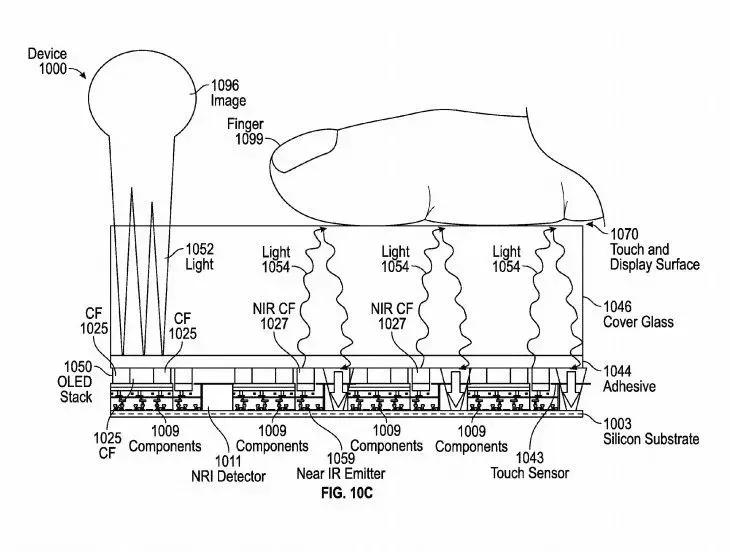
- Place a CMOS sensor under the screen and use gaps between OLED subpixels to let light pass to the sensor.
- Reduce the sensor size to fit between OLED pixels.
- Make a transparent CMOS sensor and mount it directly above the AMOLED to form a dedicated sensing layer.
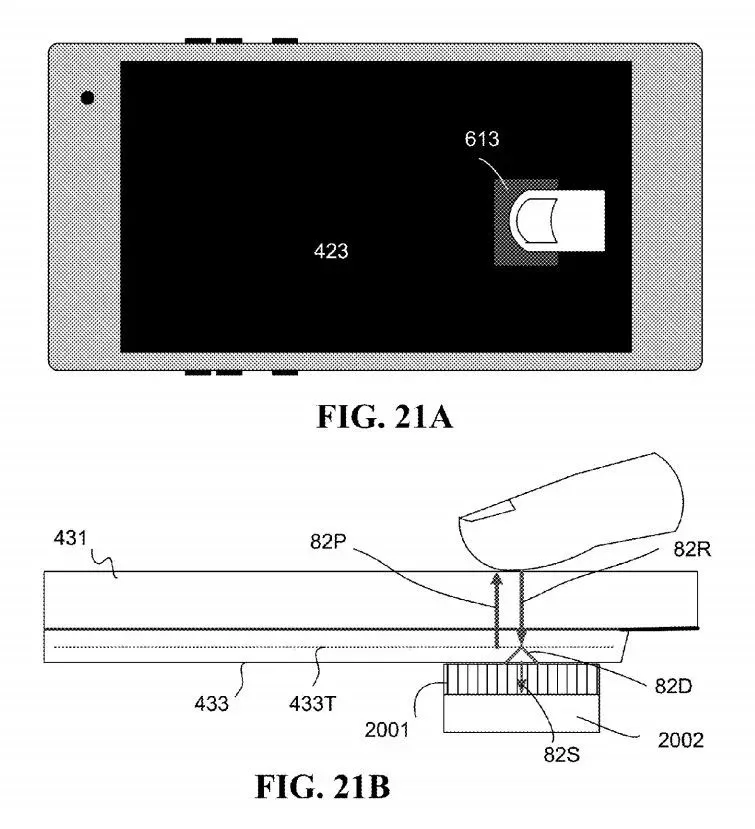
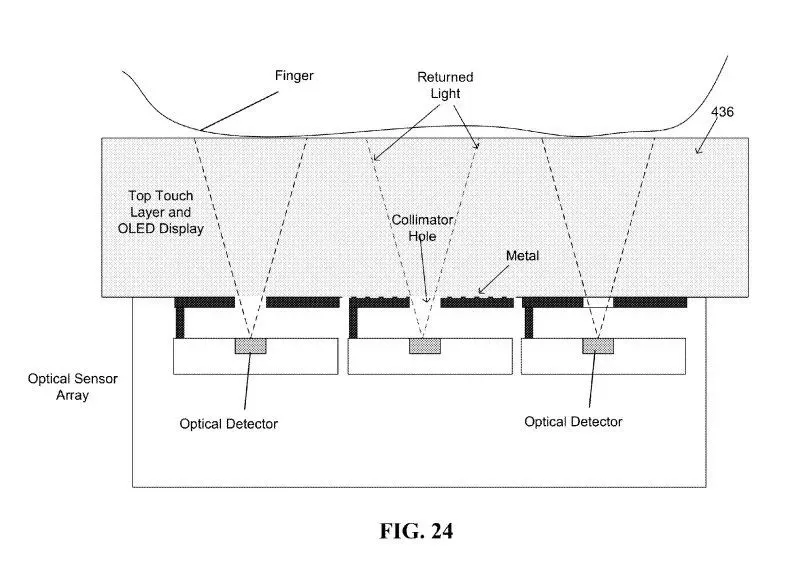
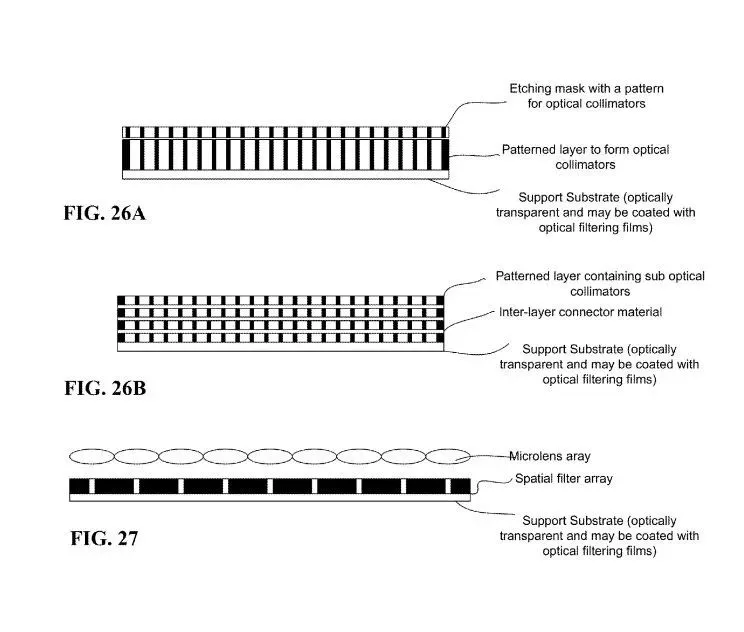
Some companies have demonstrated prototypes using AMOLED displays. Goodix’s patent diagrams illustrate sensor placement beneath the display. Micro-scale structures such as collimator holes, micro-lens arrays, and optical spatial filter arrays are used to ensure the collected light originates from finger reflections rather than display emission or external light. The micro-lens array may require MEMS or chemical processing. These optical elements help collimate light so the sensor receives mostly the fingerprint-reflected light.
Conclusion
Both optical and ultrasonic under-display fingerprint approaches have made significant technical progress. Optical solutions currently benefit from OLED compatibility and supply chain maturity, while ultrasonic solutions offer material-agnostic sensing and improved robustness. Continued algorithm refinement and integration work across the supply chain are required before large-scale, reliable deployment becomes widespread.