ALLPCB


Overview
Human hearing covers roughly 20 Hz to 20 kHz. Sound with frequencies above 20 kHz is inaudible and is referred to as ultrasonic. Ultrasonic waves have good directivity, strong penetration, and can concentrate acoustic energy; they propagate relatively far in water and are used for distance and speed measurement, cleaning, welding, particle fragmentation, sterilization, and other applications across medical, military, industrial, and agricultural fields. Common examples include ultrasonic cleaners, humidifiers, medical ultrasound imaging, and flaw detectors.
Ultrasonic Transducers
Sound is produced by vibration; devices that generate or detect ultrasonic waves are called ultrasonic sensors or transducers. Typical ultrasonic probes are built from piezoelectric elements and can both transmit and receive ultrasound. Materials and the dimensions (diameter and thickness) of the piezoelectric elements vary, so probe performance differs between models and should be understood before use.
Piezoelectric Transmitter/Receiver Operation
Common ultrasonic generators use piezoelectric crystals operating at resonance. A typical ultrasonic probe contains two piezoelectric elements and a resonant plate. When a pulsed voltage whose frequency matches the crystal's natural resonance is applied across the electrodes, the piezoelectric element resonates and drives the plate to emit ultrasound. Conversely, when no driving voltage is applied and the resonant plate receives an incoming ultrasonic wave, it compresses the piezoelectric element, causing it to vibrate and convert mechanical energy into an electrical signal; the probe then functions as a receiver. Ultrasonic sensors convert between electrical energy and ultrasonic energy based on the piezoelectric effect.
Ultrasonic Ranging Principle
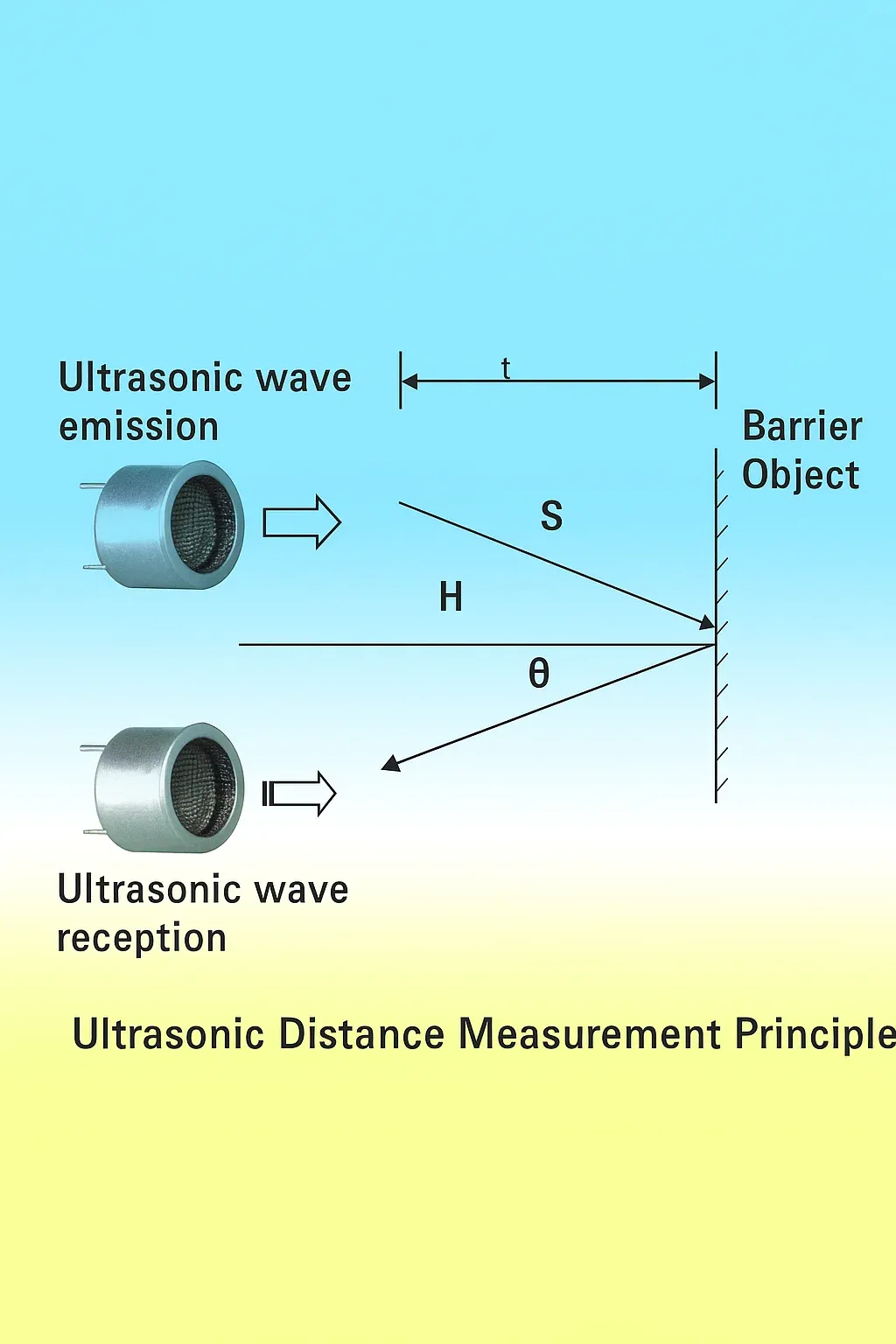
The most common distance-measurement method is echo ranging. As shown in the diagram below, an ultrasonic transmitter emits a pulse in a given direction and a timer starts counting simultaneously. The pulse travels through air, reflects off an obstacle, and returns to the receiver, which stops the timer upon detection. Using the speed of sound in air (approximately 340 m/s) and the measured round-trip time t, the distance s from the transmitter to the obstacle is given by:
s = 340 × t / 2
Transmitter and Receiver Circuits
Transmitter: A 555 timer is commonly used to generate a 40 kHz pulse signal applied to the ultrasonic probe pins so that the internal piezoelectric element resonates and emits ultrasound.
Receiver: The electrical signal produced by the receiving probe is typically very weak and requires amplification. A circuit using transistors and an LM324 operational amplifier can amplify the received signal and drive a relay or subsequent processing stage.