ALLPCB


Currently, China has not yet produced a fully mature gene chip, but several institutions have allocated personnel and resources to develop the technology and have reported some progress. This indicates that related disciplines and technologies in China are advancing. Gene chip technology is a large industrial field, and professionals in life sciences, computer science, and precision mechanical engineering in China may have roles in it. However, this is not a trivial undertaking. It is important to avoid rushing into low-level, repetitive research that wastes resources. Organized, planned concentration of units and researchers with sufficient capability may be more appropriate for China's conditions.
Definition and Basic Principle
A gene chip, also called a DNA chip or biochip, originated in the mid-1980s. Its sequencing principle is hybridization-based sequencing, which determines nucleic acid sequence by hybridizing an unknown sequence to a set of known probes fixed on a substrate. When a fluorescently labeled nucleic acid in solution, for example TATGCAATCTAG, hybridizes with a complementary probe at a specific location on the chip, the probe position with the strongest fluorescence indicates a fully complementary probe sequence. From this information, the target nucleic acid sequence can be reconstructed.
Composition and Working Principle
Hybridization relies on DNA base-pairing: under neutral conditions at moderate temperature, complementary strands form a double helix. Under high temperature, alkaline conditions, or in organic solvents, hydrogen bonds break and the double helix denatures into single strands; the temperature at which denaturation occurs is called the melting temperature (Tm). Denatured DNA exhibits decreased viscosity, altered sedimentation behavior, and increased ultraviolet absorption. When denaturing conditions are removed, complementary single strands can reanneal into the original double helix, a process called renaturation, restoring the original physicochemical properties.
Hybridization is the formation of heteroduplex molecules between single-stranded polynucleotides from different sources based on complementarity. Because temperature is easy to control, denaturation and renaturation are commonly used to drive nucleic acid hybridization: above Tm the double-stranded nucleic acid separates into single strands; below Tm single strands reanneal according to base-pairing rules. Thus, temperature cycles are often used to achieve hybridization.
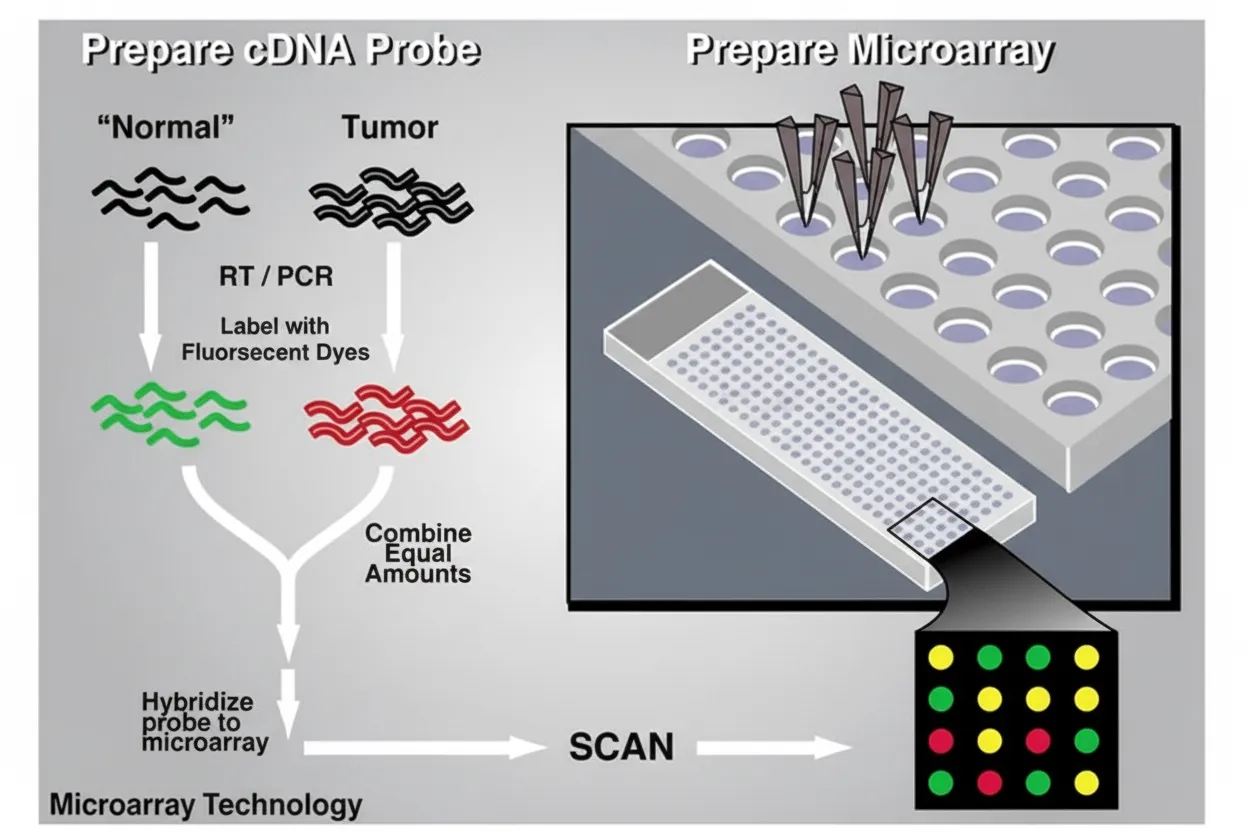
Single-stranded nucleic acids hybridize where there is complementary base sequence. Hybrid formation does not require perfect complementarity, so partial complementarity can produce stable duplex regions. Hybridization can occur between DNA-DNA, RNA-RNA, or RNA-DNA strands. Using this property, one strand of a hybridization pair is labeled in a detectable way and hybridized with the test sample; the target nucleic acid is then detected qualitatively or quantitatively. The nucleic acid being detected is called the target; the complementary sequence used to detect the target is called the probe. In traditional methods such as Southern blotting and Northern blotting, labeled probes are used in a forward-hybridization approach. Gene chips typically use a reverse-hybridization approach, where many probe sequences are fixed on the chip and labeled sample targets are hybridized to the chip. This enables simultaneous analysis of thousands of targets or even whole genomes.
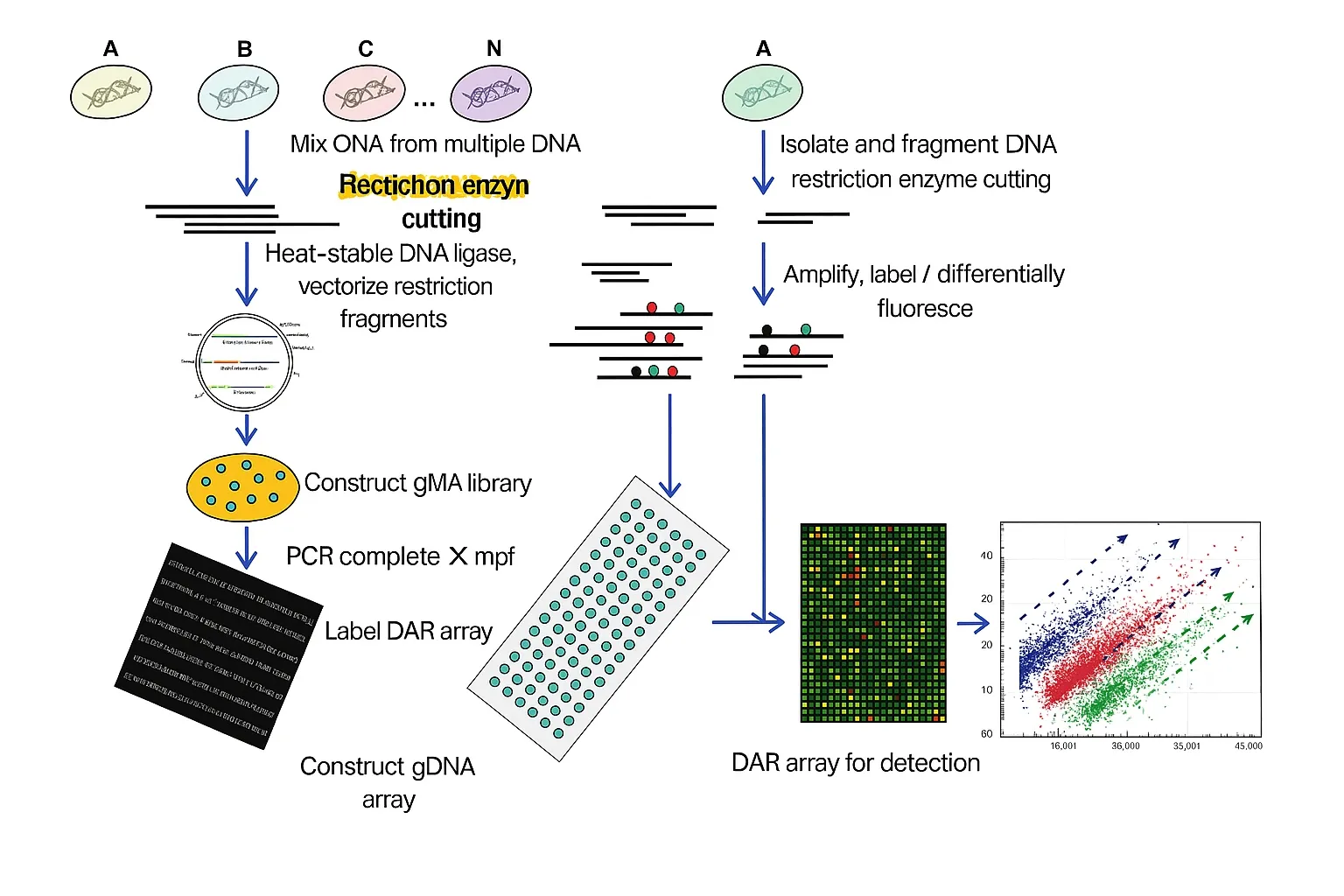
Specifically, gene chips enable two major types of assays: large-scale gene expression profiling at the RNA level, and detection of DNA structure and composition.
Types of Gene Chips
1. Probe arrays fixed on polymer membranes (nylon membrane, nitrocellulose, etc.). These typically use isotopically labeled targets and detection by autoradiography. Advantages include compatibility with existing radiographic equipment and established protocols. Limitations include low probe density, high sample and reagent requirements, and quantitative challenges.
2. Spotting DNA probe arrays on glass slides, with detection by hybridization to fluorescently labeled targets. Spot arrays can achieve higher density and more consistent probe amounts on the surface, but standardization and large-scale manufacturing remain challenging.
3. In situ synthesized oligonucleotide probe arrays on glass or other rigid surfaces, detected via hybridization to fluorescently labeled targets. This approach combines microelectronic photolithography with DNA synthesis chemistry to greatly increase probe density, reduce reagent consumption, and enable standardized, scalable production. It has significant development potential.
Gene chips are based on probes: each probe is an artificially synthesized nucleotide sequence linked to a detectable label. Probes recognize specific genes in a mixture according to base-pair complementarity. Large numbers of probe molecules are fixed on a support and hybridized with labeled samples; analysis is performed by detecting the intensity and distribution of hybridization signals. By applying planar microfabrication and supramolecular self-assembly techniques, many molecular detection units are integrated on a small solid substrate, enabling efficient, rapid, and low-cost detection and analysis of nucleic acids, proteins, and other biomolecules.
Applications
Biochip formats vary widely. By substrate material there are nylon membranes, glass slides, plastics, silicon chips, and microbeads. By signal type there are nucleic acid, protein, tissue fragment, and even whole-cell arrays. By working principle there are hybridization-based, synthesis-based, ligation-based, and affinity-recognition platforms.
The most successful parallel bio-signal analysis to date has been cDNA arrays on nylon membranes for detecting changes in gene expression profiles.
Which Diseases Can Gene Chips Detect
1. Prenatal genetic disease screening
A small sample of amniotic fluid can be used to detect whether a fetus has genetic disorders. The number of distinguishable diseases can range from dozens to hundreds, which supports informed reproductive health decisions.
2. Pathogen infection diagnostics
Conventional laboratory diagnostics can be time-consuming and incomplete. Using gene chip technology, clinicians can rapidly identify the infecting pathogen and determine whether the pathogen carries antibiotic resistance, including which antibiotics it is resistant or sensitive to, enabling more targeted treatment plans.
3. Population screening of high-risk groups with family histories of hypertension, diabetes, and other conditions
4. Cancer screening for populations exposed to toxic substances
5. Early detection across other systems—cardiovascular, nervous, endocrine, immune, metabolic, etc. —where gene chip-based testing can improve early diagnosis rates and reduce misdiagnosis, and help clinicians obtain a comprehensive view of multiple system diseases.