ALLPCB


Overview
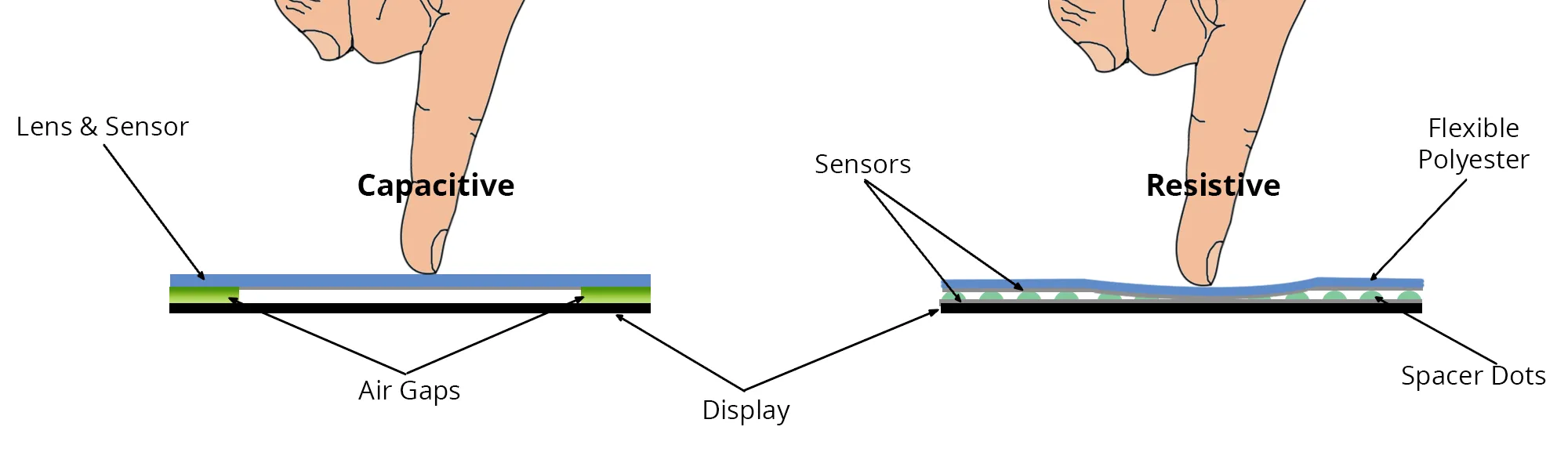
With the rise of capacitive touchscreens, styluses have undergone a material evolution. Because the touch principle differs, the idea that a resistive touchscreen can be driven by any pen or sharp object does not apply to devices such as the iPhone, iPad, or other smart devices. A capacitive stylus is a conductive instrument designed to interact with a capacitive touchscreen. Capacitive styluses are used with phones, computers, and other devices that have capacitive touchscreens.
Common Materials
Current capacitive styluses on the market mainly use conductive materials such as conductive foam, rubber (with a surface coating of conductive paint), and conductive fiber. All of these approaches rely on a conductive surface layer on the stylus tip.
Active vs. Passive Capacitive Styluses
Active capacitive stylus: contains internal electronics. The pen transmits a signal to the touchscreen matrix so the screen can detect the pen coordinates. Active stylus tips are typically moderate in size, require charging, and can be designed to support multiple functions.
Passive capacitive stylus: functions like a finger and does not transmit a signal. Contact between the stylus and the touchscreen alters the touchscreen matrix capacitance. Because it does not emit a signal, either the stylus tip must be relatively large, or the touchscreen must be designed with higher resolution specifically to support passive styluses.
Capacitive Touch Principle
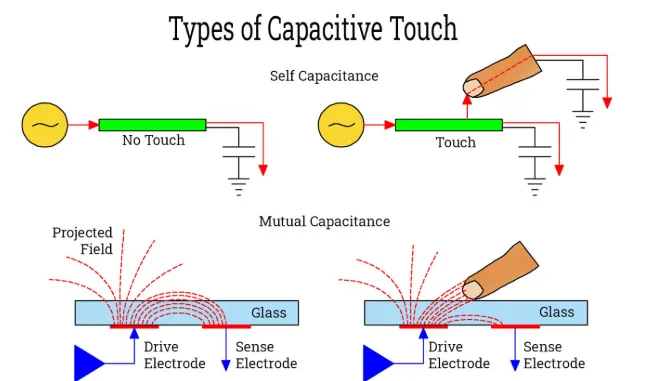
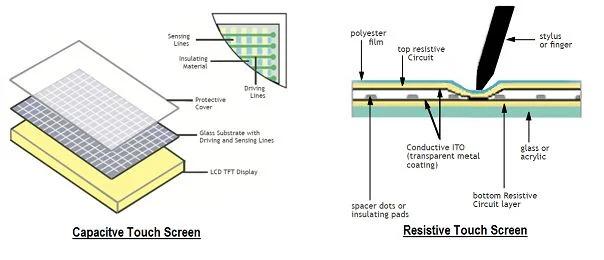
Capacitive touch technology includes surface capacitive and projected capacitive touchscreens. When a finger or other conductive material touches the panel, the panel detects a change in surface capacitance and produces an electronic signal that is used to determine the touch position. This is why a finger or another conductive material can operate the screen, while non-conductive materials such as traditional plastic resistive styluses cannot.
How a Stylus Mimics a Finger
A capacitive stylus uses conductive material to simulate the human body. When a finger contacts the metal layer of the touchscreen, the body's electric field forms a coupling capacitance between the user and the touchscreen surface. For high-frequency currents, this capacitance behaves like a direct conductor, and a very small current is drawn away from the contact point by the finger. This current flows through the four corner electrodes of the touchscreen. The currents through those four electrodes vary in proportion to the finger's distance from each corner. The controller calculates the touch position precisely by comparing the ratios of these four currents.