ALLPCB


Case 1: Frequent trips with multiple high-power appliances
Case summary: Mr. Wang regularly uses several high-power appliances at home, including a bathroom heater, water heater, induction cooker, washing machine, and range hood. The household circuit breaker trips frequently. What breaker rating should he choose?
Analysis: The breaker in Mr. Wang's home trips more often at night and on holidays. If the supply conductors are large enough, use a 4 mm2 copper conductor. For the residual-current device (RCD), 30 A can be used, chosen according to the water heater's maximum current. Note that if the RCD trips automatically too often (more than 10 times per month), a higher rated RCD should be installed. Also, RCDs that have been in service for more than five years should be replaced even if they appear to work normally.
Case 2: Breaker trips daily around 18:30 despite light load
Case summary: The household breaker used to trip occasionally under heavy load, but recently it trips consistently around 18:30, and the load is not large. What is the cause?
Analysis: This is likely caused by undervoltage protection operating.
Modern circuit breakers typically provide four automatic protections:
- Overload protection
- Short-circuit protection
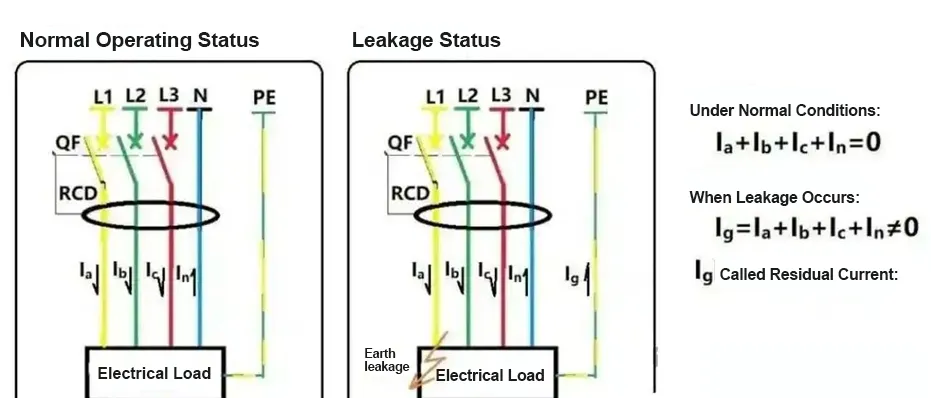
- Residual-current protection
- Undervoltage protection
6:00 pm is a peak demand period. In older buildings the voltage can fall below the normal value, which can trigger undervoltage protection on the breaker.
Case 3: Breaker trips a few minutes after closing (grounding issue below meter)
Case summary: The breaker trips a few minutes after being closed. The problem appears related to the grounding connection under the meter. What could cause this?
Analysis: A terminal on the residual-current device was not fully inserted into its wiring hole. It contacted an adjacent PCB pad, so even if the screw seemed tight the connection was poor. Whenever a high-power appliance operated, the poor contact caused a trip.
For similar situations follow these steps:
- First, inspect the breaker terminals and confirm that the live conductors are properly seated in the terminal clamps.
- Next, calculate the current to determine whether the breaker rating is inappropriate.
- If those checks do not find the cause, consult a qualified professional to inspect the wiring.
Typical household service conductors are 4 mm2, and breaker selection should not be undersized. If the conductor from the main switch to the air conditioner outlet is too thin while the air conditioner draws a large current, trips will occur. Breaker aging can also cause tripping. If trips persist, have a professional electrician inspect the wiring.
Case 4: Factory breakers trip at night but run normally in daytime
Case summary: In a factory the breakers work normally during the day, but at night they trip frequently. After resetting, they trip again within 1–2 hours. Daytime consumption is high; at night only 1.5 HP air conditioners and small refrigerators operate. How to resolve this?
Analysis: Use a process of elimination. Breaker trips can stem from several causes:
- Overload
- Leakage in an appliance or wiring
- Breaker mechanism damage
- Incoming line overvoltage
To diagnose: determine whether the trip is caused by the circuit breaker or the RCD. If the breaker trips, it usually indicates line overload. If the RCD trips, there is leakage. Check wiring connections for looseness and secure them promptly. Focus on whether electrical lines or equipment are leaking current.
Case 5: Main 400 A breaker trips while individual 100 A breakers do not
Case summary: A dormitory building has a 400 A main breaker feeding seven 100 A branch breakers. Daytime loads are small, but the 400 A main trips frequently while the 100 A branch breakers do not. What explains this?
Analysis: Possible reasons include:
- Defective main breaker (unlikely but possible)
- Three-phase imbalance with load concentrated on one phase (unlikely in many cases)
- The 400 A main includes leakage protection and the leakage current exceeds the protection threshold
- Residents using poor-quality appliances or power strips causing leakage
- Loose connections at the main breaker causing overheating at the terminals
Case 6: Frequent trips after moving in and replacing appliances
Case summary: After moving into a new home, the original wiring was left intact but appliances were replaced. The main breaker trips frequently. What is the cause?
Analysis: Replace the breaker with a new unit or inspect for poor wiring contact. Both are common causes.
Case 7: Persistent trips after replacing the breaker
Case summary: Breaker trips frequently and replacing the breaker did not fix the issue. Why?
Analysis: First rule out a defective breaker. A common household breaker rating is around 36 A. The preliminary suspicion is aged or degraded supply conductors.
Test procedure:
- Connect only the incoming supply conductors to the breaker, leaving the load conductors disconnected, and close the breaker. If it trips, the breaker is defective.
- If it does not trip, reconnect the load conductors but unplug all sockets. Turn on the lights to see if the breaker trips. If it does not, test each socket one by one. If a trip occurs when a specific socket is connected, inspect the corresponding circuit.
Also calculate the total power of household appliances and divide by 220 V to estimate the actual current and select a suitably rated breaker. Note that if the chosen breaker rating exceeds 20 A, the incoming conductor cross-section should be 4 mm2 or larger.