ALLPCB


Capacitive touchscreen parameters
1. Report rate: If the report rate is too high, the CPU may not respond in time, causing lost points and broken lines when drawing.
2. Accuracy: Up to 99% accuracy.
3. Sensitivity: Detects forces under two ounces and can respond in under 3 ms.
4. Resolution: Related to the number of channels on the X and Y axes. More channels yield higher resolution and improved touch accuracy.
5. Report range: Typically should match the LCD resolution setting.
6. Linearity: Linearity defines how closely the device output follows an ideal straight line across the working area.
7. Noise immunity: Resistance to high temperature, electromagnetic fields, oil and water contamination, and electrostatic discharge.
8. Hardness and compression resistance: Hard, scratch-resistant glass (Mohs hardness around 7) that resists scratches and wear from sharp objects.
9. Power consumption.
10. Clarity: Poor glass quality can reduce optical clarity.
11. Report rate: The number of times per second the touch point information is reported to the host.
Capacitive touchscreen types
Capacitive touchscreens are divided into surface capacitive and projected capacitive types.
Surface capacitive touchscreen
Surface capacitive touchscreens are common. Their operating principle is simple, the circuit design is straightforward, and they are relatively low cost, but they are difficult to implement for multi-touch.
Projected capacitive touchscreen
Projected capacitive touchscreens support multi-finger touch. Both types have high transparency, fast response, and long life. A drawback is that capacitance values change with temperature and humidity, which can reduce stability and cause drift that requires periodic recalibration. They also typically do not work with ordinary gloves.
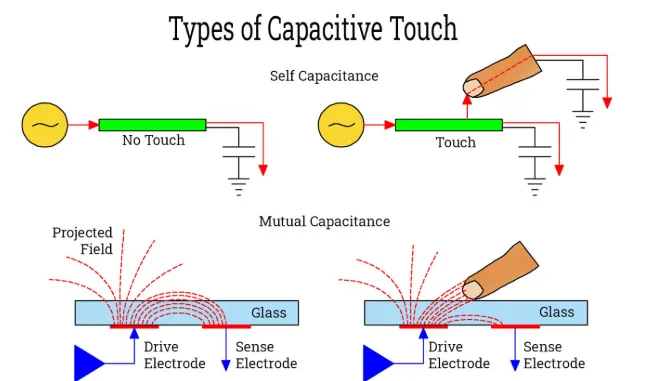
Projected capacitive screens can be further classified as self-capacitance and mutual-capacitance. In a common mutual-capacitance implementation, the interior consists of drive electrodes and receive electrodes. The drive electrodes emit a low-voltage, high-frequency signal that is projected to the receive electrodes to form a stable current. When a human finger contacts the screen, an equivalent capacitance is formed between the finger and the sensor. The high-frequency signal can flow through this equivalent capacitance to ground, reducing the charge received at the receiver. The closer the finger is to a particular transmitter, the greater the reduction in received charge, and the touch point is determined based on the received current levels.
Considerations for capacitive touchscreens
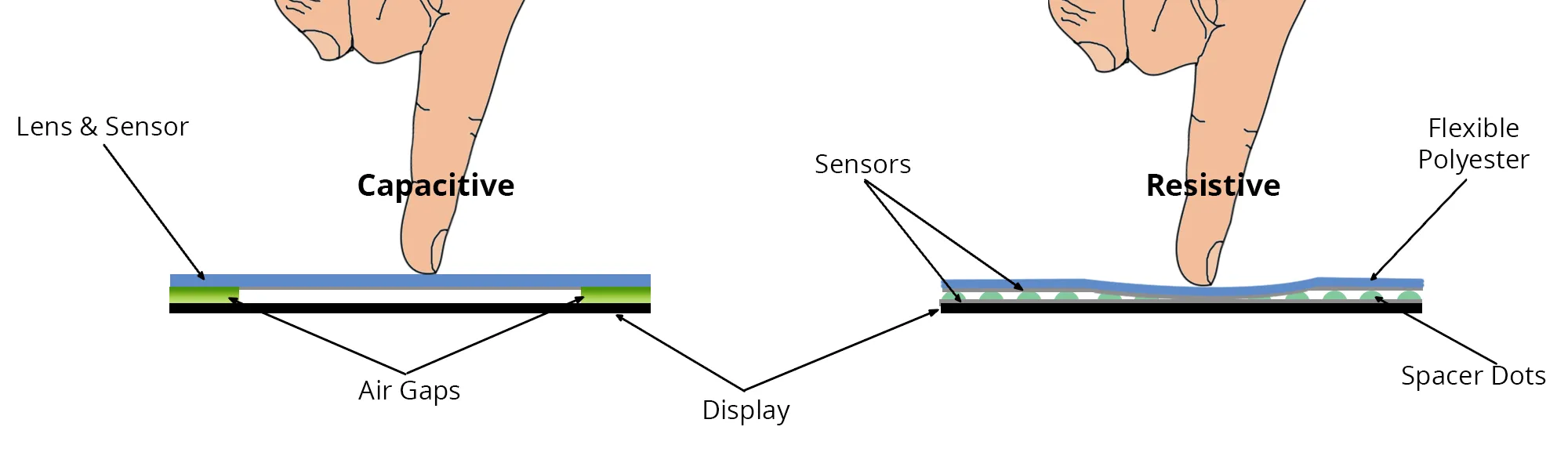
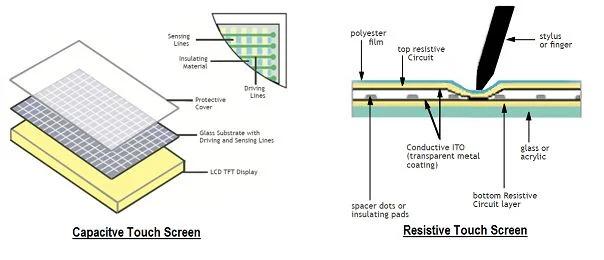
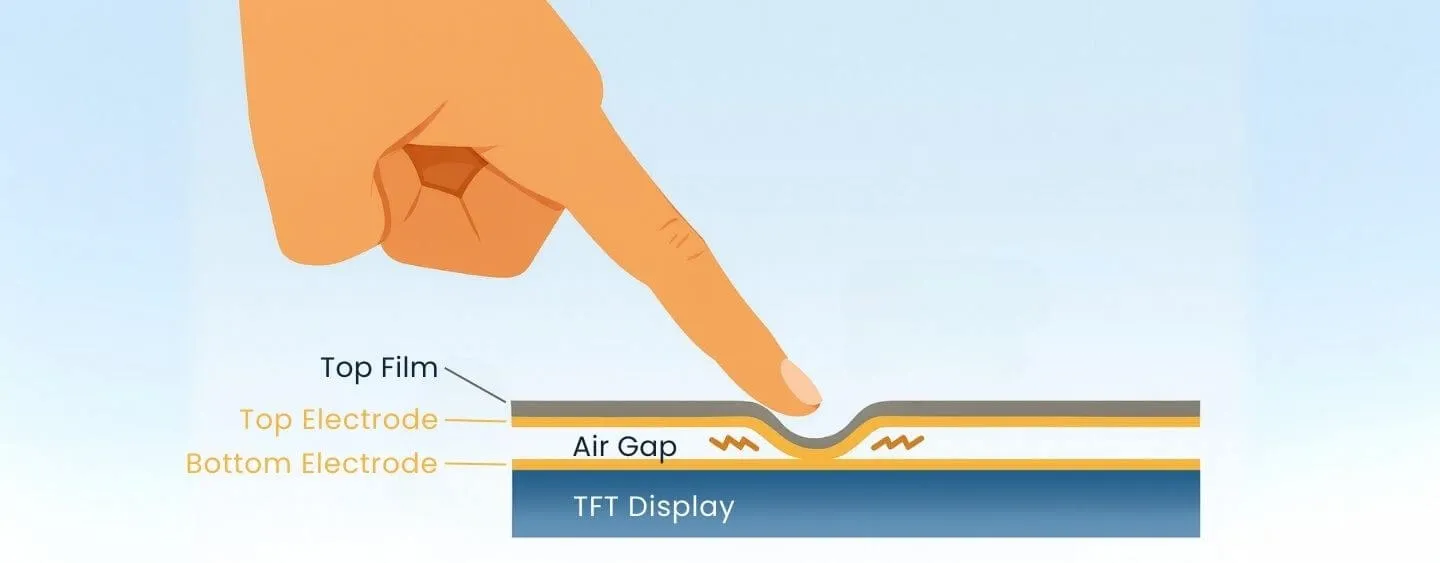
Resistive touch panels detect touch when a flexible top layer is pressed down to contact a conductive layer beneath. Projected capacitive screens have no movable parts. Projected capacitive hardware typically includes a glass cover, X and Y sensing components, and an indium tin oxide (ITO) conductive layer on the glass substrate. Some sensor suppliers implement a single-layer sensor embedding X and Y traces and small bridge structures in one ITO layer. When a finger or other conductive object approaches the screen, a small capacitance forms between the sensor and the finger. Although this capacitance is small relative to the overall system, various techniques can measure it.
One technique uses a component set that rapidly changes the capacitance and measures discharge time through a bleed resistor. An all-glass touch surface provides a smooth tactile feel. Glass is favored by device manufacturers for its aesthetic and industrial design qualities and for providing a clean capacitive signal for measurement. Understanding the operating principles is important when designing a high-performance touchscreen.
Key parameters to evaluate
Accuracy: Defined as the maximum positioning error within a predefined touchscreen area, measured as the linear distance between the actual finger position and the reported position. Measurements are performed using an analog or mechanical finger placed at known positions on the panel and comparing the measured positions to the true positions. Accuracy is critical because users expect the system to locate the finger precisely. Resistive touchscreens are often criticized for low accuracy that can degrade over time. Capacitive touchscreens enable new applications such as virtual keyboards and pen-free handwriting recognition.
Finger spacing: Defined as the minimum distance on the screen between the center points of two fingers when the touchscreen controller reports two separate touches. To measure finger spacing, place two analog or mechanical fingers on the panel and slowly bring them closer until the system reports them as a single touch. Some suppliers report finger spacing edge-to-edge, while others report center-to-center. A 10 mm mechanical-finger spacing means that multiple touches are recognized when the distance between finger centers is 10 mm, subject to the controller specifications. Adequate finger-spacing capability is necessary to implement multi-touch solutions, and it is especially important for virtual keyboards where finger spacing is typically small.