ALLPCB


Under a design-and-function mandate, capacitive touch technology has been rapidly adopted across consumer electronics. Imagine an "invisible" touch interface on a cooktop that illuminates when you approach and displays touch buttons only when needed.
Why Capacitive Touch for Cooktops
Many cooktops have moved away from mechanical knobs and buttons to capacitive touch to achieve a modern appearance while addressing reliability, usability, environmental effects, freedom of design, conformity with complex device shapes, manufacturability, cost, and ease of use.
Design Challenges
Adding capacitive touch to a cooktop creates several unique challenges. Touch keys are often placed on a plane close to the cooking area, and normal operating conditions include:
- Need for cleaning.
- Kitchen items may be placed on sensors.
- Liquid splashes may occur, or the entire surface may become wet.
- Users may operate while wearing gloves.
- Buttons may be located beneath a thick glass cover (greater than 4 mm).
Capacitive Touch Solution Overview
TI's CapTIvate technology provides tools and methods to address these issues and allows cooktop systems to adapt to new form factors and related challenges. CapTIvate is implemented as a peripheral module integrated in some MSP430 microcontrollers. The CapTIvate-enabled microcontroller can perform automatic capacitive touch sensing without occupying significant central processor resources. When proximity or a valid touch is detected, the host processor runs the application logic and executes tasks such as recalibration and control of haptic, audio, or visual feedback. This modular approach enables reuse across product variants or integration in designs where the touch module is separate from the host controller.
Flexibility and Interaction Modes
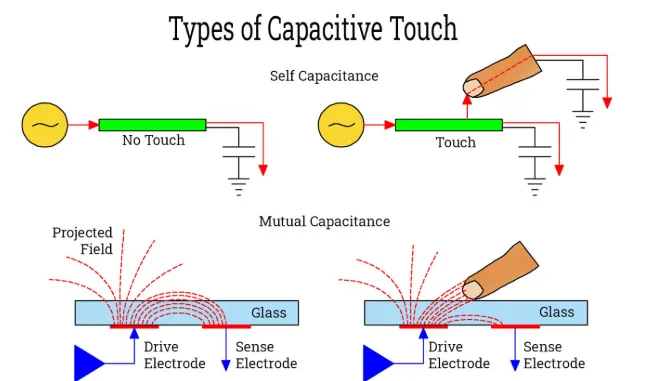
CapTIvate technology allows configuration and feature changes via software, reducing time to market. It supports buttons, sliders, wheels, and proximity sensors, and can combine self-capacitance and mutual-capacitance sensing in the same design.
Preventing False Touches
Preventing false activations caused by liquids, objects, or noise is critical for cooktops. Hardware and software solutions are used to address these issues. In normal use, users are expected to touch one or two buttons according to defined procedures. In other situations, such as touching multiple buttons simultaneously during cleaning or leaning on the touch area, software detects these undefined inputs and blocks unintended activations.
Guard Channels and Protection
To improve moisture robustness, the technology uses guard channels. A guard channel is a separate electrode with higher sensitivity that surrounds all buttons on the printed circuit board. This guard electrode detects unintended touch events, and software can use its input to prevent false activations.
Mechanical Assembly Considerations
Beyond simplifying production, it is important to keep assembly tolerances between the printed circuit board and the glass surface small and stable. In cooktops, metal springs or conductive fillers can be used to fill the air gap between the PCB and the cover layer.
Noise Immunity and EMC
Electrical noise immunity is another key requirement for capacitive touch on cooktops. To meet IEC 61000-4-3 and IEC 61000-4-6 standards, MSP430FR2675 and MSP430FR2676 microcontrollers can simplify electromagnetic compatibility certification.