ALLPCB


Overview
Cars are generally classified by engine type into two categories: turbocharged engines and naturally aspirated engines. Because the methods used to supply air to the engine differ, vehicle behavior and performance also differ. The following explains the main differences between these two engine types.
The letter "T" indicates the engine is equipped with a turbocharger (Turbo). The common shorthand "L" for naturally aspirated engines comes from "Liter," referring to engine displacement. Thus, "T" and "L" denote turbocharged and naturally aspirated engines respectively.
Turbocharged Engines
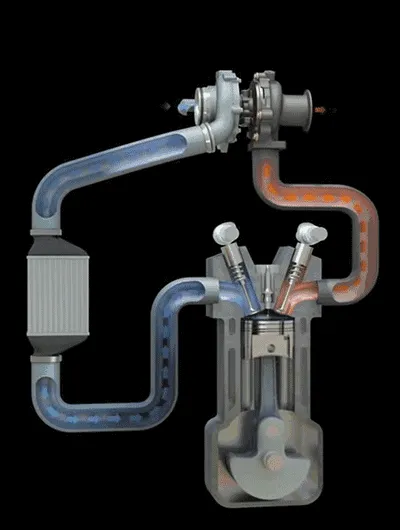
A turbocharged engine is fitted with a turbocharger. A turbocharger uses the engine's exhaust gases to drive a turbine-compressor assembly that compresses intake air. By increasing the air flow entering the engine, the turbocharger raises engine efficiency.
By using the heat and flow of exhaust gases, a turbocharger can increase an engine's power output. In some vehicle designs, turbochargers are paired with smaller-displacement engines to maintain performance comparable to a larger naturally aspirated engine while improving fuel economy and emissions.
Exhaust-driven turbochargers can increase engine power and torque by roughly 30% in many cases, which can create a noticeable increase in acceleration. The main drawback is turbo lag. When the throttle is released or at low engine speeds, exhaust volume and pressure drop, reducing turbine speed and therefore intake boost, which delays the increase in intake flow.
Adding a turbocharger generally increases engine weight and the energy required to overcome rotating inertia. Because turbochargers are powered by exhaust gas rather than being driven directly by the crankshaft, they have advantages over mechanically driven superchargers.
However, at low rpm the exhaust flow may be insufficient to spin the turbine to its effective range, so boost performance can be worse than with a mechanical supercharger, producing turbo lag. Advances in technology have reduced this effect by enabling earlier turbo intervention to improve low-speed performance.
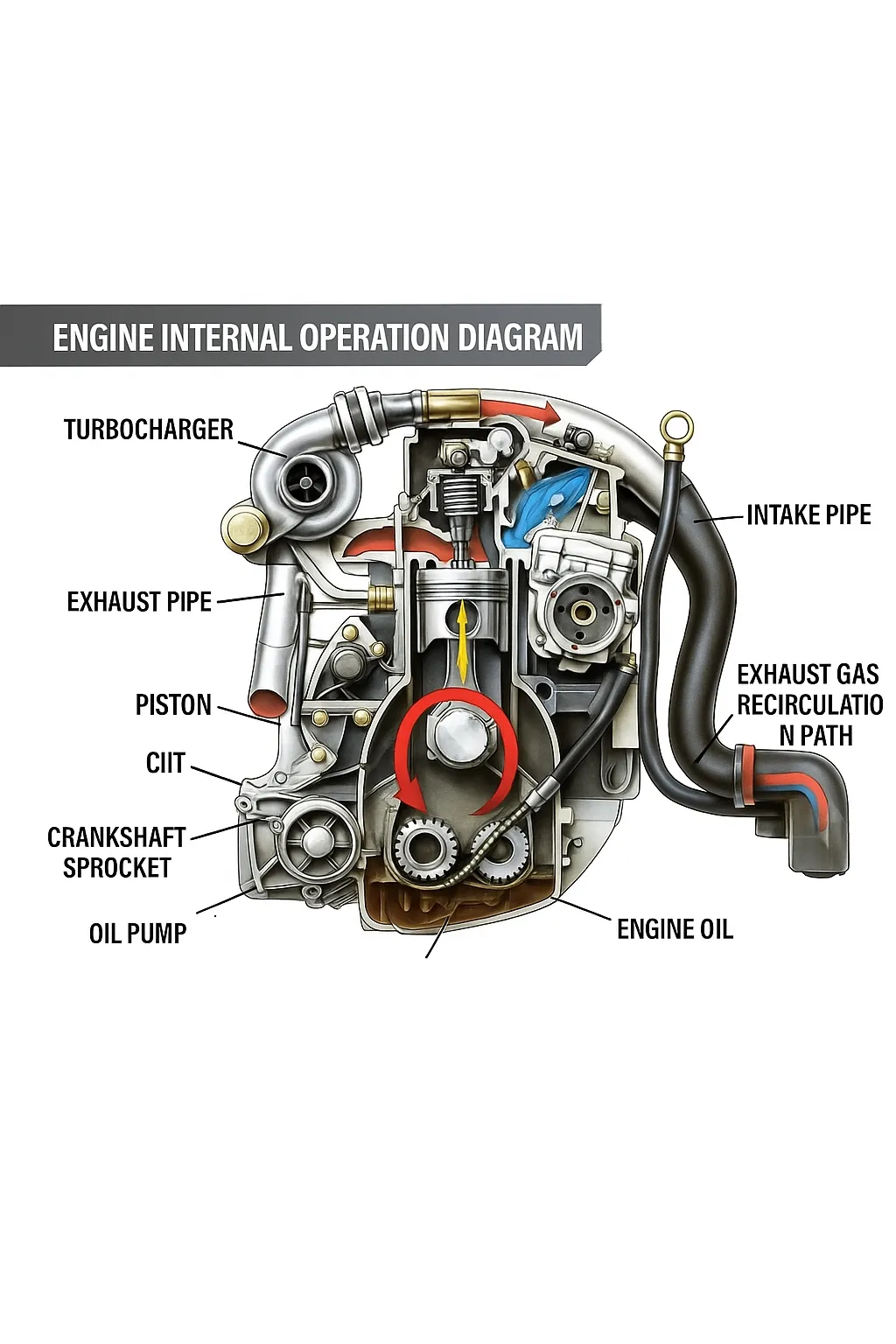
Turbine rotational speed depends on the size and mass of the rotating parts, the pressure in the intake manifold, and compressor design; it can reach 80,000 to 200,000 RPM. At such high speeds, ball bearings can present problems, so most turbochargers use fluid film bearings. These bearings use a flowing oil film to suspend and cool moving parts; the oil typically comes from the engine's oil circulation system.
There is also a belt-driven centrifugal supercharger that sometimes behaves like a turbo and sometimes like a mechanical supercharger. Because it is belt-driven and not powered by exhaust gas, it has no lag, but its critical pressure characteristics differ from exhaust-driven turbos. The trade-off is extra load on the crankshaft, reducing overall efficiency. Its advantages are no lag, easier installation since exhaust routing does not need modification, and simpler maintenance.
Naturally Aspirated Engines
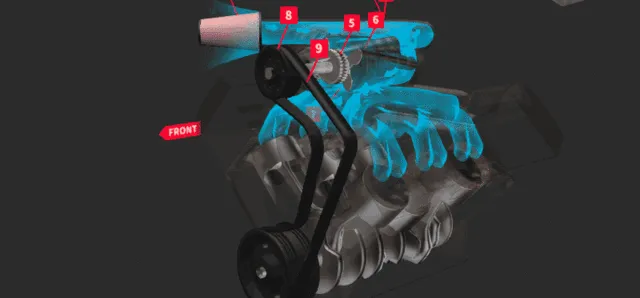
A naturally aspirated engine has no turbocharger. It draws air into the cylinders using the vacuum created inside the cylinders. Air is drawn from outside the vehicle through the air filter, then passes the throttle and intake manifold before reaching the cylinders. Power output is proportional to throttle opening, so the power increase is more linear compared with turbocharged engines.
In naturally aspirated engines the air typically flows through the air filter, then the throttle, then the intake manifold to the cylinders. Fuel is injected either into the intake manifold by fuel injectors (port fuel injection) or directly into the cylinders (direct injection), depending on the system used.
Because naturally aspirated engines lack a turbocharger to increase intake mass and promote more complete combustion, they generally feel less powerful than turbocharged engines. However, naturally aspirated engines tend to be technically simpler and more stable in operation, and the engine bay environment during operation is often less demanding.
Turbocharged engines place higher demands on fuel quality, engine oil, and spark plugs, and their maintenance costs are typically higher than those for naturally aspirated engines. For drivers who do not require high performance, a naturally aspirated engine is usually sufficient for everyday family use.