ALLPCB


1 Introduction
Remote rehabilitation is a multidisciplinary topic that combines modern information and communication technology with rehabilitation medicine. It can be defined as delivering distant rehabilitation medical services based on communication, remote sensing, remote control, computing, and information processing technologies.
International research in this area has followed different approaches. Many efforts treat remote rehabilitation systems primarily as a communication medium to overcome spatial barriers between assistive-device assessment experts and remote patients. There has been some mention of using remote rehabilitation systems themselves as assistive-device assessment and diagnostic tools to advance rehabilitation medicine, but substantive research is limited. In China, reports exist of a first nationwide remote rehabilitation system developed by a regional disabled persons' federation; that system focused on expert–patient communication and allowed patients to consult experts online for rehabilitation advice.
Based on current developments both internationally and in China, research in this area still has significant limitations and remains at an early stage. Therefore, research on remote rehabilitation systems is important.
Within remote rehabilitation systems, the data acquisition subsystem is a main component. Effective remote control of that subsystem critically affects overall system performance, including control quality and response speed. Because the remote rehabilitation data acquisition system is a multivariable, nonlinear, time-varying system, constructing an accurate global mathematical model for synchronous control is difficult. Therefore, an effective control approach such as fuzzy control is required.
2 System architecture of the remote rehabilitation data acquisition controller
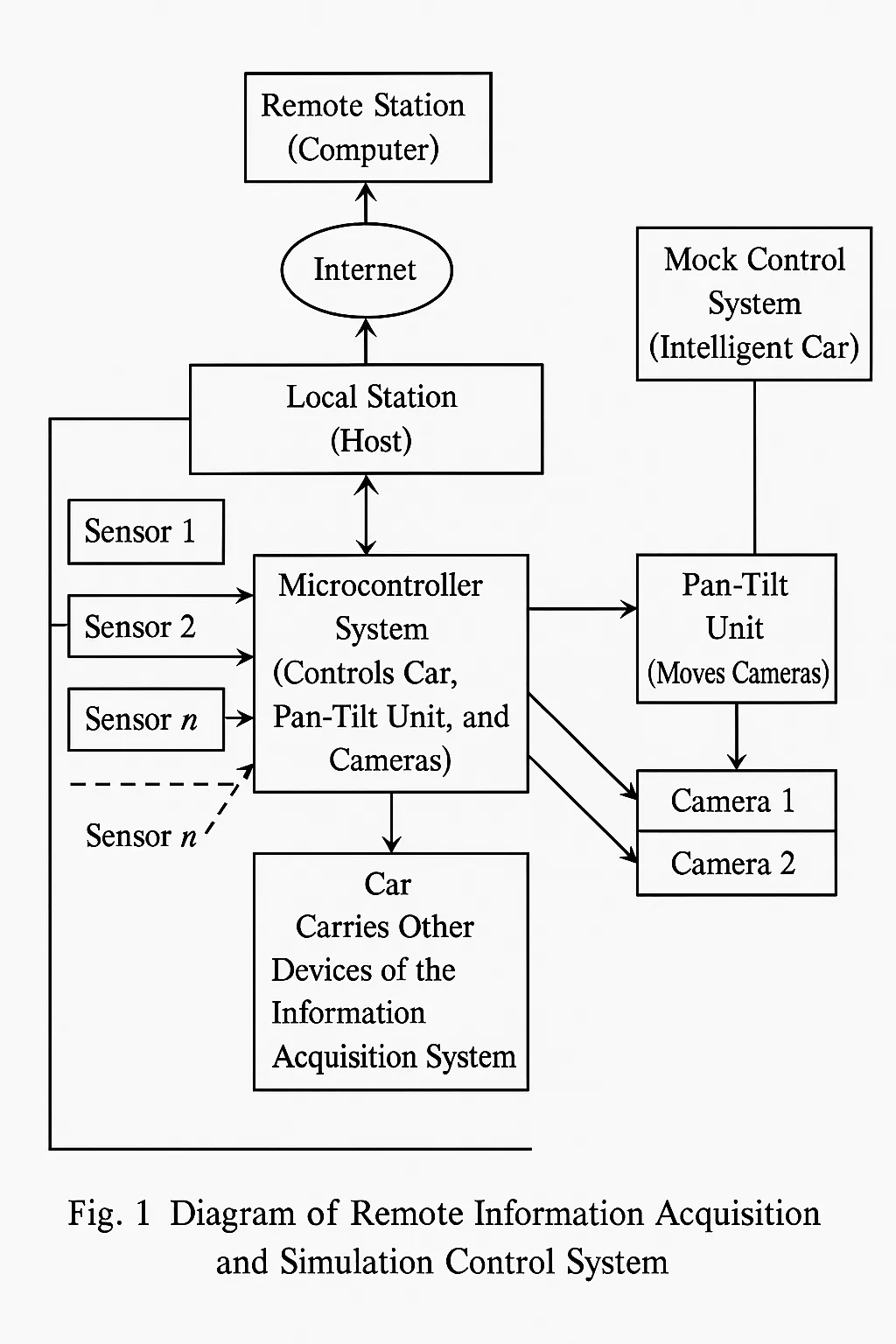
The remote rehabilitation data acquisition control system block diagram is shown in Figure 1. The system is essentially a camera-assist robot that can follow a specified spatial trajectory to observe a patient. The controller consists of two main functional modules. First, an on-site PC receives remote control commands over the Internet, processes them with a fuzzy control algorithm, and sends commands via an RS-232 serial port to a microcontroller-based control system to drive the mobile platform, the pan-tilt unit, and the camera. The on-site PC can also process captured image data as required and present it to the remote site via the Internet in appropriate formats for remote rehabilitation experts and assistive-product designers to diagnose and design.
Second, the microcontroller control system controls the motion of the mobile platform, the pan-tilt unit, and the camera so the system can reach suitable positions and orientations. This allows remote experts to observe a patient's physical condition in real time, regardless of distance, for remote diagnosis and assessment. The microcontroller system also processes signals from position-detecting motors and sensors and feeds back the execution status of the fuzzy control actuators to the remote site. In short, the fuzzy control system automates the motion of the mobile platform carrying the data acquisition devices, the pan-tilt unit, and the camera to collect real-time video or image data for diagnosis and assistive-product design.
3 Fuzzy control design for the data acquisition system
3.1 Fuzzy control strategy for the data acquisition system
The system input variables include the mobile platform's steering angle to the target, the distance from the mobile platform to the target, the pan-tilt unit's height relative to the target, and the camera's orientation angle and distance to the target, totaling six input variables. The output variables include the rudder motor speed and direction, the drive motor speed and direction, the motor speed and direction for moving the pan-tilt unit up and down, and four pan-tilt orientation controls, giving ten output variables in total. Thus, the acquisition system is initially a multivariable fuzzy controller with multiple inputs and outputs.
Using fuzzy decoupling, the multivariable fuzzy control structure is transformed into single-variable fuzzy controllers for design. Below, the control rules for the mobile platform drive motor speed are used as an example to illustrate rule construction in detail.
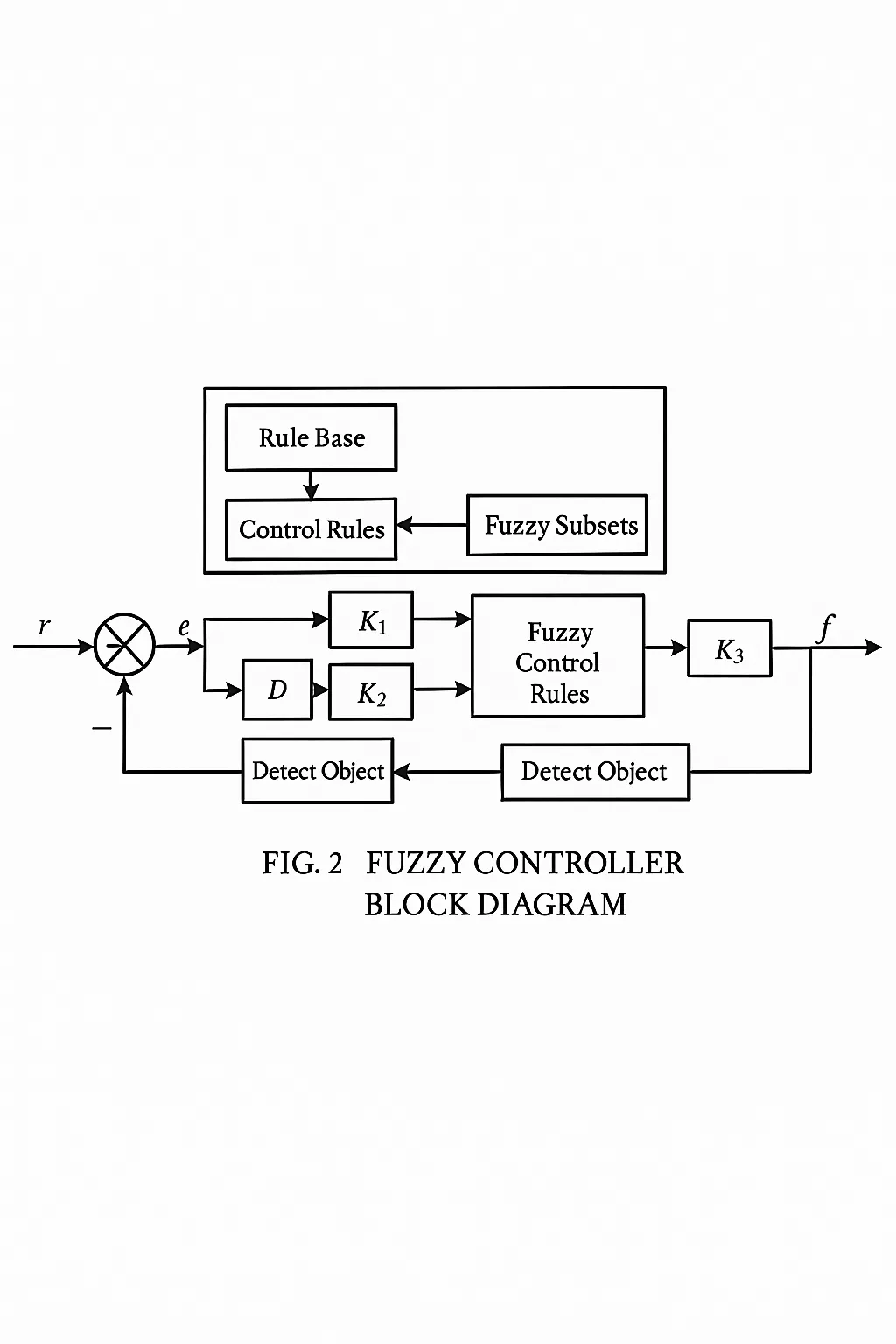
The mobile platform drive motor uses a stepper motor, whose speed is controlled by changing the pulse frequency of the drive signal. Therefore, speed control adopts a single-variable, two-dimensional fuzzy controller with inputs of the distance error e (between the platform and the target) and the error change rate ec. The output variable is the control pulse frequency f. The fuzzy lookup-table method is used for implementation, as shown in Figure 2.
For each sampling instant, the error e and its change rate ec are scaled by factors k1 and k2 and then quantized to map the physical input values to points in the input domain. By consulting the control lookup table, the corresponding output control value on the output domain is obtained. That output point is rescaled by factor k3 to produce the required control pulse frequency f. The control lookup table represents the mapping from input-domain points to output-domain points and encapsulates the fuzzification, fuzzy inference, and defuzzification processes. It can be precomputed offline. The lookup-table method is simple, easy to implement, requires few resources, and executes quickly online.
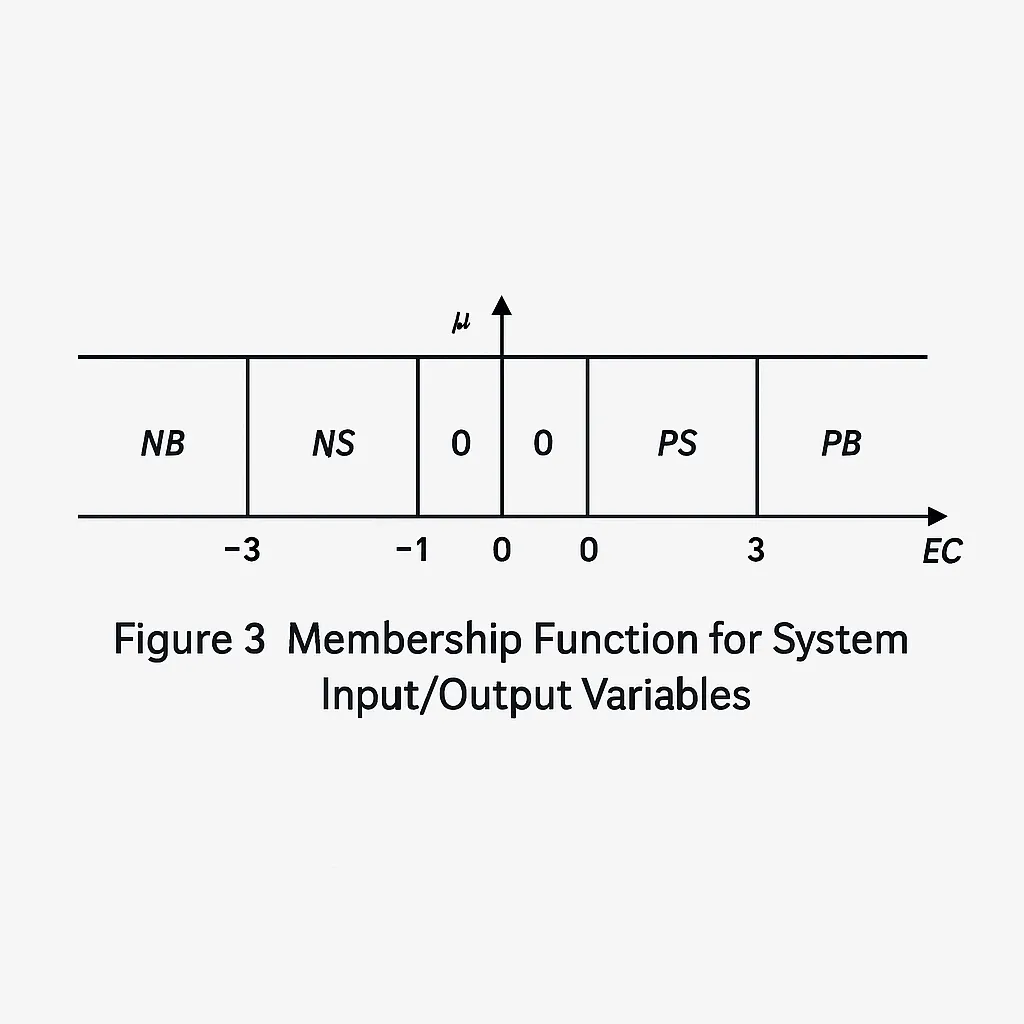
The basic fuzzy subsets for error e, error change ec, and control f are {NB (negative big), NS (negative small), 0 (zero), PS (positive small), PB (positive big)}. The domain for distance error e is E, for error change ec is EC, and for output f is F. Based on the system, each variable is quantized into five levels {-3, -1, 0, +1, +3}. Membership functions are selected as shown in Figure 3 to realize input fuzzification.
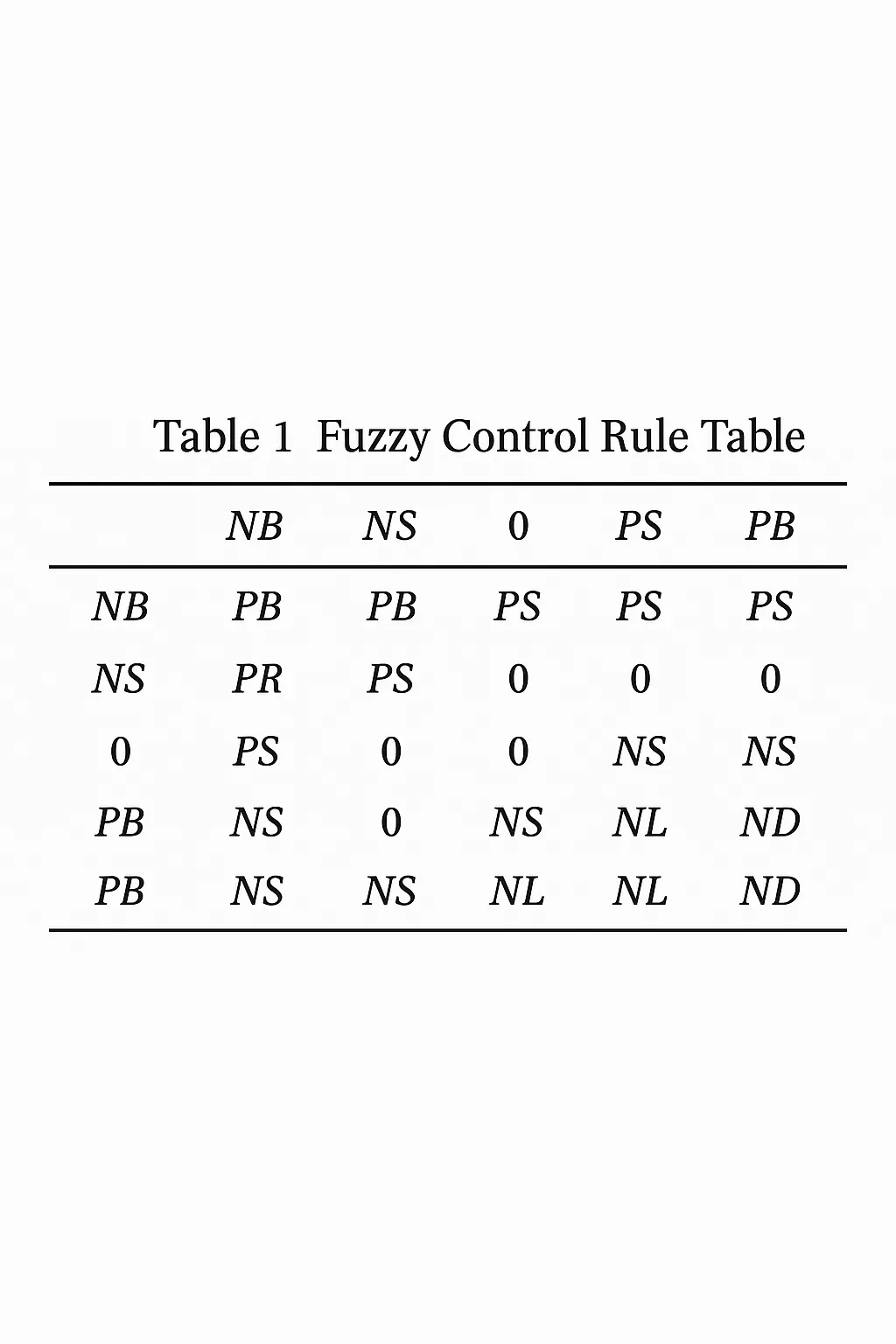
Fuzzy input variables are then processed by the fuzzy control rules to infer fuzzy output linguistic variables {NB, NS, 0, PS, PB}. The inferred fuzzy outputs must be converted into actual correction values to adjust the drive motor pulse frequency and thus control the mobile platform speed.
To simplify programming and facilitate real-time control, the control rules are tabulated. The fuzzy controller operates according to the control-state table.
The choice of quantization factors k1 and k2 for error E and error change EC significantly affects dynamic performance. k1 determines system response speed: larger k1 yields faster response but larger overshoot and longer settling time. k2 affects overshoot: larger k2 reduces overshoot but increases response time. k3 is the overall gain of the fuzzy controller: too small a k3 lengthens dynamic response, while too large a k3 may cause oscillation.
Rules for other control variables follow principles similar to those used for the drive motor speed.
3.2 Software design of the data acquisition control system
Currently, three techniques exist to construct fuzzy controllers: implementing fuzzy inference and control in software on a conventional microcontroller or microcomputer; building fuzzy controllers as dedicated ICs where configuration data defines the controller structure; and implementing fuzzy controllers using programmable gate arrays. Because the on-site remote rehabilitation station requires a PC to receive remote commands, process camera image data, and transmit information via the Internet, the design uses a host PC as the physical base and implements fuzzy inference and control in software to maximize resource utilization.
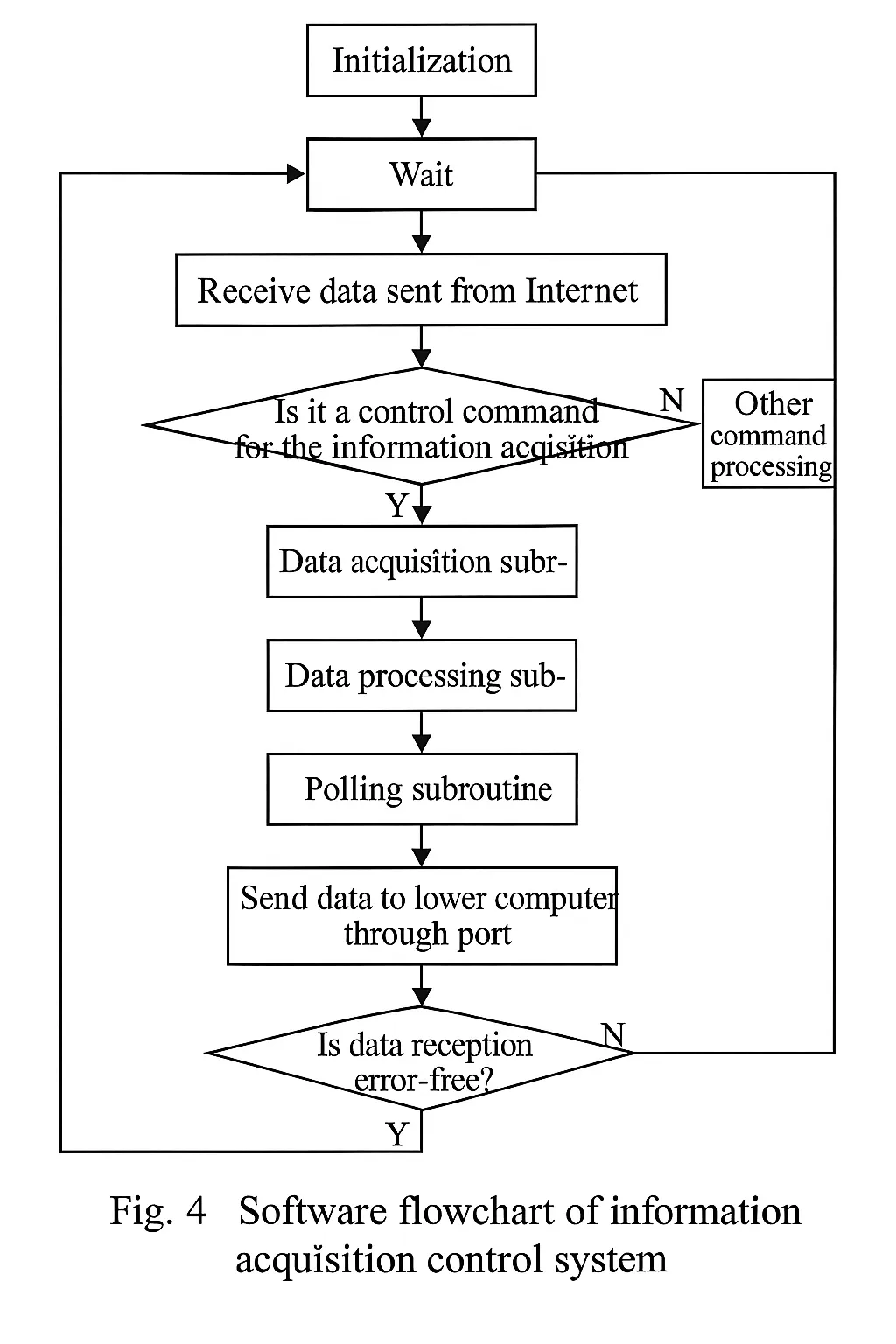
The host PC software design centers on implementing the fuzzy control algorithm and includes serial communication between the PC and microcontroller and the Internet interface. The program flow is shown in Figure 4.
The host PC program implements the fuzzy control functionality for the data acquisition system. Before operation, the host PC initializes settings including the serial port to prepare for correct operation. When remote control commands arrive at the on-site PC via the Internet, they are processed by the fuzzy control algorithm and then sent via the serial port to the microcontroller control system for execution. This control process does not require on-site personnel intervention and is fully remote, allowing remote experts to conveniently control the data acquisition system while reducing operation errors that could result from miscommunication between remote experts and on-site staff or family members.
4 Conclusion
The system applies fuzzy control techniques to achieve intelligent remote control of the rehabilitation data acquisition system. Remote rehabilitation experts and assistive-product designers can remotely control the on-site acquisition system via the Internet to collect accurate, real-time 3D visual data at appropriate positions and angles for diagnosis and assistive-product design. Tests indicate the control system met the design requirements and is capable of real-time remote 3D visual data acquisition.