ALLPCB


Introduction
Determining the composition and quality of liquids is critical for many applications. Water is a primary example given its essential role and the increasing scarcity of clean water. Liquid measurement also extends into medical applications such as blood, saliva, and feces. By analyzing these fluids, clinicians can detect disease and monitor health. All these measurements share a common underlying principle: impedance measurement. This article focuses on medical liquid sensing, describes representative applications, and highlights the generality of impedance-based techniques.
Liquid Measurements in Healthcare
The best-known medical liquid measurement is blood glucose testing. A single drop of blood on a test strip can reveal glucose levels so patients can adjust medication or diet. There is a trend toward continuous monitoring of glucose, which requires highly accurate and energy-efficient impedance measurements.
Dialysis is another example. Patients with chronic kidney failure require blood filtration, and conductivity measurements of dialysis fluid are performed using impedance analysis. This approach supports measurement of pH, conductivity, composition, and saturation.
Urine and stool analysis are increasingly used to detect disease. These tests often use electrodes to perform impedance measurements and derive diagnostic information, including pH and conductivity. Other medical liquid measurements include hormones and drug concentrations, where impedance-based methods also play a role.
Although specific parameters differ across applications, impedance analysis is the common foundation. Many medical use cases require compact, low-power solutions suitable for wearable or portable devices. The following sections summarize several impedance measurement methods used in liquid sensing.
Impedance Measurement Principles
Potentiostat
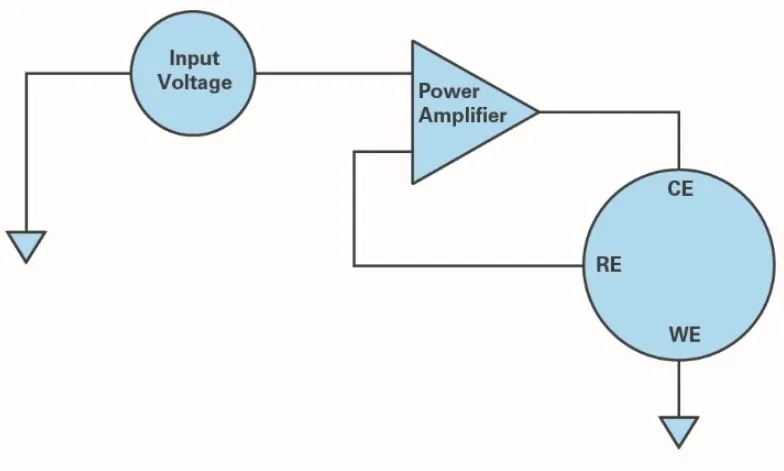
The most basic and widely used method is based on a potentiostat. A potentiostat measures and controls the voltage between a working electrode (WE) and a reference electrode (RE). By adjusting the current through a counter or auxiliary electrode, the potential of the working electrode is held constant relative to the reference electrode.
Current Measurement
The simplest current measurement applies a bias voltage to a sensor and measures the response current. A constant voltage is applied between RE and WE and a transimpedance converter followed by an ADC converts the current profile to a digital signal. The current profile depends on the sensor and the target analyte. Figure 2 shows a circuit example that uses the ADuCM355.
Cyclic Voltammetry
Cyclic voltammetry is an electrochemical technique in which the potential of the electrochemical cell is ramped up and then down in a triangular waveform. The current through the working electrode is measured while the potential varies. This method probes redox activity of analytes, producing oxidation and reduction currents useful for qualitative and quantitative analysis.
Conductivity Measurement
Conductivity measurement is based on the ohmic resistance determined in the liquid. Two parallel inert electrodes are immersed and AC resistance is measured. From this measurement it is possible to estimate ionic mobility, particle density, oxidation state, and solution concentration.
pH Measurement
pH measurement relies on half-cell reactions at an electrode membrane that are directly related to H+ concentration. The resulting potential produces a voltage that is linearly related to pH. A key challenge is that pH sensors typically have very high series resistance, which places demanding requirements on the input impedance of the measurement electronics.
Electrochemical Impedance Spectroscopy (EIS)
EIS measures the impedance of an electrochemical cell or sensor across a range of frequencies. Frequency-dependent impedance changes can reveal sensor degradation and enable automatic adjustment of the signal chain. Sensor accuracy can drift over days to weeks, which is problematic for continuous monitoring applications such as continuous glucose monitoring (CGM). Regular impedance checks help maintain measurement integrity. Figure 3 shows an example circuit.
System and Sensor Considerations
Different medical measurements have diverse requirements, so different measurement methods are applied as appropriate. Temperature measurement is usually required for compensation and calibration, and multiple sensors are often needed to achieve the required accuracy. A discrete implementation of all these measurements can require substantial PCB area and high power consumption.
For wearable and portable medical devices, designers prioritize small size, low power, and low cost. The ADuCM355 is an integrated device designed to address these constraints by combining an analog front end with a microcontroller to support electrochemical and biosensor measurements.
ADuCM355 — Integrated Measurement Front End
The ADuCM355 integrates a low-power analog front end (AFE) and a microcontroller to manage measurement and system functions. It controls electrochemical and biosensors at low power and supports current, voltage, and resistance measurements. Key features include a 16-bit, 400 kSPS multichannel SAR ADC with input buffering, integrated anti-aliasing filter (AAF), and a programmable gain amplifier (PGA).
The transimpedance amplifier (TIA) offers programmable gain and selectable load resistance to accommodate different sensor types. The AFE also includes a potentiostat amplifier to maintain a constant bias voltage relative to an external electrochemical sensor. An input multiplexer upstream of the ADC selects among three external current inputs, multiple external voltage inputs, and internal channels. Three voltage DACs are provided: two dual-output DACs where one output controls the potentiostat amplifier non-inverting input and the other controls the TIA non-inverting input; a third high-speed DAC is intended for high-performance TIA operation with output frequencies up to 200 kHz.
The Cortex-M3 processor includes a flexible multi-channel direct memory access (DMA) controller and supports two SPI ports, UART, I2C, GPIO, and timers that can generate PWM outputs. These peripherals can be configured per application requirements.
Additional Measurement Paths
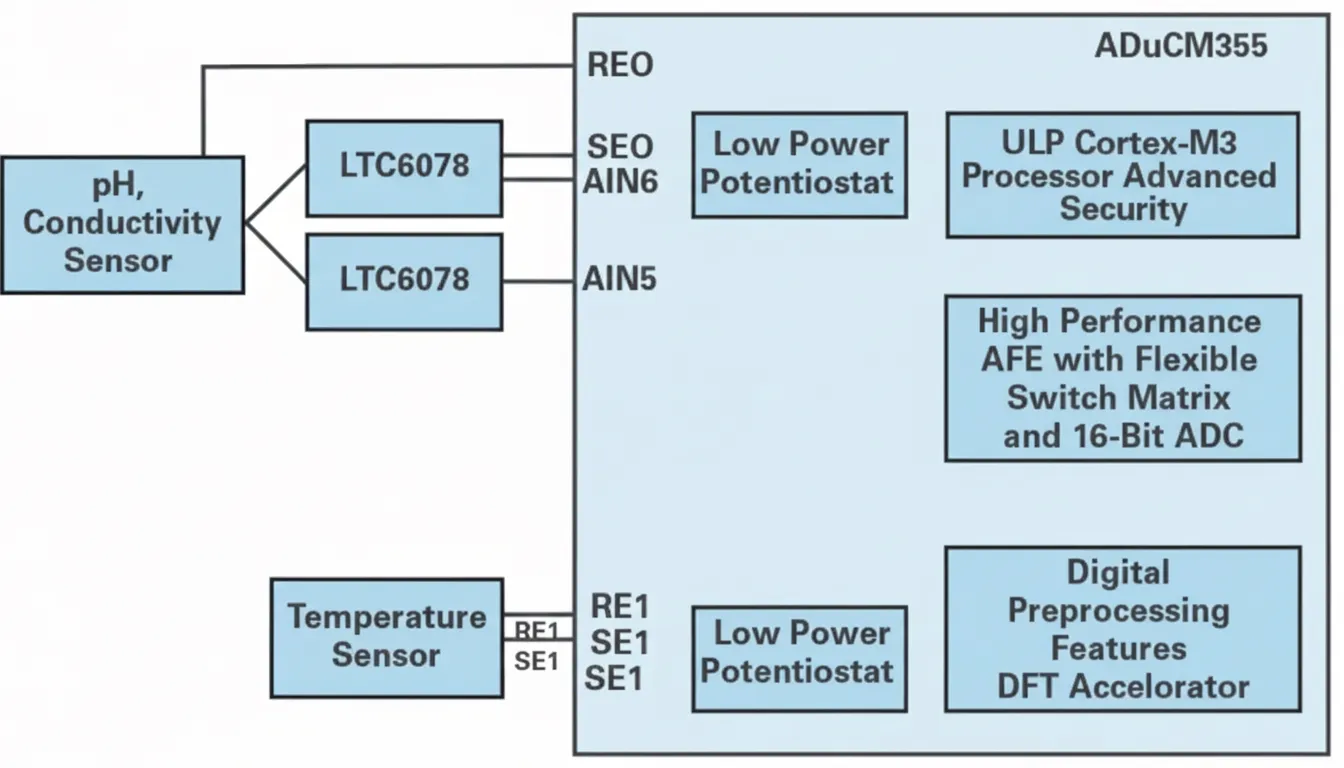
Many sensors for the measurements described above can be driven directly by the ADuCM355 inputs, such as potentiostatic blood glucose sensors. More accurate measurements, for example for conductivity and pH, may require an extended signal chain and external components to raise input impedance. External amplifiers such as the LTC6078 can increase input impedance to match high-output-impedance sensors. Temperature sensing is typically added for compensation. With an expanded signal chain, the ADuCM355 can read voltages and currents spanning impedances from under 100 Ω to 10 MΩ, covering the range required for many medical measurements. High dynamic range is particularly important for conductivity measurements to handle a wide range of concentrations.
Conclusion
Although liquid measurements target different parameters, they share impedance-based techniques and often require different sensors and signal chains. The need for compact, energy-efficient solutions suitable for wearables and portable medical devices favors integrated, multi-functional devices. The ADuCM355 provides an integrated analog front end and microcontroller that support a wide set of impedance-based electrochemical measurements as well as supplementary sensing such as temperature. With appropriate sensor front-ends, the device can be used for electrochemical gas sensing and bioimpedance measurements in addition to liquid analysis.