ALLPCB


01 — Shared-Spectrum Channel Access Bands
What is shared spectrum channel access? In 38.521-1 FR1 there are two bands, n46 and n96, defined as shared spectrum channel access. "Shared" means these bands are not exclusive to 5G and in some cases not even licensed specifically for 5G. They can be used by multiple parties without an additional license or authorization, similar to Bluetooth and Wi-Fi in the 2.4 GHz band. The n96 range clearly overlaps with the Wi-Fi 6E spectrum. Earlier articles covered Wi-Fi 6E details in depth.
The n46 5 GHz band also includes spectrum used by Wi?Fi, radar, V2X, and other systems. TR38.889 (Study on NR-based access to unlicensed spectrum) records existing regulatory requirements for deploying unlicensed spectrum in the 5 GHz band and other bands. It provides a feasibility assessment for base stations and user equipment operating in the 5 GHz band relative to the relevant licensed bands.
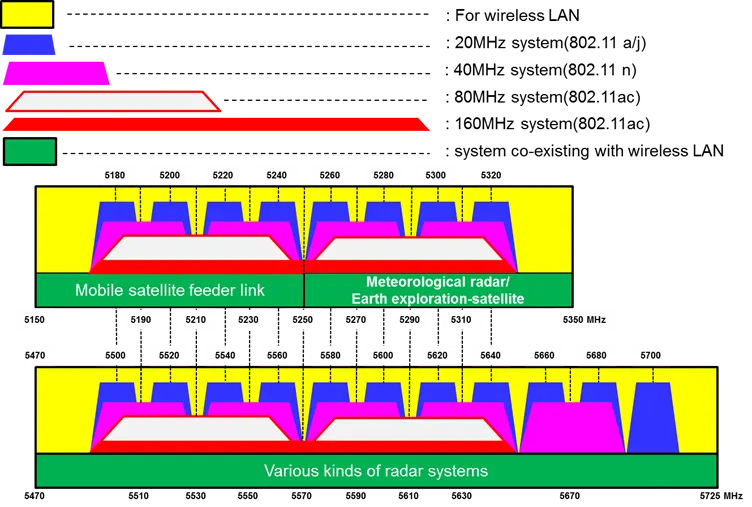
The following figure shows available spectrum and channel deployments for different channel bandwidths, along with information about existing systems that coexist with RLAN systems in Japan.
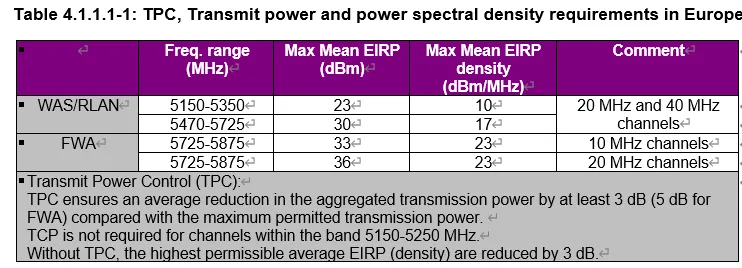
The following summarizes the usage and power rules for the 5 GHz band in Europe:
Combining unlicensed spectrum with licensed or shared spectrum can expand 5G in multiple ways, such as providing additional capacity, higher speeds, improved spectrum efficiency, and new deployment scenarios. It can benefit mobile operators that hold licensed spectrum and also enables operators without licensed spectrum to adopt 5G technology.
Because the spectrum is shared, usage must follow defined sharing rules: who may use it and under what conditions, maximum continuous usage duration, required intervals between uses, how to detect power levels, and whether reuse is allowed. These rules are specified in 37.213.
02 — Transmit Power
Although many test procedures for shared spectrum channel access are still undefined, and certain scenarios such as V2X cannot be fully tested yet, the basic power requirements are available. A Class 5 power level is defined, and the TT for n96 is TBD:
Class 5:20dBm
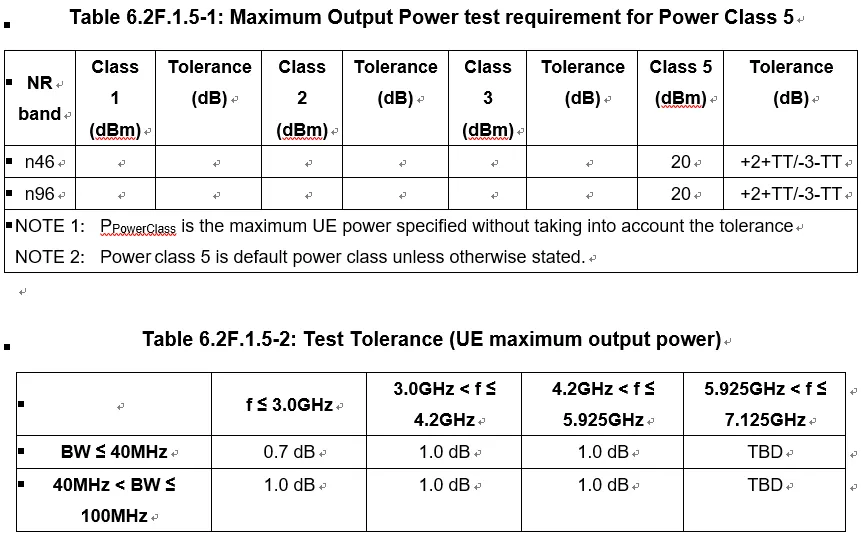
MPR is FFS.
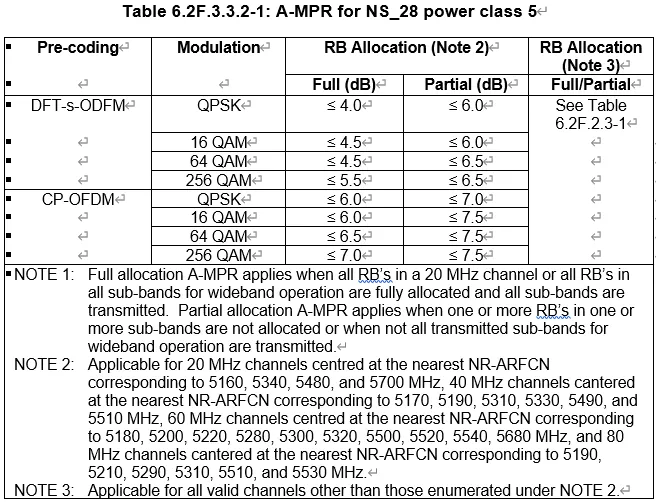
A-MPR is more fully defined. When an NS signal is transmitted, and when a transmission overlaps any part of a specified frequency range, UE operation must meet the additional maximum average transmit power density requirements specified in Table 6.2F.1.3-2. In cases where a transmission overlaps multiple frequency ranges, the lowest power density requirement applies.
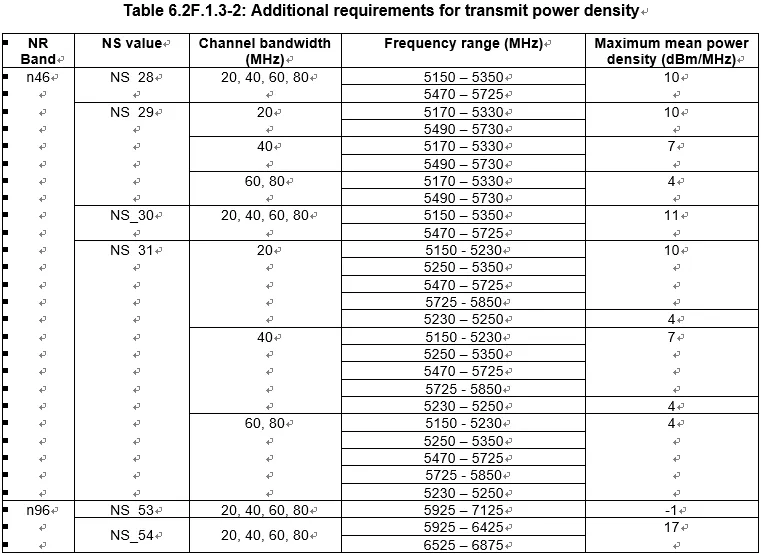
The NS values to consider for n46 and n96, and the corresponding bandwidth requirements, are given in the following table. The specific requirements for each NS value are already defined.
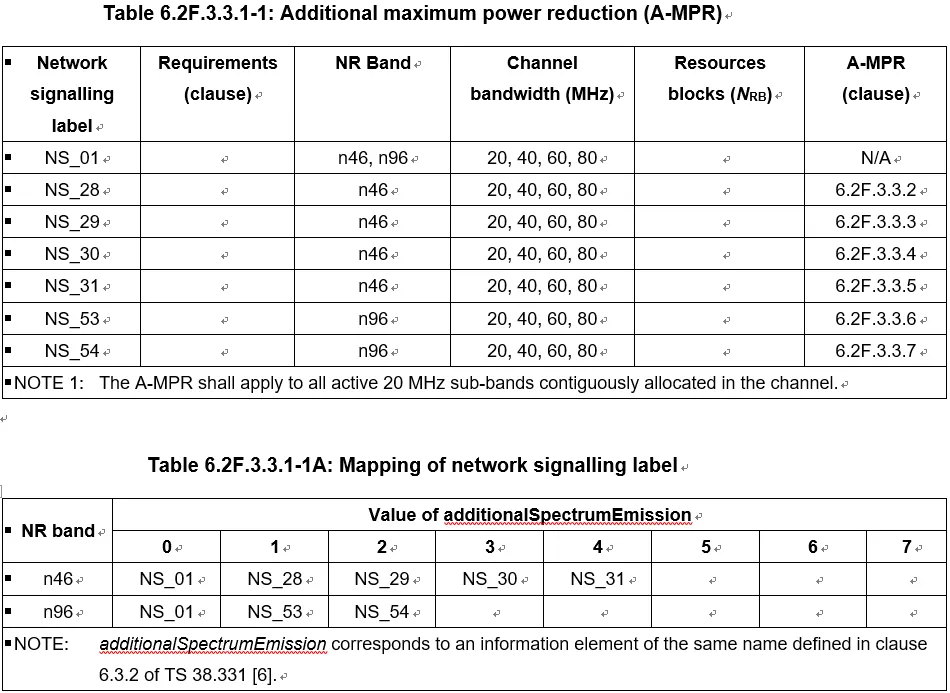
Below is the A-MPR requirement for n46 NS_28.