ALLPCB


Overview
As early as the 1980s, touch technology began to emerge. From PDAs that were once expensive and niche to the current ubiquity of touchscreen mobile phones, touch interfaces have transformed human-computer interaction over the past three decades. Interaction shifted from buttons and joysticks to light touches, and the industry moved from resistive to capacitive sensing. Today, capacitive touch accounts for a large share of the touch market, becoming the de facto representative of mainstream touch technology. Why do leading vendors favor this approach?
Mainstream Touch Technologies
If the sole goal is to achieve touch input, manufacturers have several options. Mainstream touch technologies include resistive touch, capacitive touch, optical touch, surface acoustic wave touch, and electromagnetic induction. These technologies use different principles but all enable touch input. Optical, acoustic, and electromagnetic approaches were developed earlier but remain niche due to technical limitations. The rise of capacitive touch accelerated in the past decade. When the first-generation iPhone appeared, resistive touch dominated, so resistive and capacitive solutions have competed closely; these two are the main focus here.
Capacitive Touch Form Factors and Trends
Capacitive touch itself has experienced internal competition. Early external-module approaches have faced strong challenges, especially in mobile devices where thinner capacitive solutions became mainstream. OGS (one-glass solution) and In-Cell touch technologies greatly reduced module thickness and challenged traditional external touch modules. However, thin designs are still evolving. For example, when the iPhone 5s adopted In-Cell technology, launch-day controversies illustrated that thinner touch integration was not yet entirely mature.
Industry competition is intense. New entrants, price pressure, and upstream-downstream consolidation have turned touch into a highly contested market. Panel manufacturers have entered the space, creating a crowded field. As a result, many touch vendors have shifted attention to larger displays. In 2014, touch-enabled notebooks and touch monitors began to show promising adoption, reflecting a trend to expand beyond small-screen devices like phones. The touch market will likely continue evolving as vendors seek new growth areas.
Why Resistive Touch Declined
Resistive touch once dominated a wide range of applications from phones to automotive, medical, and industrial devices. Under pressure from capacitive solutions, resistive touch has become less visible. What caused this decline?
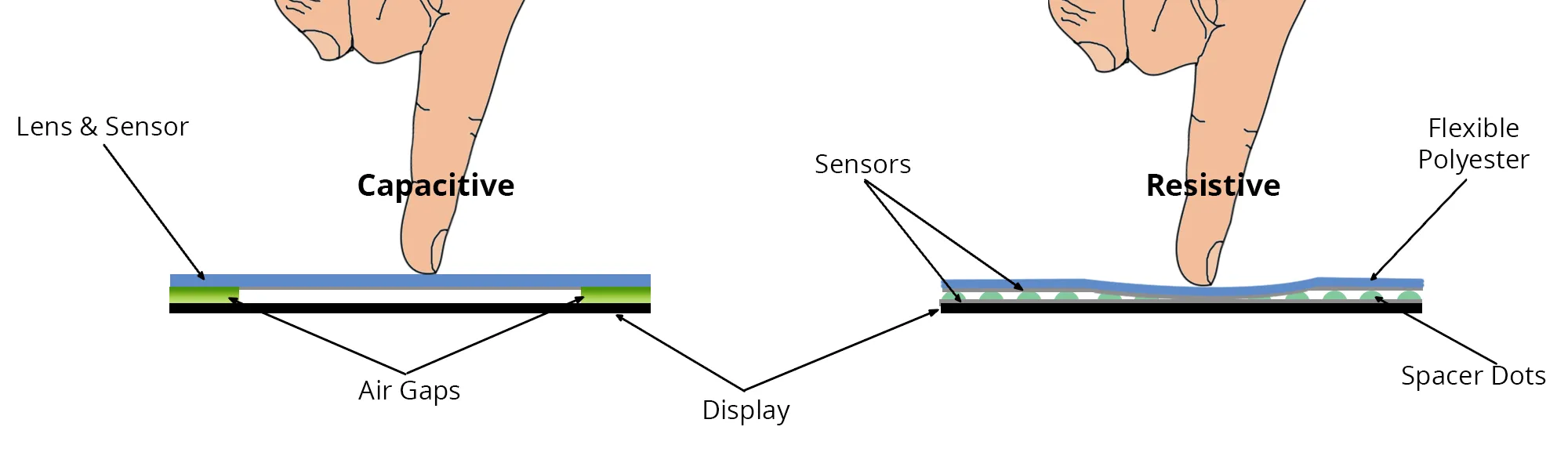
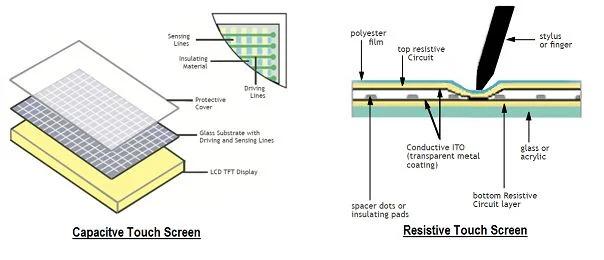
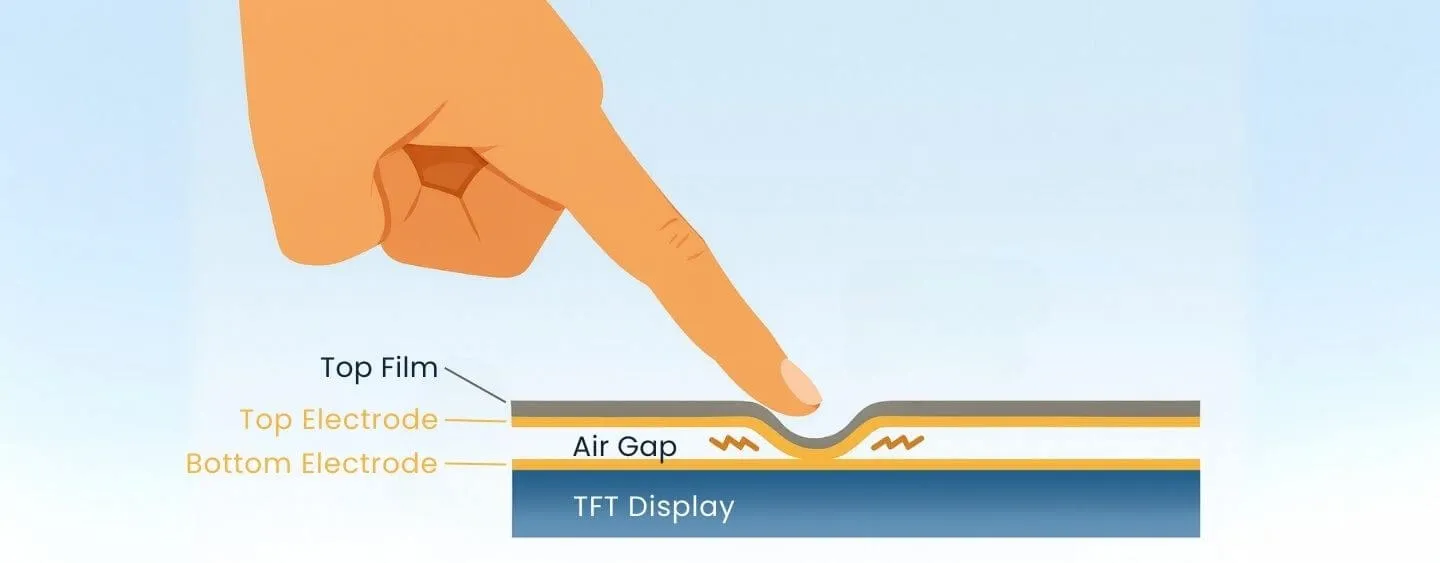
Users who experienced resistive-touch phones will recall the need to press firmly. Some even used fingernails to improve responsiveness. Resistive touch determines touch coordinates by measuring voltage: a common four-wire scheme applies a constant 5 V across each of two transparent conductive layers, one oriented vertically and one horizontally. When pressure brings the layers into contact, the local voltage change allows the system to calculate X and Y coordinates.
Resistive Touch: Strengths and Weaknesses
Advantages of resistive touch:
- Unaffected by dust, moisture, or oil; usable across a wider temperature range.
- Pressure sensing allows input from any object, including with gloves on, and supports handwriting recognition.
Disadvantages of resistive touch:
- Panels are relatively fragile and less suitable for public or heavily used products.
- Typical best-case accuracy is around 98.5%. Capacitive panels, driven by current sensing, can reach around 99% accuracy.
- Response time is longer, limiting suitability for applications like drawing.
Resistive touch’s primary drawback is limited sensitivity, which contributed to its replacement by capacitive touch. Its robustness has kept it relevant in some industrial and automotive niches for a time, but capacitive technology has been gradually encroaching on those markets. Some automakers announced plans after 2014 to transition to capacitive touchscreens, further reducing resistive market share.
How Capacitive Touch Works
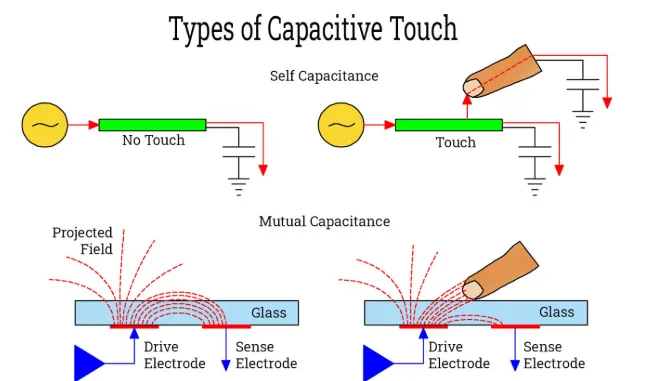
Capacitive touch architectures are relatively simple. Typical designs use ITO-coated glass as the main substrate. Electrodes at the corners create an even electrostatic field across the surface. When a conductive object, such as a human finger, touches the surface, it draws a tiny amount of current. A controller measures the change in current distribution to calculate the X and Y coordinates. Because current sensing can be more sensitive than voltage sensing, capacitive touch offers higher responsiveness.
Capacitive Touch: Strengths and Weaknesses
Advantages of capacitive touch:
- High touch sensitivity, which significantly improves perceived user experience.
- Better high-temperature tolerance; capacitive panels can typically tolerate around 20 degrees Celsius higher temperatures than resistive panels, making them suitable for heat-prone devices like smartphones.
- Less affected by ultraviolet exposure compared with some resistive materials, which supports outdoor use.
Disadvantages of capacitive touch:
- Limited input methods: it normally requires direct conductive contact, so gloves or barriers can prevent touch detection unless special solutions are used.
- Optical issues such as reduced transmissivity and glare remain challenges. Some manufacturers use semi-transflective designs to mitigate glare, but results are not always perfect.
Conclusion
Technically, capacitive touch has clear advantages that enabled it to replace resistive touch in many consumer applications. Better sensitivity and suitable cost points facilitated rapid adoption. Additional benefits such as higher temperature tolerance, thinner form factors, and improved outdoor resilience further supported its spread. While challenges remain, especially regarding glove operation and optical performance, capacitive touch continues to lead in mainstream devices and expand into larger displays.