ALLPCB


Overview
The TS951X series is an analog front-end chip developed by Kunyuan Microelectronics for finger-clip pulse oximeters. The TS951X-based solution has become one of the mainstream approaches for finger-clip pulse oximeters. Devices using TS951X solutions typically achieve weak-perfusion performance below 0.4% on the Fluke Index2 oximeter simulator, with top solutions reaching 0.1%. Products using the TS951X solution offer high performance, high integration, and low cost.
Integration and System Benefits
Compared with traditional solutions, the higher integration of the TS951X family reduces the number of discrete components, including analog switches for selecting red and infrared light, analog switches for adjusting LED drive level, amplifiers for I-V conversion, and amplifiers for filter circuits. The TS951X solution also places minimal requirements on MCU peripherals, requiring only a timer. Fewer components lower BOM cost, improve product reliability, and reduce production management overhead. Table 1-1 lists a comparison between the two schemes.
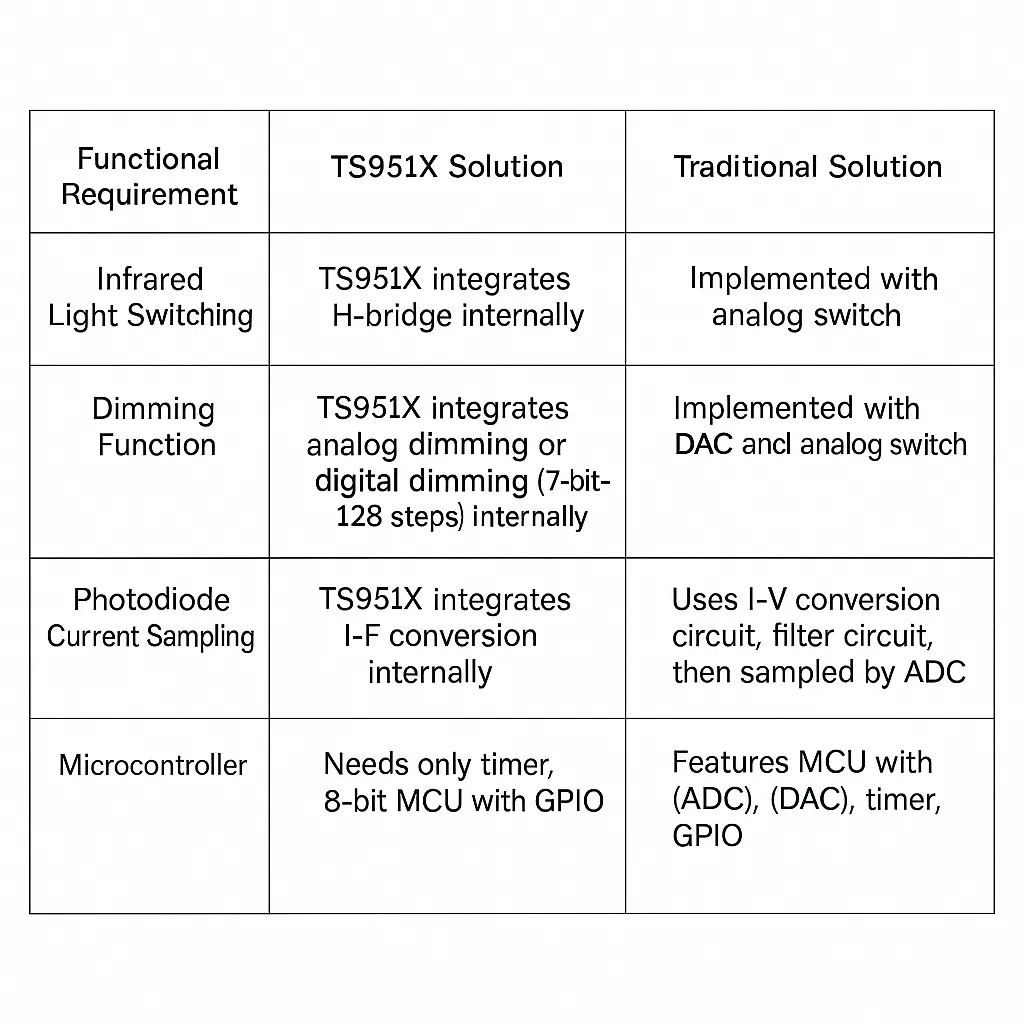
Key Specifications and Integration
TS951X operates from 2.5 V to 5.5 V, with a typical quiescent current of 1.25 mA. The current-to-frequency converter sensitivity is 100 kHz/uA. The TS951X family integrates a low-noise current-to-frequency converter (I-F), an H-bridge LED control unit, an analog (TS9514) or digital (TS9517) constant-current dimming unit, and a Kunyuan-patented hardware ambient-light cancellation unit (TS9516, TS9517). The chips are available in TSSOP-14 and QFN-16 packages. Pin assignments are shown in Figures 1-1 and 1-2.
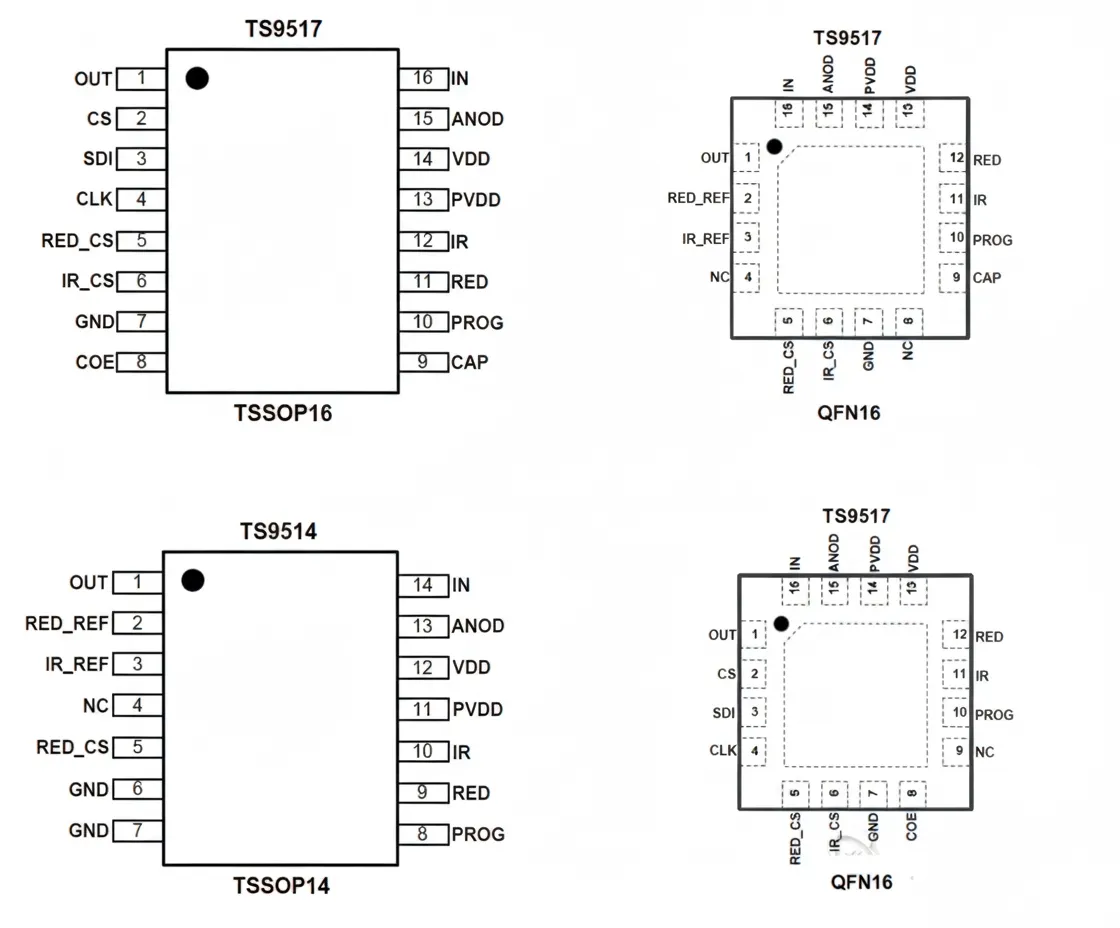
Figure 1-2
TS9514 Typical Application
Figure 1-3 shows the TS9514 application. The IR and RED pins are connected to the infrared LED and red LED, respectively. The two LEDs are connected in anti-parallel. IN and ANOD are connected to a photodiode. The PROG pin is connected to a current-sense resistor. RED_REF and IR_REF set the emission currents for the red and infrared LEDs by inputting a voltage derived from the R1, R2, R3 voltage divider. The MCU controls RED_CS and IR_CS to switch between red and infrared emission. OUT connects to the MCU, and the output frequency corresponds to the photodiode current. PVDD supplies the LED pulse current; it is not recommended to share PVDD with VDD, and a large bypass capacitor should be placed close to the PVDD pin.
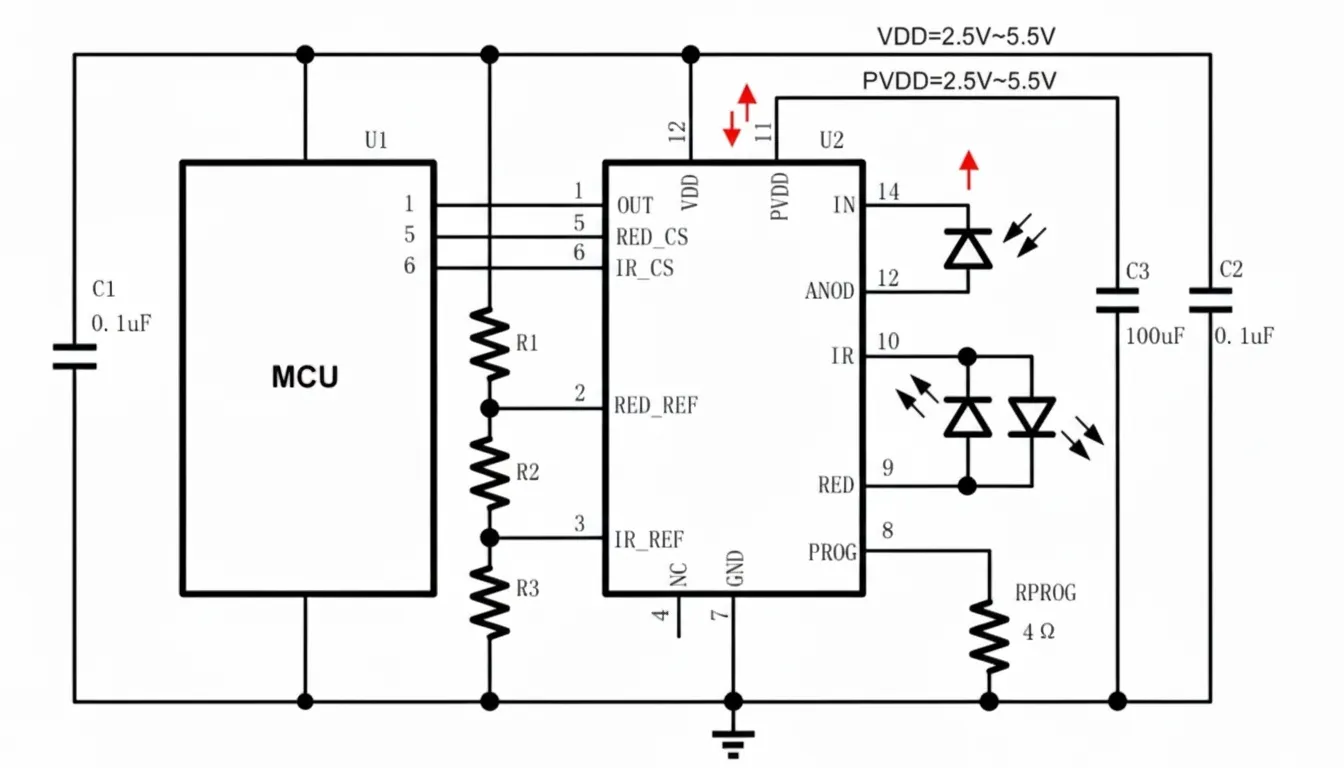
Figure 1-3
TS9517 Typical Application
Unlike the TS9514, the TS9517 uses digital dimming. The MCU communicates with the TS9517 over an SPI bus formed by CS, SDI, and SCK to control the internal 7-bit DAC for LED intensity adjustment. The TS9517 also provides a hardware ambient-light cancellation enable pin, COE, which can be controlled by an MCU GPIO. If the ambient-light cancellation feature is not used, connect COE to ground.