ALLPCB


Overview
Touchscreens have evolved from early kiosk ticket machines and ATM terminals to widespread adoption in AIO desktops, tablets, smartphones, and laptops. Alongside legacy resistive touch panels, capacitive materials have been continuously optimized for higher optical transmittance and multi-touch sensing, making them prevalent in modern devices.
Why touchscreens are used
Touchscreens are often chosen where keyboards and mice are impractical. They offer a low learning curve and intuitive operation, and when paired with a graphical user interface they can provide convenient information access. Since Apple introduced capacitive touch on the first iPhone, capacitive touch has been widely adopted across small and medium displays, driving broader integration of touchscreen interfaces in consumer devices.
Main touchscreen technologies
Touchscreen technologies are generally classified by sensing principle: resistive, capacitive, wave-based (ultrasonic, infrared), and embedded (on-cell, in-cell). Each technology differs in sensing and touch-point analysis, performance characteristics, and component cost. Market demand and technical limitations have shaped their typical application domains. For example, resistive touch is now mostly used in mid/low-tier or specialized applications, while capacitive touch — with superior transparency and intuitive feel — dominates many consumer devices.
Resistive touchscreens
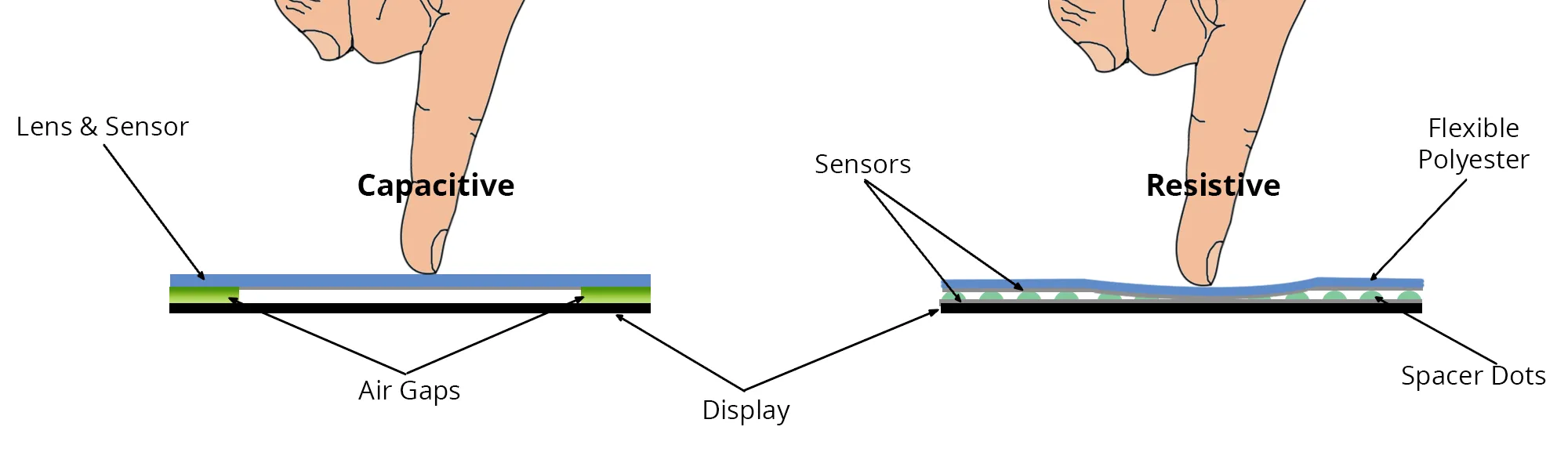
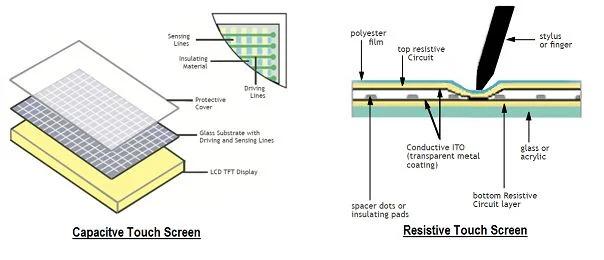
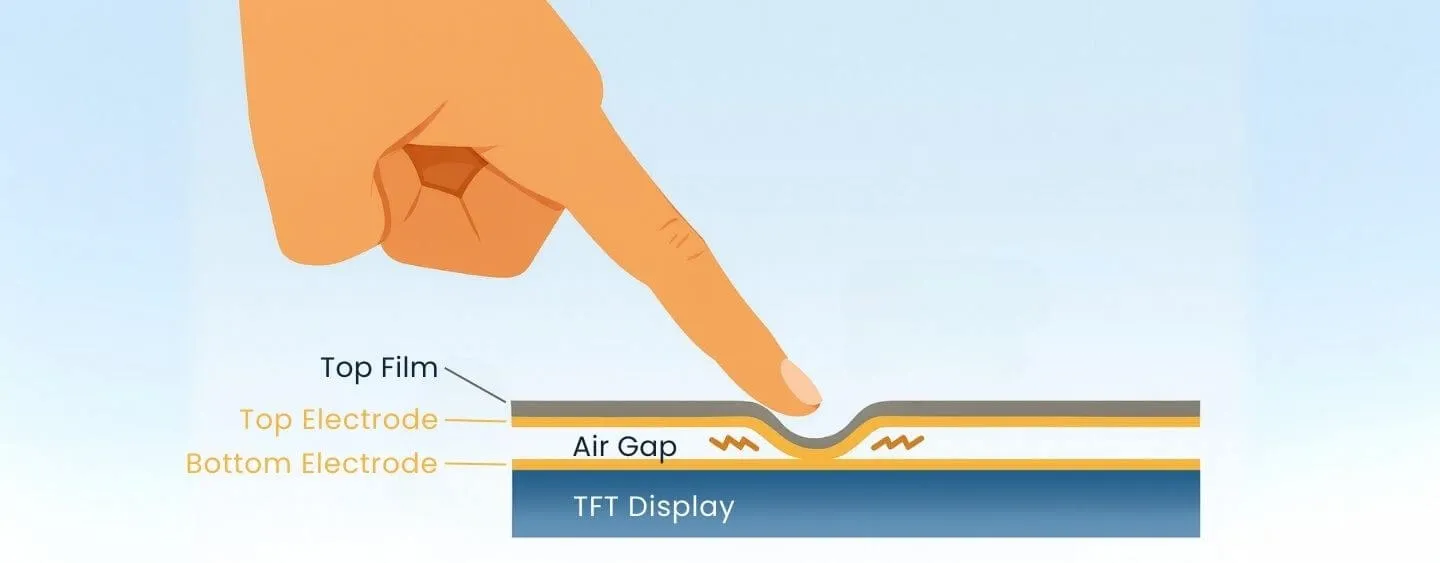
Resistive touchscreens are formed by two transparent films. Each film has a conductive layer such as indium tin oxide on the inner surface, and the two layers are separated by insulating spacer dots. An outer scratch- and weather-resistant cover is typically applied. When a user presses the screen with a finger or stylus, the top film deforms and contacts the bottom film. The resulting resistance or voltage difference is used to determine the touch location.
Application and limitations
Because resistive sensing relies on mechanical pressure, repeated pressing on local areas can cause mechanical fatigue, material deformation, mis-tracking, or false detections. However, the mechanical nature is also a strength: resistive touch works with a stylus, a gloved finger, or bare finger, making it suitable for harsh environments. As a result, resistive panels remain common in industrial PCs, human-machine interfaces (HMI), ATMs, and outdoor kiosks. Current demand tends to focus on special-purpose, higher-cost materials and multi-layer designs that support durability and multi-touch where required.
Capacitive touchscreens
Capacitive touch has become one of the most widely used touchscreen technologies. Although not new, capacitive sensing was originally common in laptop touchpads and control panels. Its adoption in smartphones following the first iPhone greatly increased demand, prompting device makers and component suppliers to optimize capacitive components and architectures.
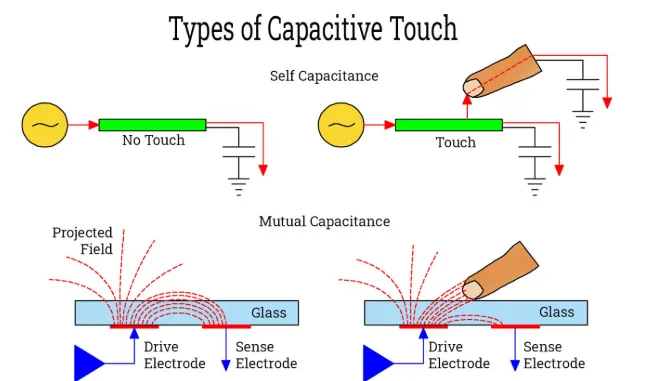
Typical capacitive touchscreens use multiple layers: a hard, scratch- and fingerprint-resistant glass cover, a conductive substrate beneath, and electrodes around the display edges that establish a uniform electric field across the screen surface. A touch changes the local capacitance; the touch controller measures current changes and computes the touch coordinates from those variations.
Advantages and scaling
Capacitive touch offers fast response and light-touch operation compared with resistive panels. The high transparency of glass covers preserves display quality, and operation by fingertip without a stylus improves usability. Strong market demand motivated investments in materials and touch controllers, reducing cost and improving performance. Early capacitive designs were focused on small displays because larger areas increased surface capacitance noise. With ongoing optimization, capacitive solutions now support displays exceeding 20 inches, enabling entry into medium-sized touchscreen markets.
Wave-based touch for large displays
For large and very large displays, wave-based sensing is commonly used. Surface acoustic wave systems place ultrasonic transmitters and receivers at the glass corners; touch is detected by measuring signal attenuation at the receivers and estimating touch coordinates. Infrared systems place IR emitters and receivers along the X and Y edges; a touch interrupts beams and the system computes the touch location. Positional resolution depends on the number and placement of emitters/receivers, and accuracy tends to decrease as screen size increases.
Wave-based systems are sensitive to surface contamination such as dirt or smudges, which can degrade touch accuracy. Multi-touch implementations based on wave sensing are costly and have limited practical value, so these technologies are mainly used in large interactive displays and electronic whiteboards.
Embedded touch: on-cell and in-cell
Embedded touch integrates the sensing mechanism into the display panel itself. On-cell designs place touch structures on or near the color filter layer, while in-cell integrates touch sensing directly within the LCD cell architecture. Embedded approaches can simplify and thin the physical stack, and in some cases provide higher optical transmittance. The main challenges are higher cost and yield optimization; therefore, embedded touch integration is most attractive for higher-priced products where the integration benefits outweigh the added cost.