ALLPCB


Introduction
With increasing living pressures and China's aging population, elderly people living alone has become a social trend. When an elderly person living alone suffers an acute episode such as a heart attack or hypertensive crisis, symptoms often include confusion, loss of motor ability, or falls. In most cases, the patient cannot call for help, and the optimal rescue window may be missed. This article describes a GSM-based remote medical automatic alert system designed to address this problem. The system is portable, reliable, and supports long-range transmission for medical assistance to elderly people living alone.
System overview
The GSM-based remote medical alert system consists of multiple remote units and a central station. Each remote unit performs vital-sign monitoring and wireless transmission; it comprises several medical monitoring devices, a controller, and a GSM module. The central station communicates with the remote units via GSM, analyzes the received data, and provides reference information for subsequent medical response.
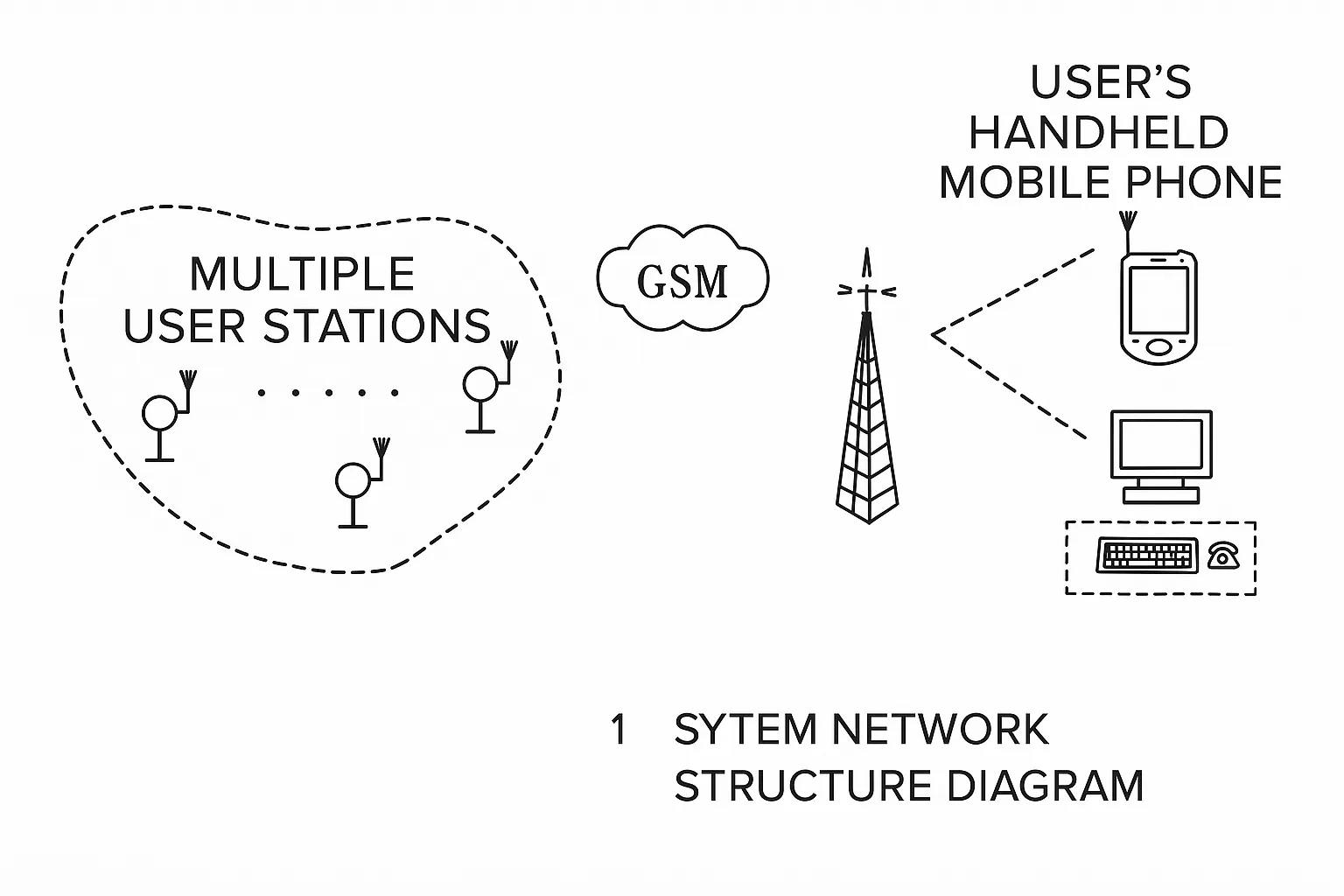
The user-carried remote unit periodically wakes the medical monitoring devices to measure vital signs. The remote unit controller compares the collected data to predefined normal ranges. If a measurement falls outside the normal range, the controller uses the GSM module to send the user ID (to distinguish users) and the current vital-sign data to the central station (medical facility), and it also sends an alert message to a family member's mobile phone. The central station can retrieve the user's medical history using the user ID and combine it with current vital signs to determine an appropriate response.
Hardware design
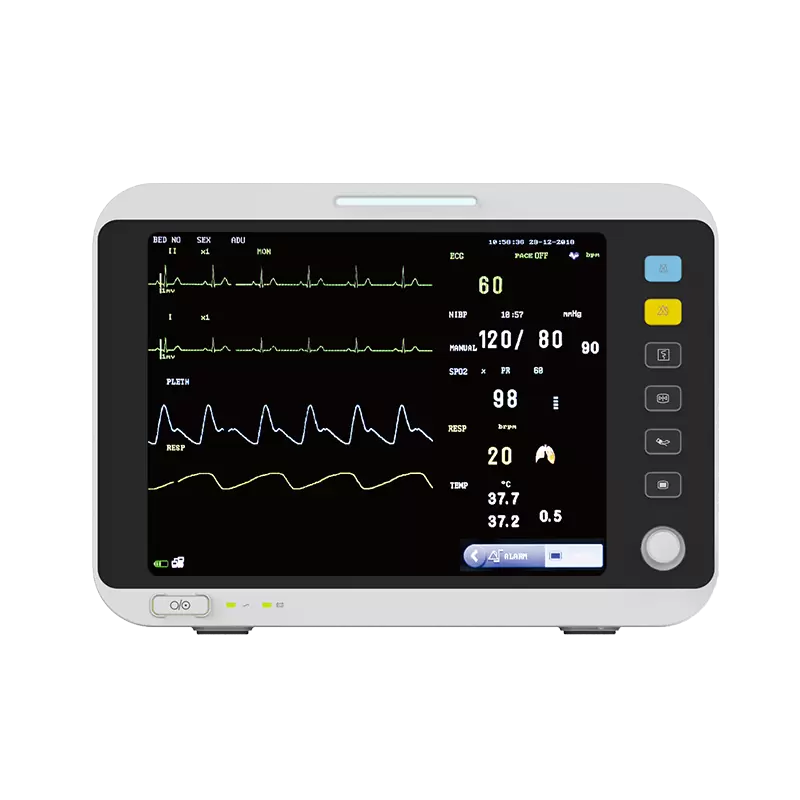
Remote units typically include an electronic blood pressure monitor, a fall-detection module, a GSM module, and a microprocessor (CPU). The central station includes a GSM module, a microprocessor (CPU), and display and alarm circuits (it can also connect to a computer via a serial interface). The hardware block diagram is shown below.
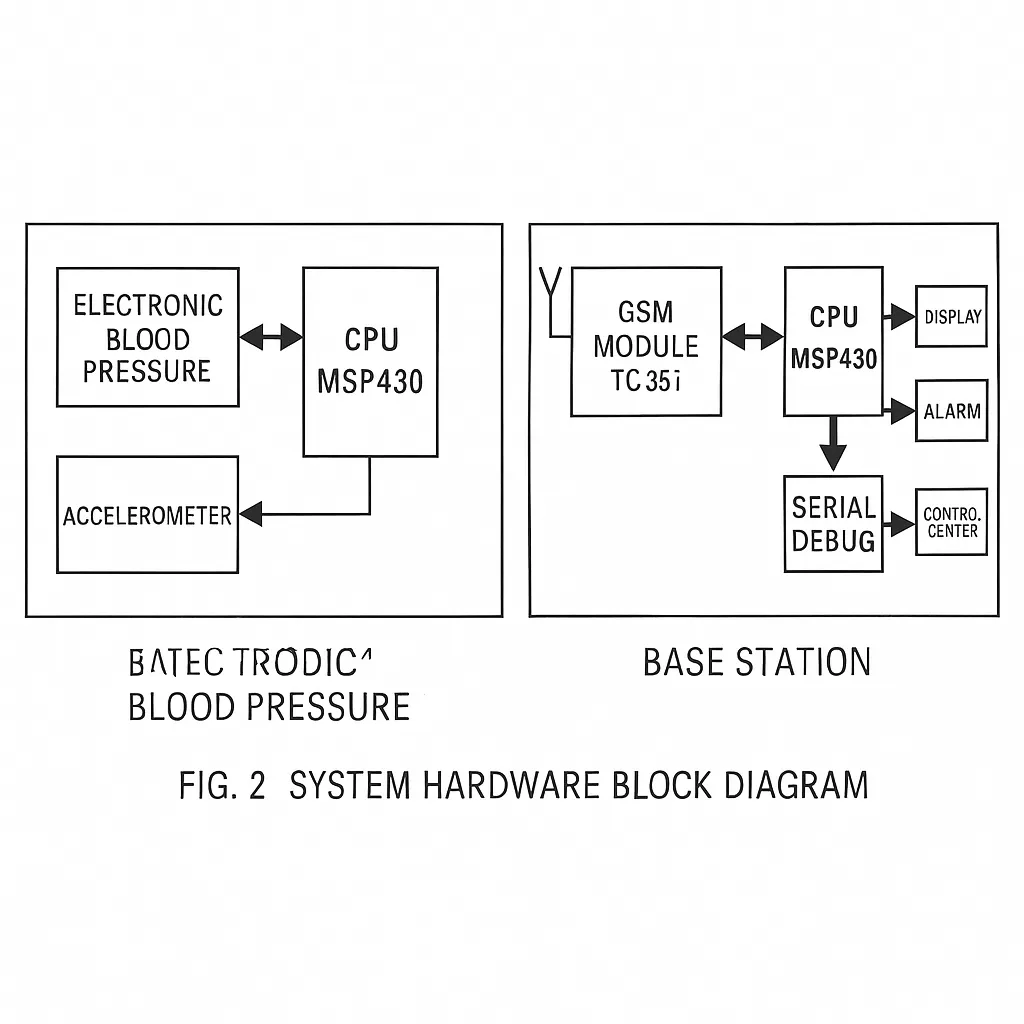
Medical monitoring devices can be selected according to the monitored subject. Considering common conditions in elderly patients such as heart disease and hypertension, this design uses an electronic blood pressure monitor and a fall-detection module. To reduce power consumption and extend battery life of the remote unit, the design uses MSP430-series ultra-low-power microprocessors.
Wireless communication module
The design uses Siemens' TC35 wireless data module for reliable data, voice, and short-message services. The module integrates RF and baseband circuits, operates at 3.3 to 5.5 V, and supports the 900 MHz and 1800 MHz bands. It provides a standard AT command interface to simplify application development and also offers an RS232 data interface for convenient serial communication with microcontrollers.
Microprocessor to GSM interface
The system uses an MSP430-series microcontroller. This ultra-low-power mixed-signal controller integrates a rich set of on-chip and off-chip peripherals, minimizing circuit complexity, power consumption, and size.
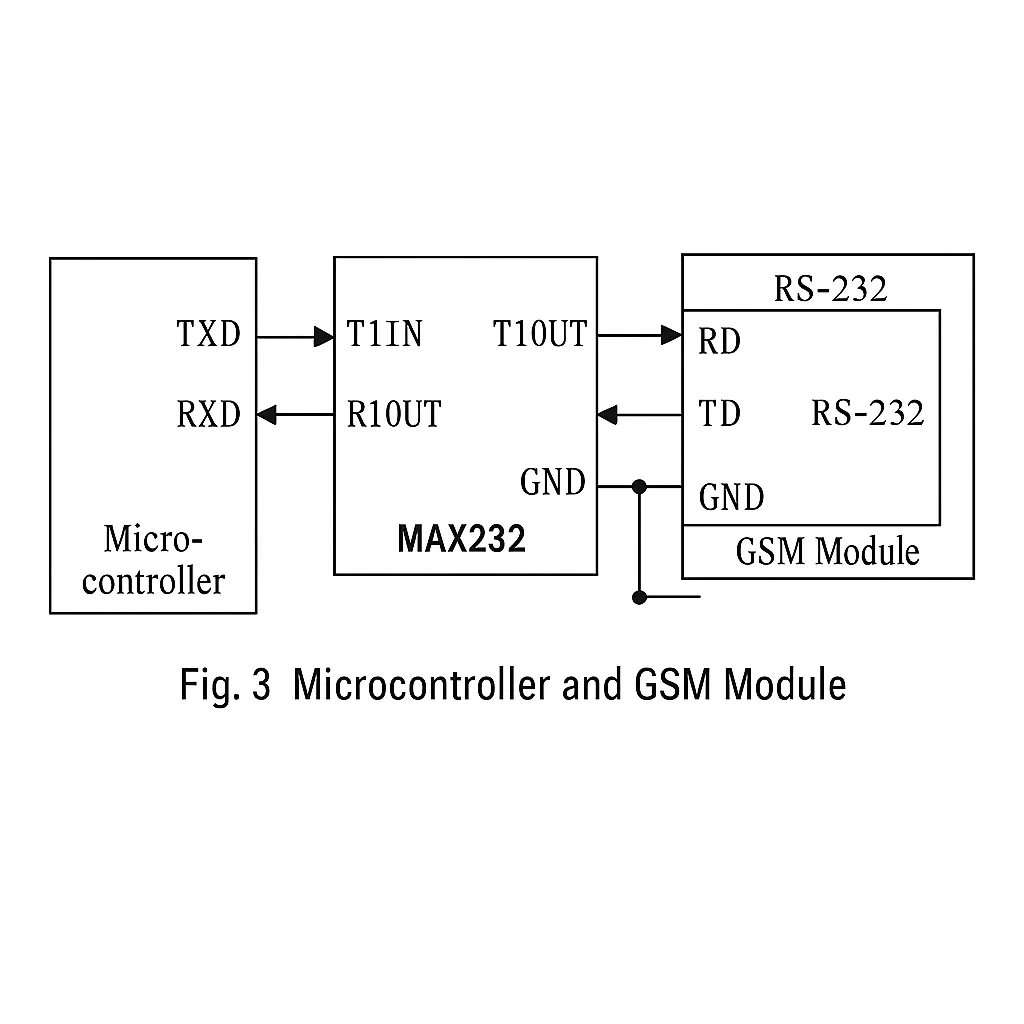
The microcontroller connects to the GSM module via a MAX232 level-conversion interface, which provides the necessary drive capability without extra driver circuitry. Note that the central station and remote units can perform two-way communication and are distinguished by user address codes. Remote units do not communicate directly with each other.
Fall-detection module
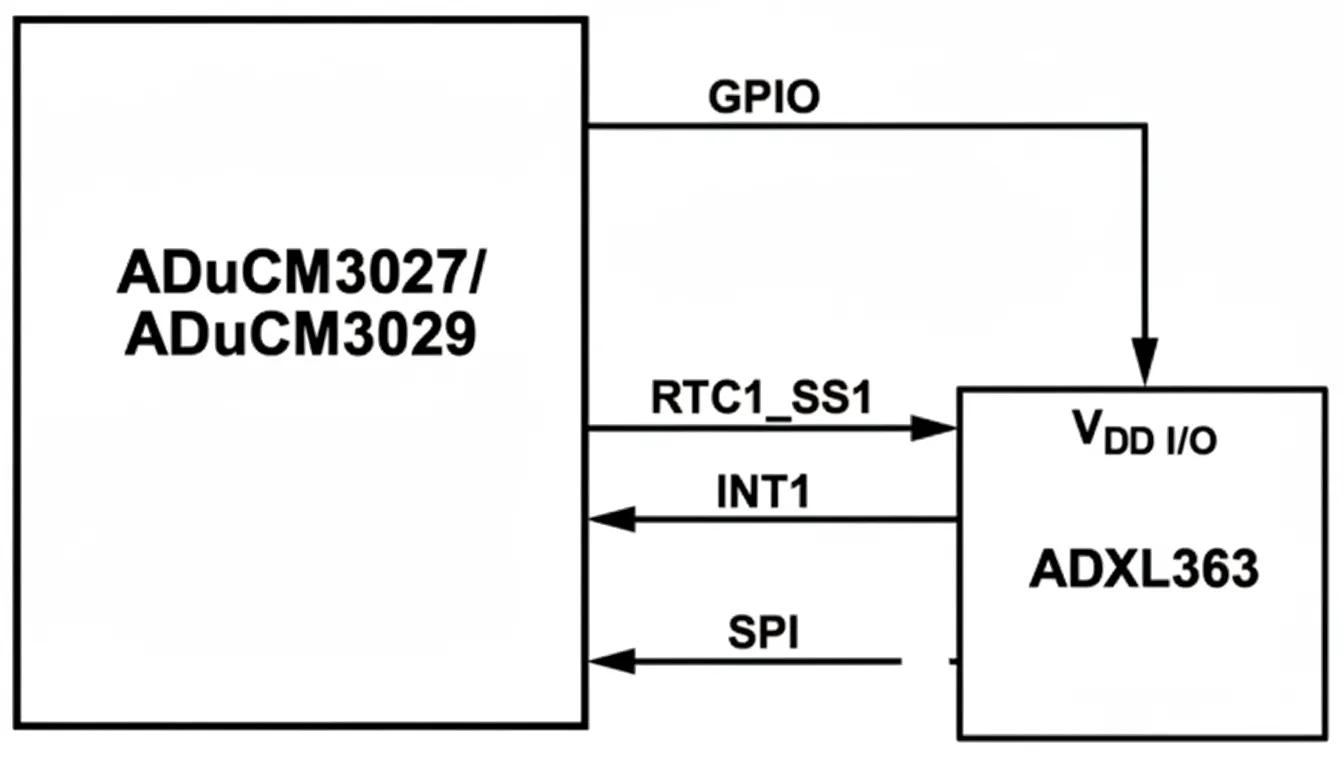
The system uses the GY-29-ADXL345 digital accelerometer module for fall detection. Its core is the low-power 3-axis accelerometer ADXL345, with a measurement range up to ±16 g and 16-bit two's complement digital output accessible via SPI or I2C. It can measure static gravitational acceleration for tilt detection and dynamic acceleration from movement or impacts, with high resolution capable of detecting tilt changes smaller than 1.0°.
Fall detection is based on measuring acceleration changes along three orthogonal axes during user motion to infer body posture changes and determine whether a fall has occurred.
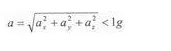
During a weightless fall, the resultant acceleration across the three orthogonal axes decreases and its duration is roughly proportional to fall height, which can be used to estimate fall severity. After a fall, the body often remains motionless for a short period (longer if the fall causes unconsciousness). A fall produces a rapid change in posture compared to the previous moment. In this system, fall detection uses the current resultant acceleration value, the change in posture between consecutive measurements, the duration that resultant acceleration stays below 1 g, and the duration of post-fall immobility to assess whether a fall occurred and its potential severity.
Vital-sign monitoring
Given the target conditions of heart disease and hypertension, the system uses a PAL-901 wrist electronic blood pressure monitor for vital-sign monitoring. This monitor measures heart rate, systolic pressure, and diastolic pressure. Measurement data are output via a serial port as a 6-byte packet at 19,200 bit/s and a 2.8 V logic level. The monitor is compact and battery-powered, making it convenient to carry.
Software design
Communication protocol
Wireless transmission between remote units and the central station can experience frame loss or bit errors due to weather, interference, and noise. To ensure reliable transmission, a communication protocol is defined.
The GSM transmission frame used by this system consists of a frame header, user address code, fall indicator, vital-sign data, and a CRC checksum.
In practice, the probability that noise produces the specific pattern 1111111100000000 is low, so frames use 0xFF and 0x00 as the header to reduce false reception. A single-byte address code distinguishes different remote units. CRC is used for error detection. The receiver treats a frame as valid upon detecting 0xFF and 0x00. If the CRC check passes, the frame is accepted; otherwise it is discarded.
Program flow
The program flow for the GSM-based remote medical alert system is shown in the diagrams below.
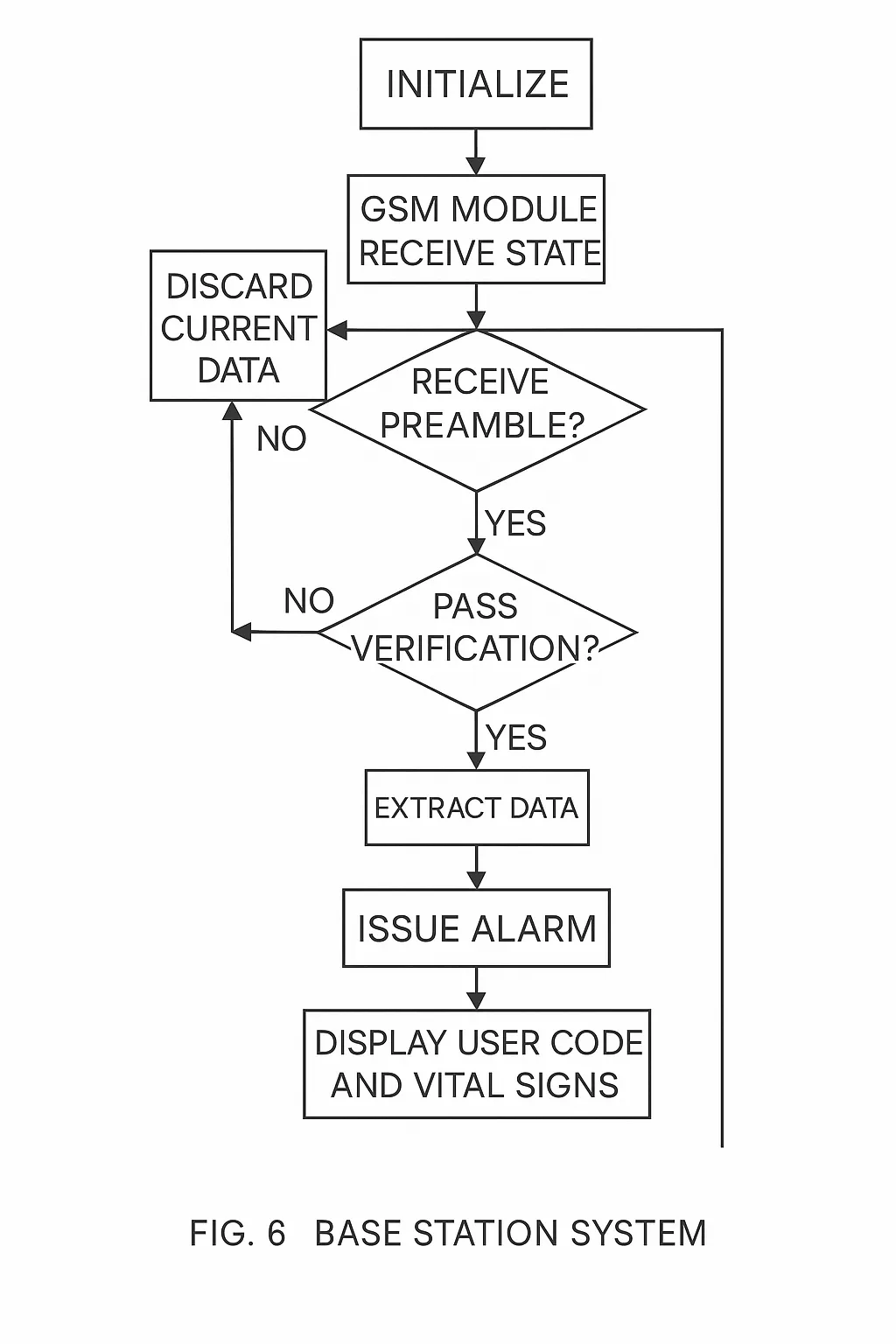
The remote unit periodically wakes the blood pressure monitor to measure vital signs, then compares the collected data to preset normal values. If a value is outside the normal range, the remote unit sends the user ID and current vital-sign values to the central station via the GSM module and sends an alert to a family member's mobile phone. The central station validates the received data for correctness and reliability; after validation it issues an alarm and displays the user ID and vital-sign values.
Conclusion
This article presented a design for a GSM-based remote medical automatic alert system. The system uses an accelerometer to measure signals associated with falls and proposes a fall-detection algorithm. It monitors vital signs with an electronic blood pressure monitor and uses a GSM wireless module for data transmission and alerting. The design is portable, reliable, and supports long-range transmission, offering a practical approach to assist elderly people living alone.